Posted January 20, 2023 by Jim Parr Categories:History/Mystery
Be the first to identify the location of this photo, and win a copy of my latest book. Remember, do not respond on Facebook! The winner will be the first person to correctly respond in the comments section at the bottom of this page! Parr family members and co-authors not eligible. I will post the correct answer and announce the winner later tonight. Good luck!
This is a fun new feature of the blog that I will post from time to time. The first person to correctly identify the location of a posted photo will win a copy of my most recent book “Murder and Mayhem in Metrowest Boston.” Because I share my blog posts on several Facebook groups, the correct answer must be posted in the comments directly on the blog (found at the bottom of the post where it says “Leave a Reply”). Now, it is true that subscribers to the blog may have a slight advantage as they receive the post directly in their email as soon as it is published, so there’s that. To subscribe, scroll to the bottom of this page and enter your e-mail in the box. Then confirm your subscription by responding to an email you will receive from Word Press.
Sorry, no Parr family members may participate!
The first mystery photo will be posted on Friday, January 20th at 6:00 pm. Good luck!
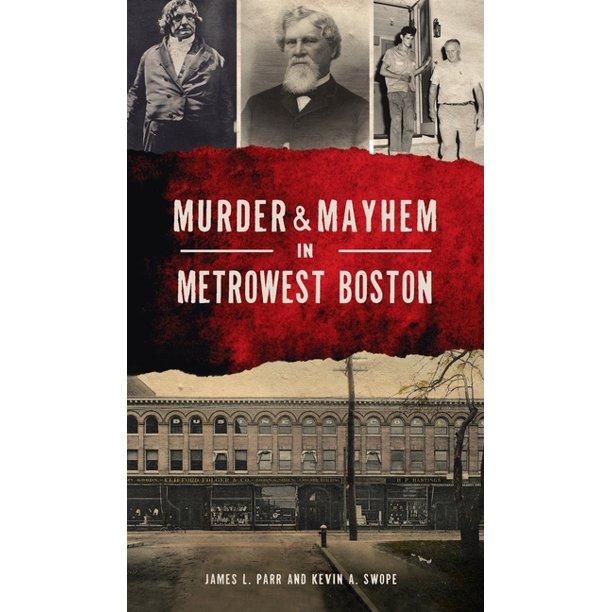
Written with co-author Kevin Swope, Murder and Mayhem is a collection of true crime stories from Framingham, Natick, Wayland and other nearby towns spanning over 125 years. Published by The History Press/Arcadia.
The Pauls of Dedham made significant contributions to the town’s agricultural, civic and political life for almost two centuries. The loss of the 172 year old house in which they resided for eight decades is both surprising and disappointing, but the occasion offers an opportunity to shine a light on this old New England family.
The first Massachusetts settler, Richard Paul came from England sometime between 1620-1630 and settled in the Taunton area, where Pauls would reside for the next hundred years. In 1719 Richard’s grandson Samuel purchased about 100 acres situated between the Neponset River and Sprague Pond for his sons Isaac and Samuel. This area quickly became associated with the Paul family, and the bridge over the Neponset acquired the name it retains to this day, Paul’s Bridge.
Paul’s Bridge 2022. This bridge was built in 1849.
By this time this area of Dorchester had been annexed by Dedham and was known as the “Low Plain.” The house and land eventually came into the possession of Ebenezer Paul, (b. 1818) great-great-great-great-great grandson of Richard Paul. Ebenezer was a respected progressive farmer and member of the Allin Congregational Church (despite living on the edges of town some three miles from the town center.)
Farming pursuits were seriously curtailed in July of 1861 when the US government took over the bulk of Paul’s acreage for a training camp for Union soldiers. According to an article written for the Hyde Park Historical Record (Volume VI, 1908):
” …the first that Ebenezer Paul knew of any designs on his land as a camping ground was the sudden discovery one morn of two or three men sitting under one of the long rows of elms, a few of which are now standing, and his cows gazing upon them with interest. Later, it is said, they came and took the land, leaving him to apply to the State for compensation which he did, and I am credibly informed that he received three hundred dollars per year rental.”
The government also took over about 80 acres west of Sprague Pond owned by Isaac Tower (my childhood street was named for him) who after the war submitted a claim for rent and additional funds for damages done to his house and fences. The government paid the rent but denied the claim for damages.
The first two regiments to occupy the land were the Massachusetts 18th and 20th, and the site was known as both Camp Brigham and Camp Massasoit. Later it would come to be known as Camp Meigs and gain historical significance as the training ground for the 54th Massachusetts, the first Massachusetts regiment of African American soldiers who arrived in February 1863. The history of Camp Meigs and its association with the 54th Massachusetts Regiment is a rich and fascinating one that will not be explored here. There is a brief history of the camp in my book Dedham: Historic and Heroic Tales from Shiretown.
The Ebenezer Paul House (underlined in red) stood north of Milton Street (present-day Neponset Valley Parkway). This map shows the extent of the camp at Readville and its close proximity to both the Paul House and the Edson House. In 1868 most of the land east of Sprague Street would become part of the new town of Hyde Park, which was annexed by the City of Boston in 1912.A section of Dedham from an 1858 map of Norfolk County. The red arrow indicates the original Paul house just west of Paul’s Bridge and the Neponset River. The blue arrow indicates the house at 390 Cedar St. where Ebenezer moved with his family in 1867. The house just east of that house (labeled N. Fales and S.F. Alden) was the home of Elizabeth Fales, who was murdered by Jason Fairbanks in 1801. It stood on the southeast side of Cedar St. near present-day Turner St. (See my earlier post “May 18- A Tragic Anniversary” from May 2010).
Ebenezer Paul sold his property and moved to the Cedar Street house in 1867, along with his wife Susan Dresser Paul and five children; Henry, (b.1851), Edward (b.1853), Isaac (b.1856), Ebenezer (b.1858), and Martha (b.1865). Upon his father’s death in 1898, Ebenezer Talbot Paul took ownership of the property and he and his wife Marietta Taylor Paul began the next chapter of the Paul family in Dedham.
Posted December 23, 2022 by Jim Parr Categories:JP's Dedham
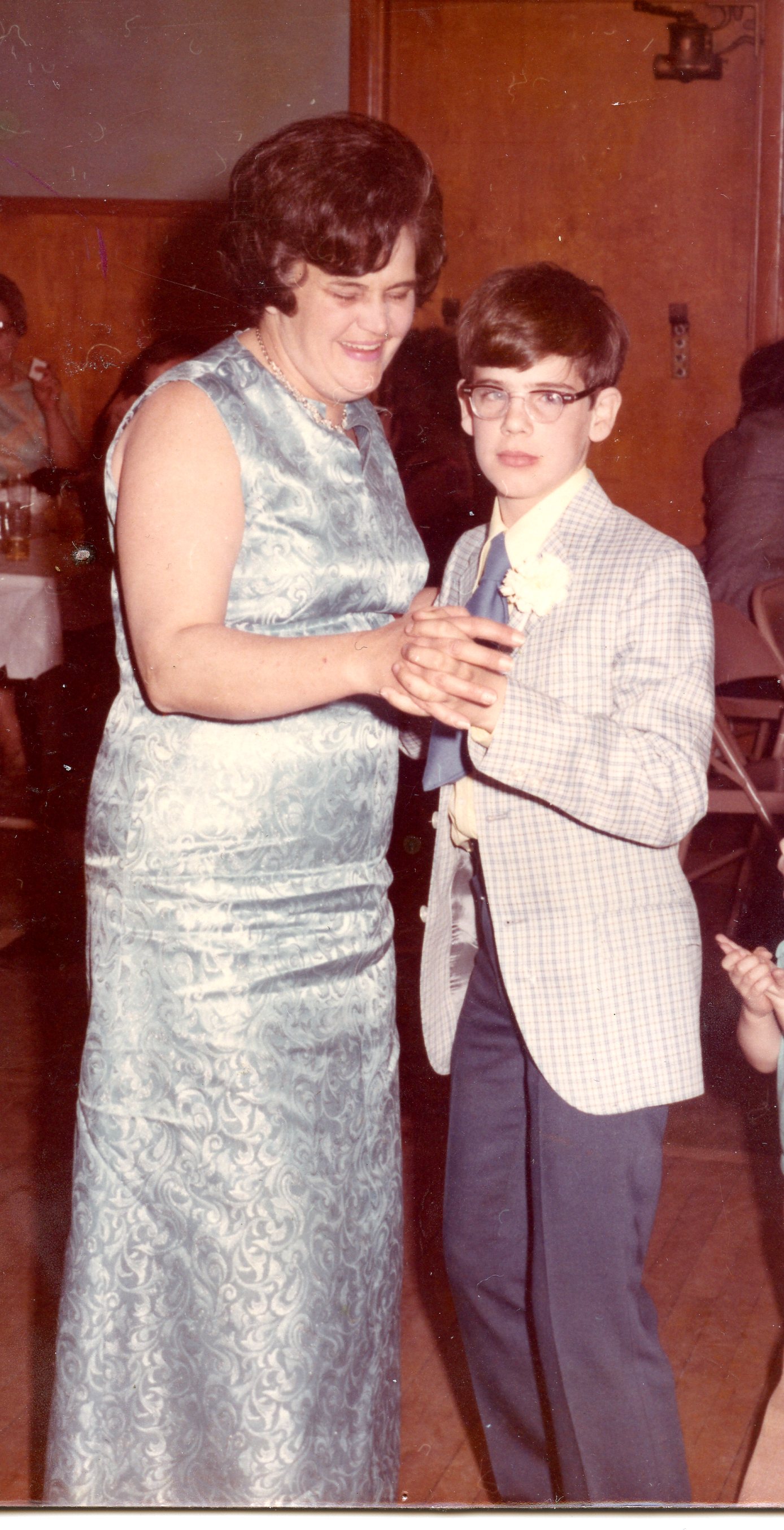
This is me tearing up the dance floor with my mother in April, 1972 at my sister’s wedding reception at the Legion. As you can tell by my joyful expression, ballroom dancing was a favorite activity of mine, and I credit that love of the Terpsichorean arts to this man:
Russell Curry ran a Junior High Dance class in Dedham from the early 1950s through the 70s. The classes were held in the Oakdale School gym. According to the Transcript, Curry offered “instruction in ballroom dancing, Virginia Reel and a ‘Rock’ step, social graces, including introductions, reception lines, and general party behavior.” The boys wore suitcoats and ties, the girls wore dresses and white gloves, and upon arrival would sit on opposite sides of the gym until the dance selection was announced. Then the boys would take that long stressful walk across the floor to choose a partner. The only part of the class more stressful than this was “ladies’ choice.” At some point in the evening, the boys would take the arm of their partner and join the long receiving line to greet the evening’s chaperones, who were seated at the stage end of the gym.
“Hello Mr. and Mrs. Chaperone, my name is James Parr and this is Abbie Normal.” Handshakes all around, and then back to the dance floor to tackle the Rock step to the strains of “A Horse With No Name.”
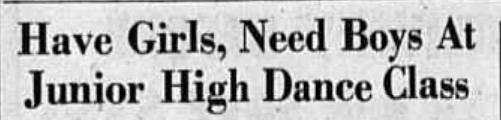
Surprisingly, the classes were more popular with girls than boys, as evidenced by this Transcript headline that ran just 2 days before classes were to start in October, 1971.
Several of my DHS ’77 classmates and I are described in the article as the “brave crew of boys” who had already signed up for seventh-grade beginner classes. I remained part of the brave crew for the rest of seventh grade, but did not continue my studies the following year.
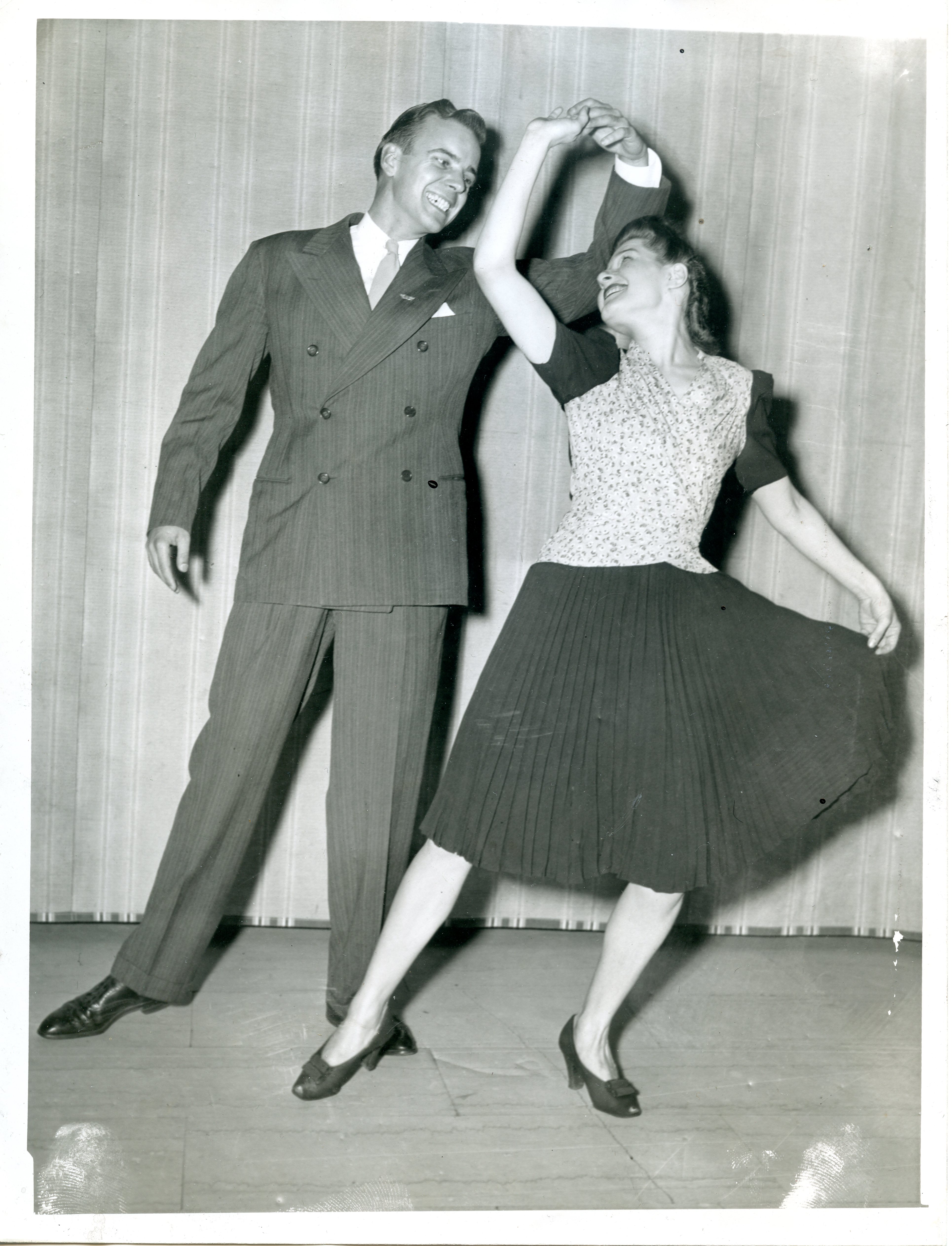
Arlington born Russell Curry was a well-known figure in the Boston dance scene beginning in 1938 when he joined his mother’s Curry School of Dance, an enterprise she had started in 1920. During World War II, Curry worked with the USO traveling to local army camps teaching dance steps to servicemen. In the 1950s, he began instructing young people across New England in social etiquette and dance. During his heyday, Curry taught over 15,000 students a year in 50 communities across New England.
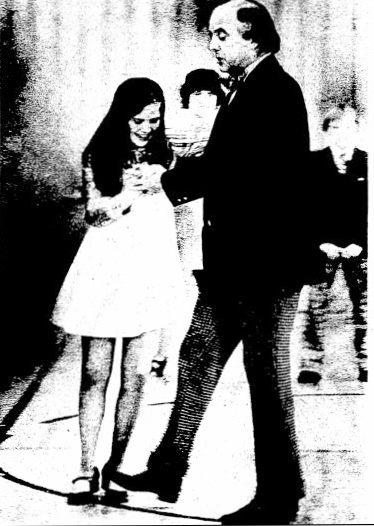
In this news photo from 1944, Russell Curry and his partner Virginia Touse demonstrate a new dance called “The Boston” at the Hotel Bradford.
Curry retired some time in the 1970s and moved to mid-coast Maine where he continued to teach and choreograph shows for the Boothbay Region Playhouse. He died in Damariscotta in 1997 at the age of 79.
Despite my somewhat unenthusiastic participation in dancing school, I actually learned a few things and could demonstrate a decent waltz step, fox trot or cha-cha if called upon. I bet there are many other members of that “brave crew” and their one-time dance partners out there who could make the same claim.
Back in the 1960s, my brothers and I had paper routes in town, delivering the Globe, Record American, and Herald Traveler. We got our papers from East Dedham News, which was operated by a man named Bob Stadelmann who was located in East Dedham Square. After the redevelopment of that area, Bob moved his operation to Sprague Street in the Manor. Eventually, I took over the routes by myself, delivering afternoon dailies and the Sunday editions in my Tower St. neighborhood.
Christmas was indeed the most wonderful time of the year for paperboys, for that’s when we got our holiday tips. You can’t imagine the excitement felt by 10-year old me on a cold Sunday morning in December as I placed the thick newspapers between the doors of my customers and found a card-sized envelope that might contain an extra buck or two. This card came from a Mrs. Donavan:
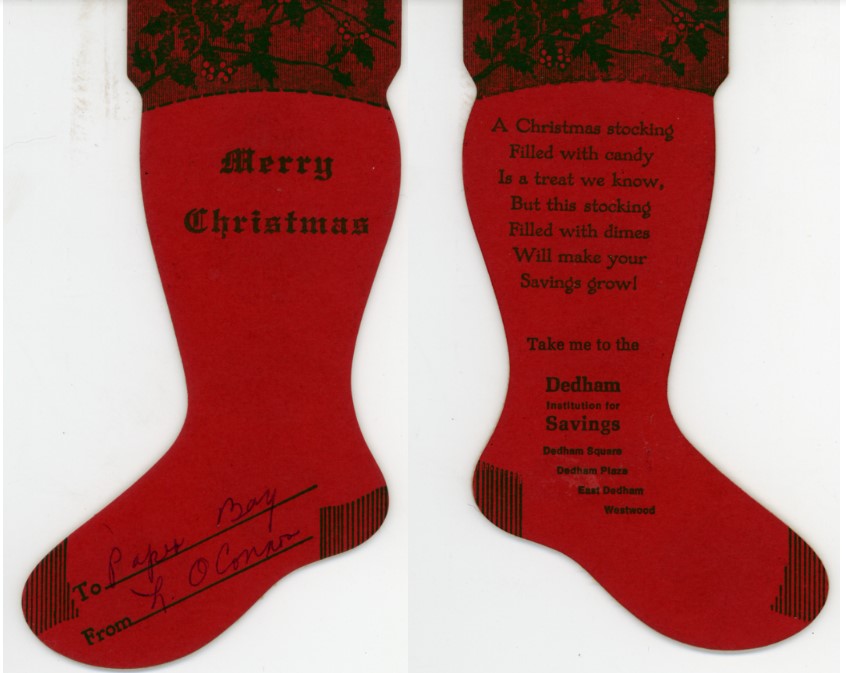
This next card was a cardboard stocking with slots on the inside that held ten dimes. It impressed me so much I’ve kept it for over 50 years! (After removing the dimes). Lillian O’Connor lived about three doors down from me on Tower Street but apparently did not know my name.
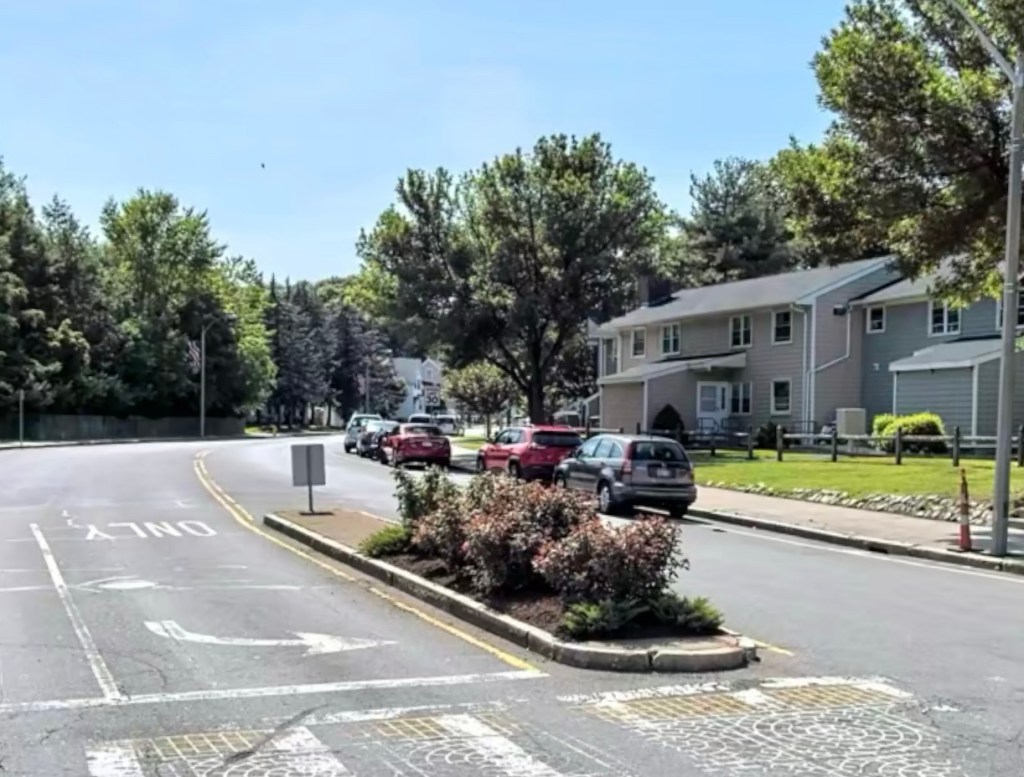
I gave up my paper route in high school but continued selling Sunday papers for East Dedham News. Bob’s son Mark would pick me up in his van and drop me off with a stack of papers at this island at the intersection of High and Milton streets, where I would stay until noon, or until I ran out of papers.
The intersection of High and Milton/Bussey
This job was such an important part of my high school experience, I mentioned it in my senior yearbook profile. I also wrote a poem called “Sunday Morning Lament.” It begins:
I sit all alone on an island in the street. The wind at my back, the cold in my feet….
and continues…
A rip or a wrinkle in the funnies won’t do. They all want a paper that’s clean and brand new.
Despite my poetic protestations, it was a good part time job for a high schooler. I sold a lot of papers, made a lot of money in tips and met some interesting characters, one of whom passed me a counterfeit $10 bill one morning. I was so scared, I gave him his paper and his $9.45 in change and stuffed the phony bill in my apron. Later I showed it to my mother who hid it deep in the top drawer of her dresser where it stayed for decades.
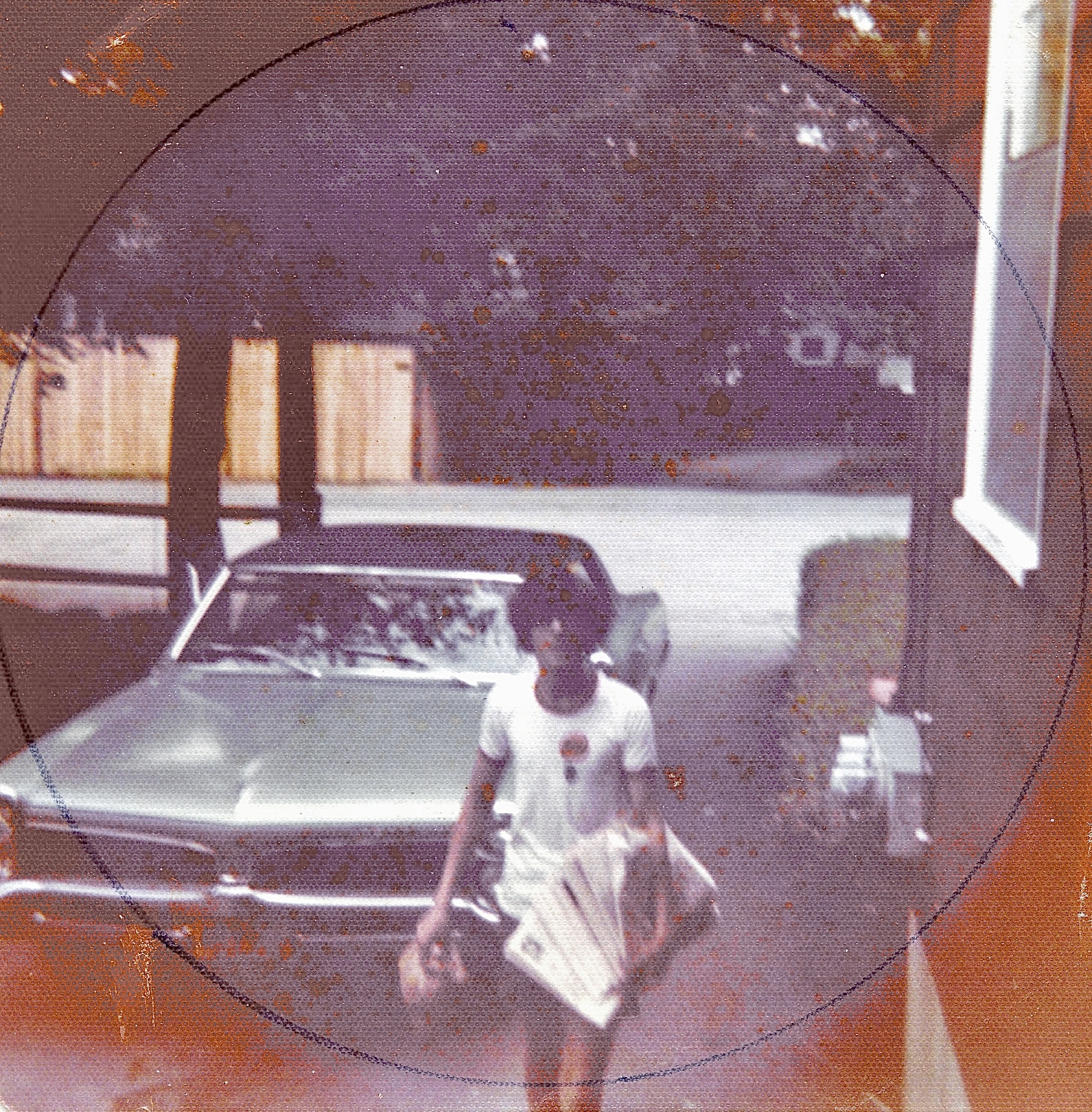
My change apron, from the bicentennial year 1976Returning home to Tower St. with unsold papers, ca. 1975
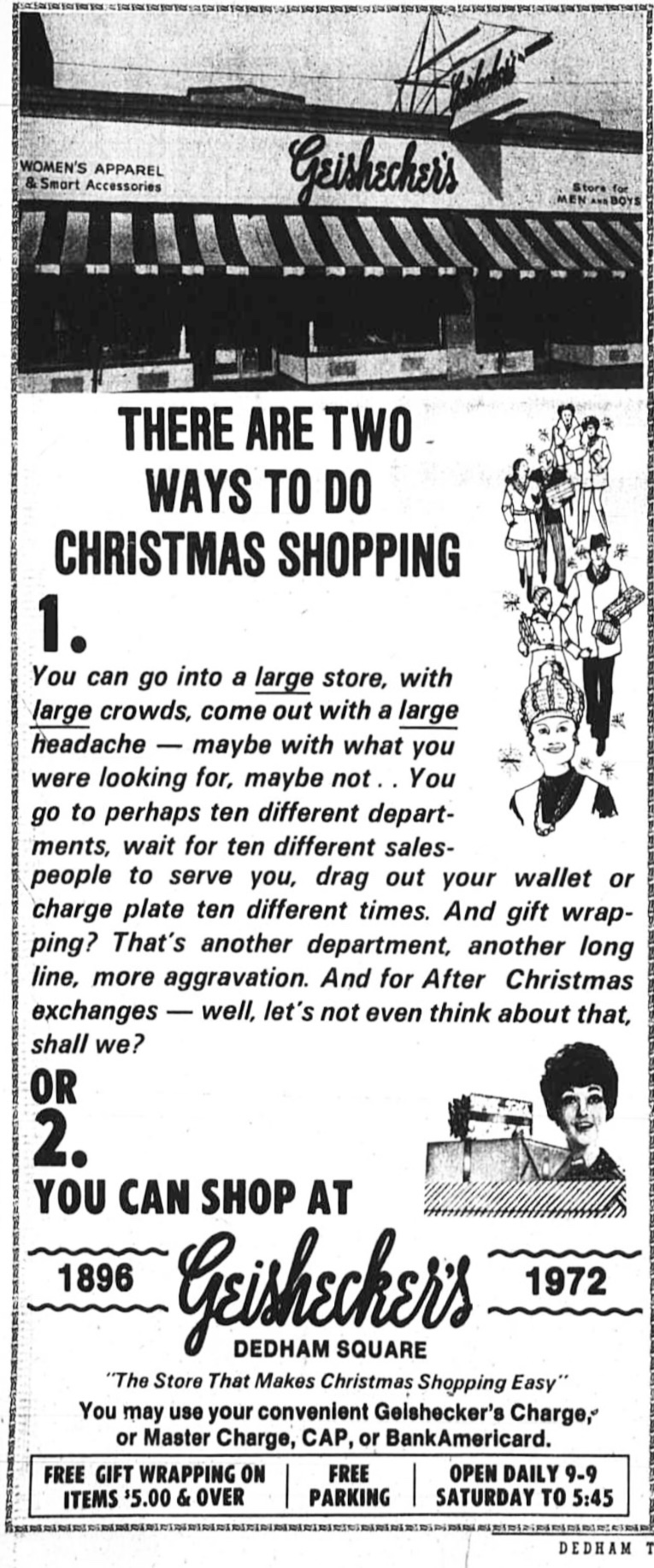
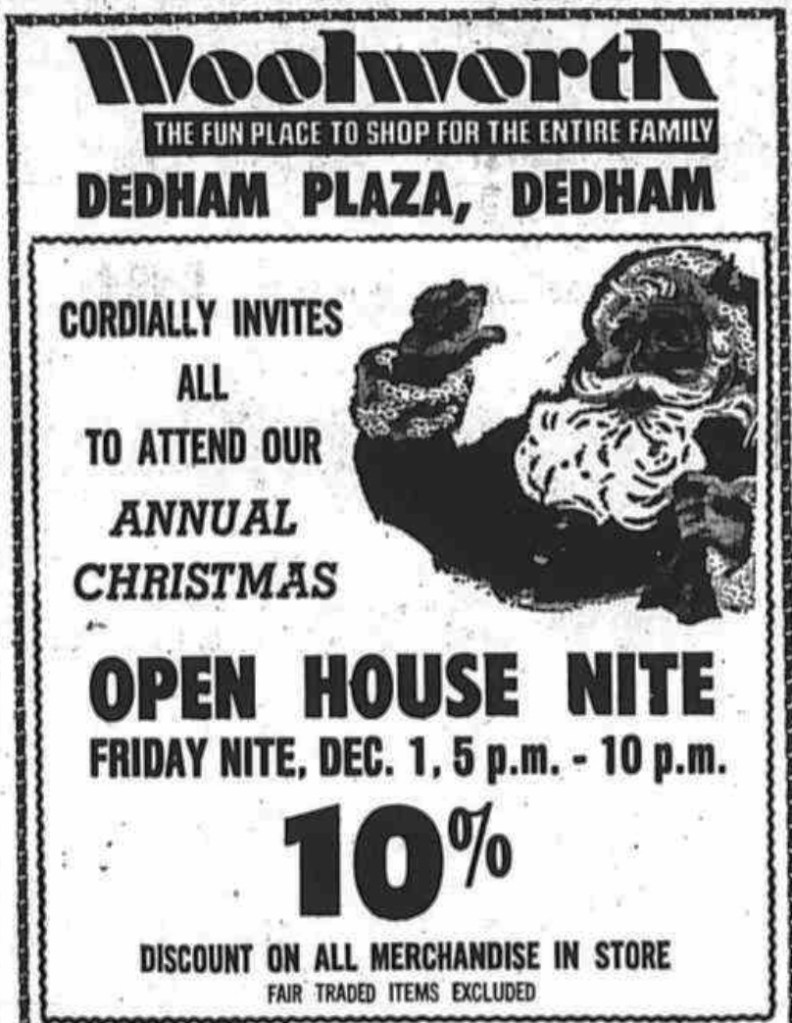
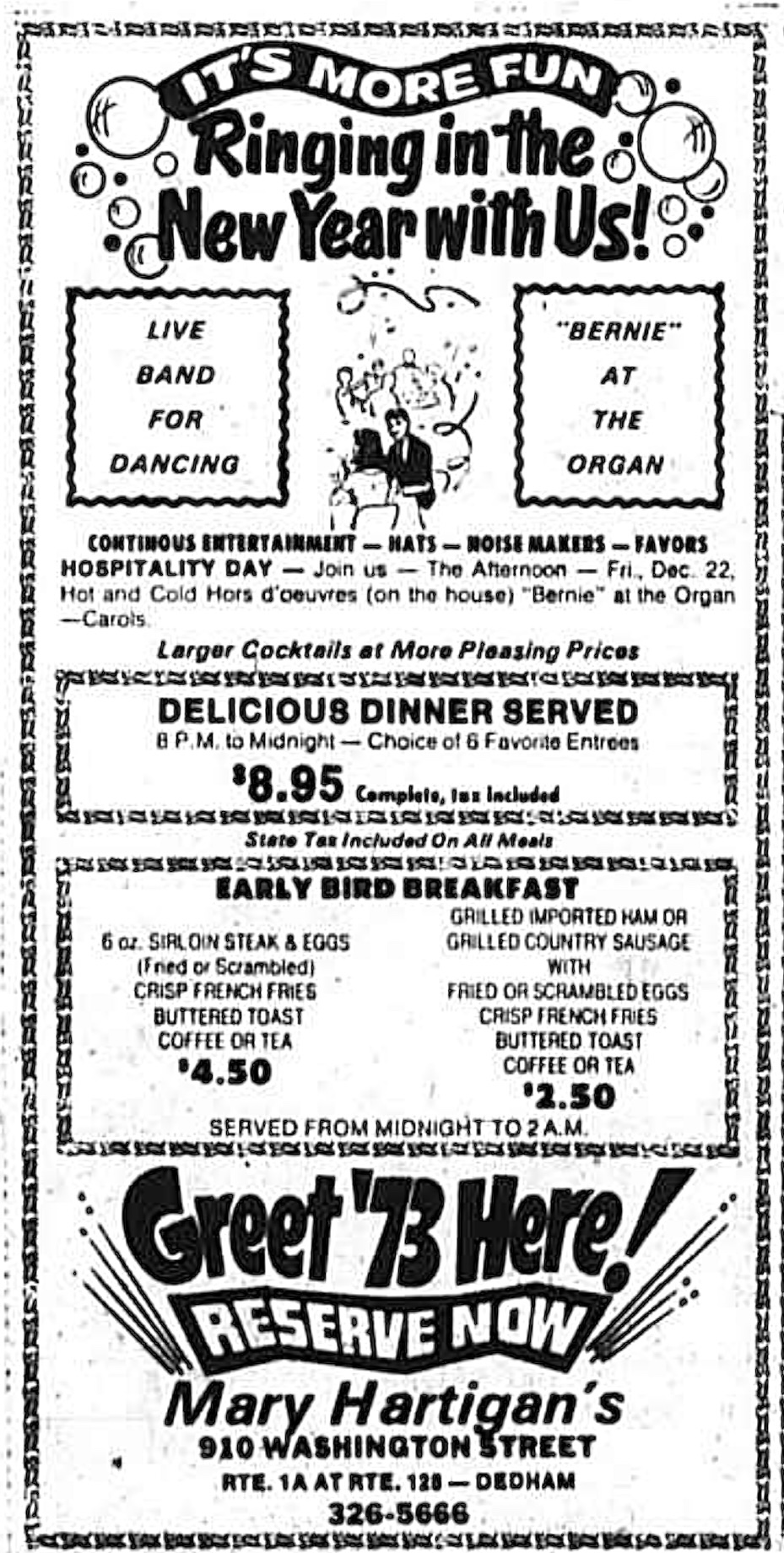
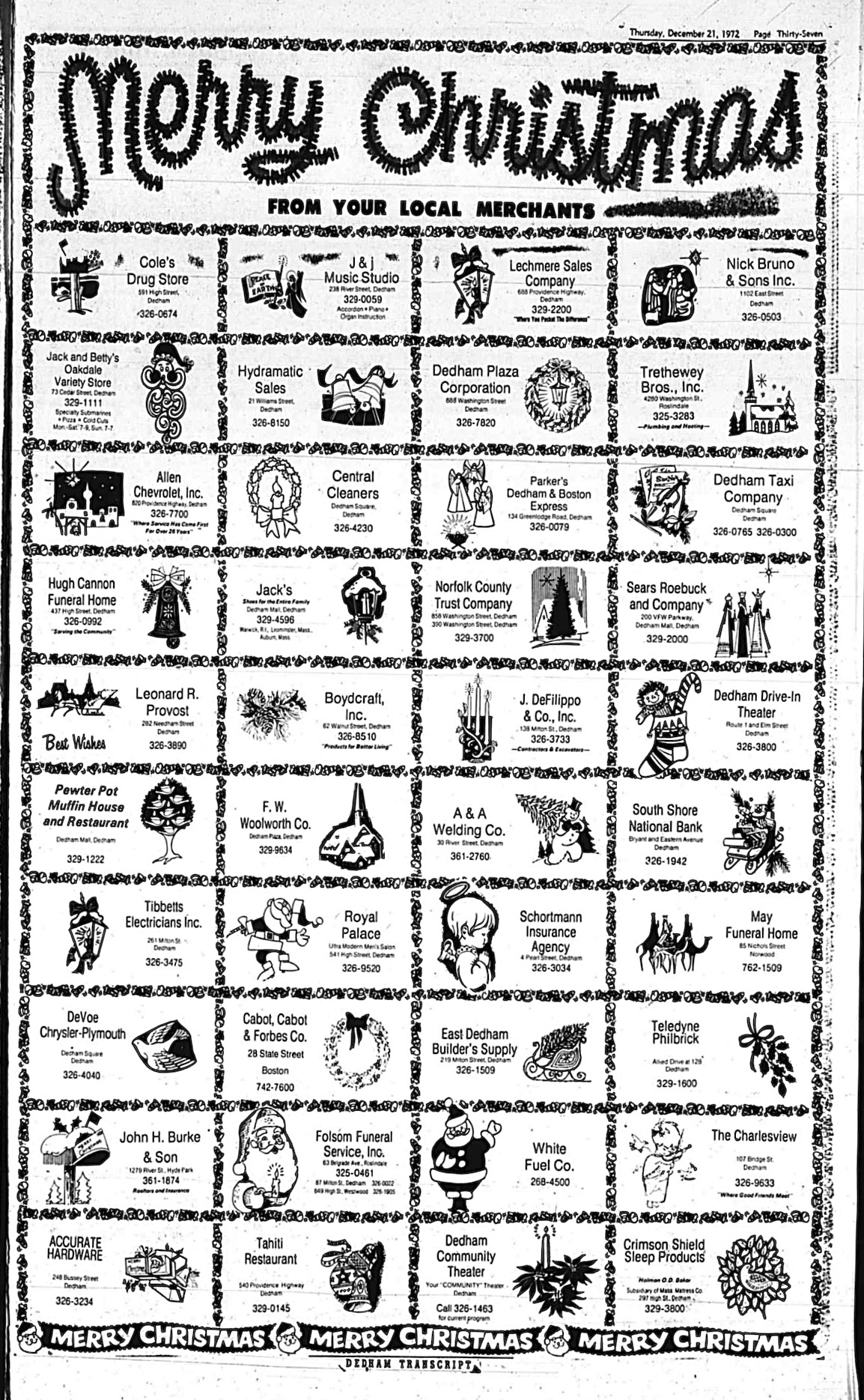
Enjoy these ads that ran in the Transcript during December 50 years ago. I’m sure blog readers will remember most of these Dedham businesses- a few of them still exist!
It’s been twenty-one years since workers dismantled the 103 ft. water tower on Walnut Street that had stood there since 1881. At the time, it was the oldest steel water tank in the country, but because it had no real historical significance (and was sitting on prime real estate in Oakdale) there was little objection to its removal.
Here’s a postcard from the early 20th century featuring the picturesque East Dedham Standpipe:
You can see the picturesque standpipe in this 1895 view from the top of the courthouse.
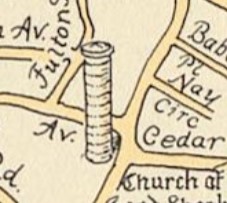
And finally, here is the “standpipe” on a pictorial map of town from 1954. I’m sure lots of people have their own special memories of this old Dedham landmark, feel free to share them in the comments!
While I continue working on Part 3 of the Paul family story, enjoy this little diversion about Oakdale Square.
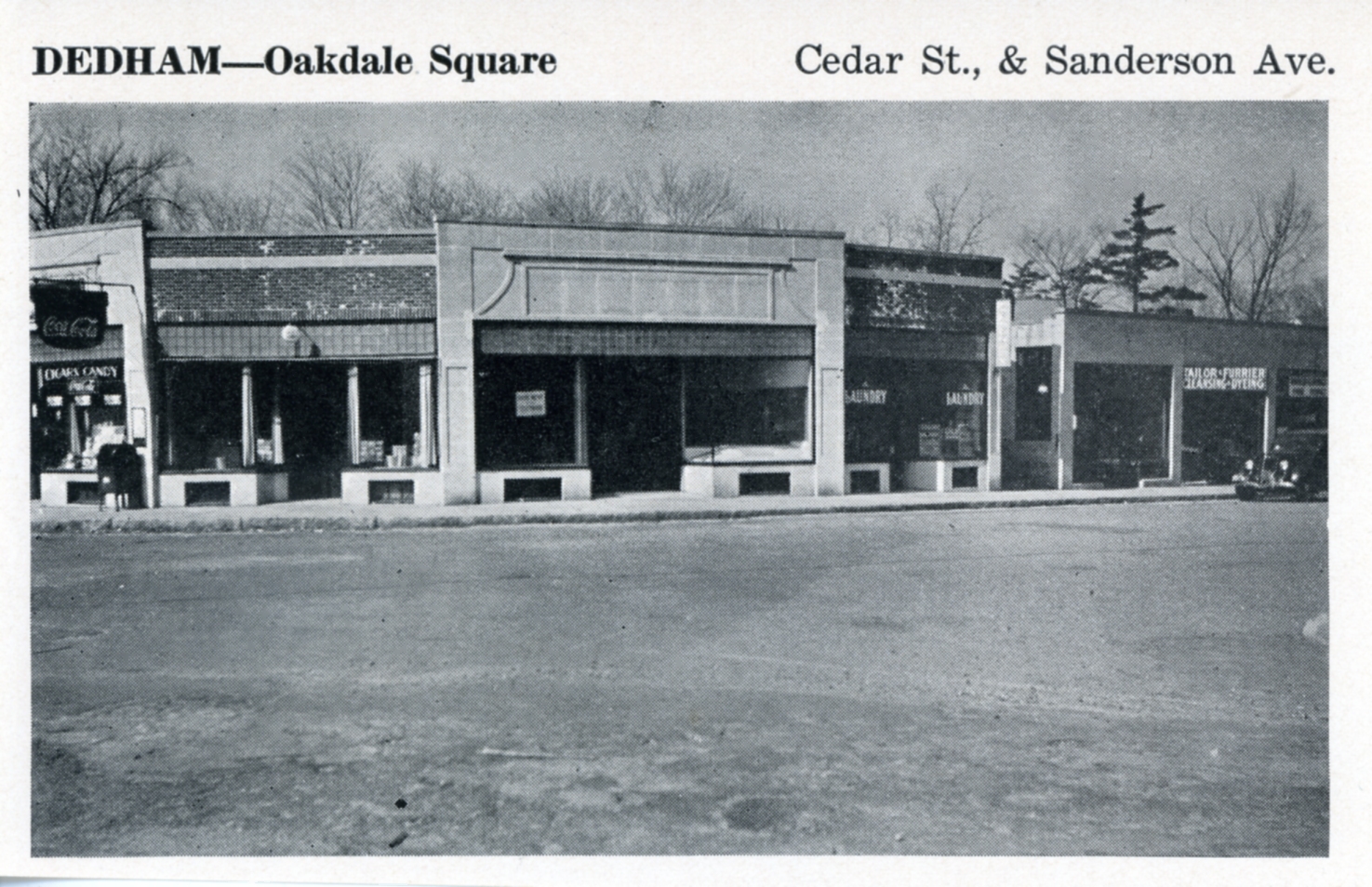
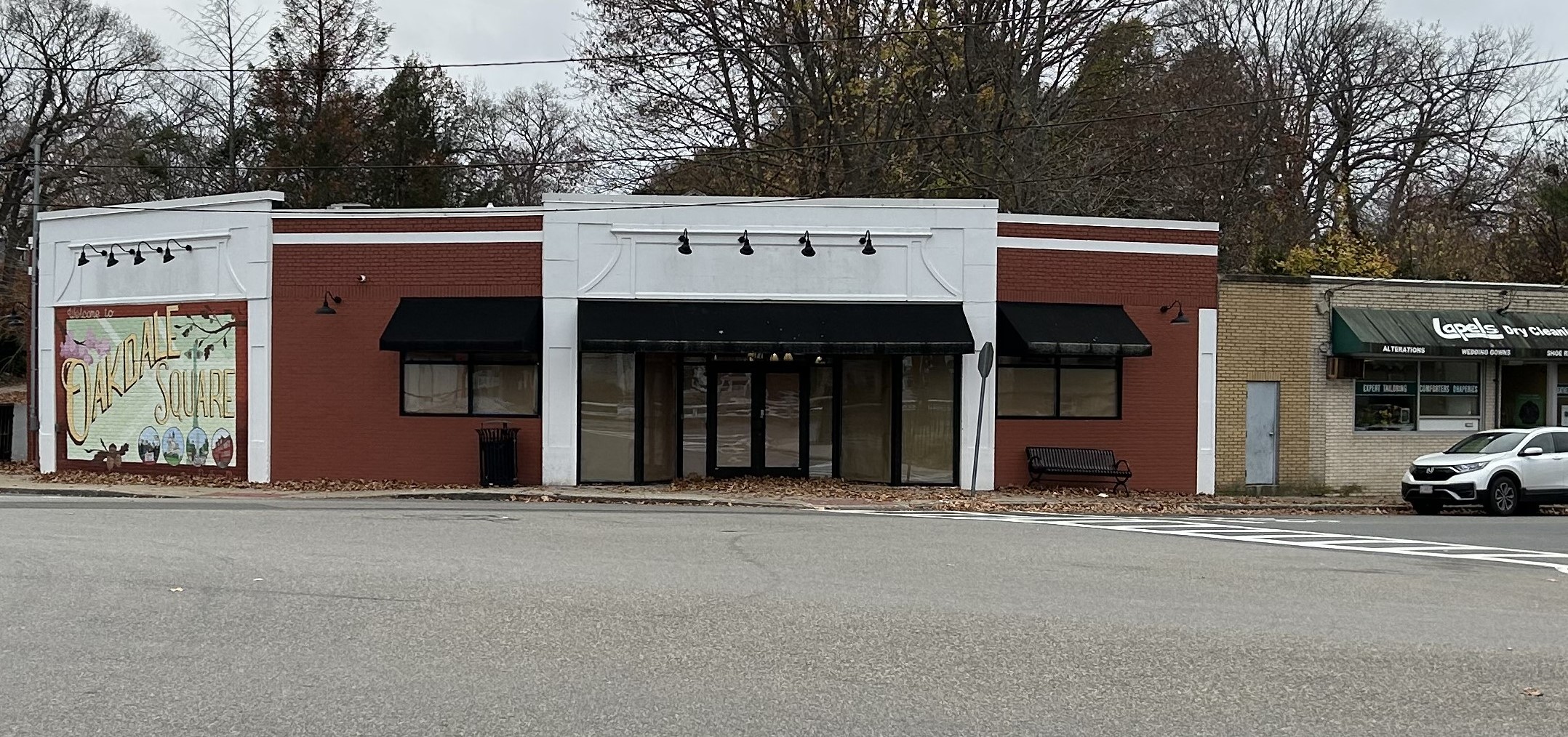
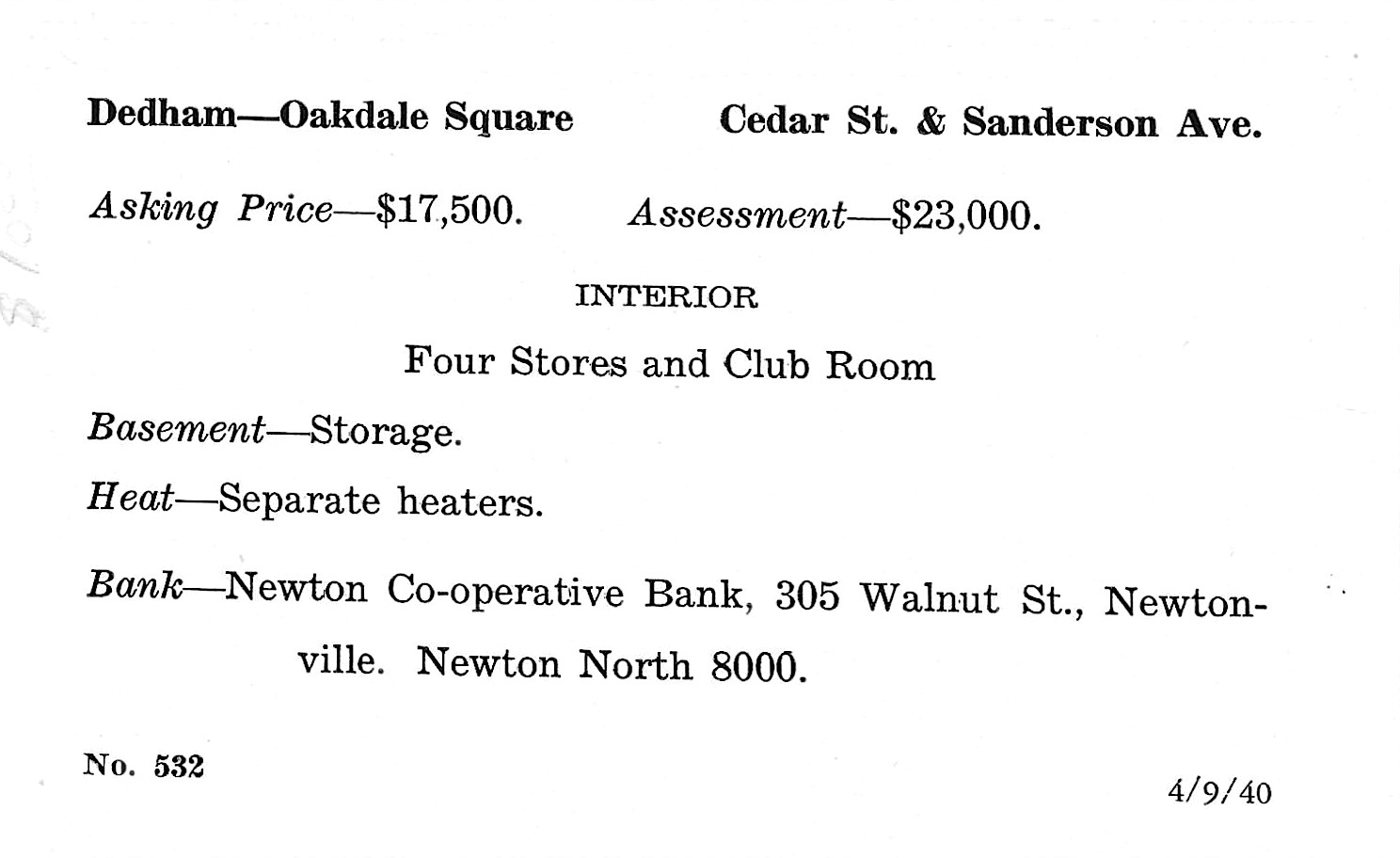
Oakdale Square doesn’t look all that different after 80 years, does it? The top photo is from a real estate postcard dated April 9, 1940. The bottom photo was taken November 11, 2022 after the 7-11 removed all traces of their presence here. When I was a kid, it was Danny’s Supermarket.
When the building was being constructed in 1925 (as 6 separate stores), the Dedham building inspector tried to halt construction due to neighbors’ complaints that the structure would create a “blind corner” for motorists. The builder, John Picone, of Newton, took his case to the Supreme Judicial Court of Massachusetts where it was heard by Associate Justice Harry K. Braley, who ruled in his favor.
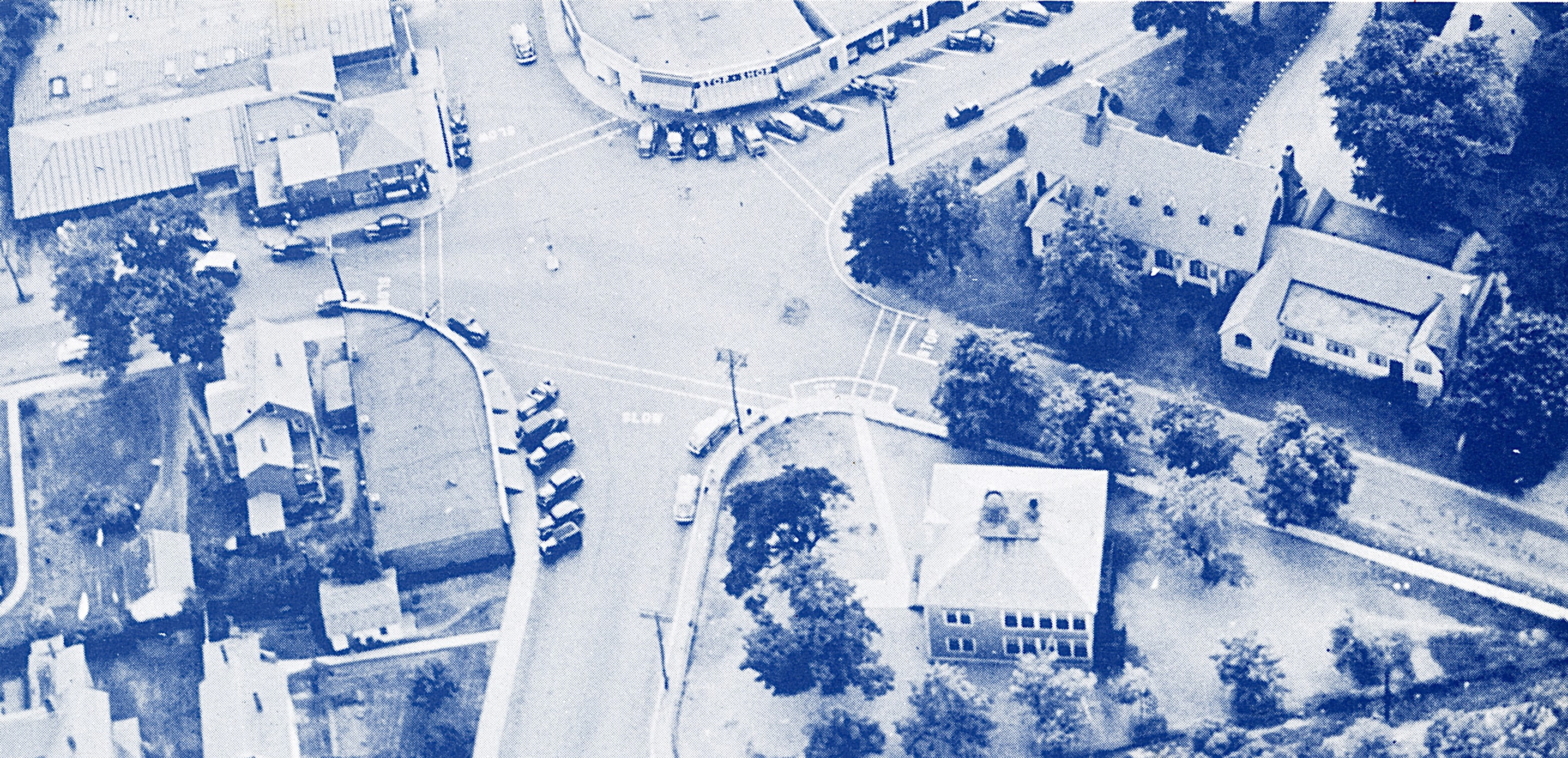
Here’s an aerial view which was included on the Dedham Planning Board’s 1947 Master Plan for improvements in town. As you can see, Stop & Shop now occupies the vacant store. The original Oakdale School is seen at the lower right. It stood where the Veterans’ Park is today.
I am James L. Parr. I grew up on Tower St. and went to St. Mary's and Dedham High (Class of 1977). I teach school in Framingham and co-wrote a book of Framingham history, which led me to write a book of weird Dedham history called Dedham: Historic and Heroic Tales from Shiretown. That book led to this blog. To order your own copy of the book, e-mail me at jameslparr@yahoo.com








 Jim Parr
 Dedham Tales