The 130th Boston Marathon will take place on Monday, April 20th, and if you’re out on the course be sure to cheer on our own Dedham Museum archivist Nicole McAllister. Nicole is running for the Joe Andruzzi Foundation, which supports families affected by cancer by offering financial assistance and hope during difficult times.
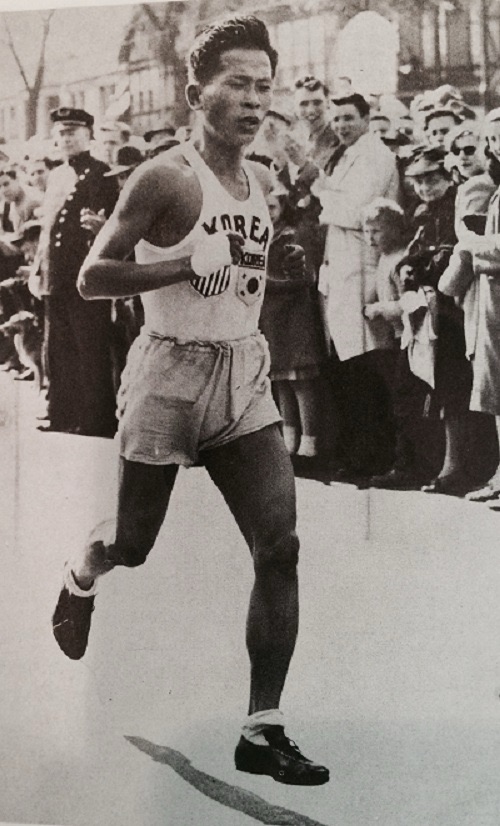
This will be Nicole’s second Boston run, which is one more than the 1947 winner who also had a Dedham connection. Despite being tripped up by a dog at Heartbreak Hill and running half the race with one shoelace untied, Korean Suh Yun-bok was not only victorious but also set a new course and world record of 2 hours, 25 minutes and 39 seconds. The 24-year-old was financed by American Armed Forces members serving in Korea at the time. During his training, Suh was the guest of Mr. And Mrs. Norman Paik of Boulevard Road in Dedham. In the weeks before the big race, residents frequently saw the marathoner and his two teammates running through the neighborhood near the Endicott Estate.
A reception was held at the Paik home the night of Suh’s record-setting victory, where he was honored with official town congratulations from selectman Thomas Lilly. Suh died in 2017 at the age of 94.
I will be out there as well on Monday, participating in my 16th Marathon… as a volunteer at the Mile 3 Hydration Station in Ashland. So Nicole, make sure your shoes are tied, watch out for pesky pups and know that the whole Dedham Museum community is rooting for you!
I was weeks away from graduating from Bridgewater State College. It had been a tumultuous senior year and it wasn’t over yet. Ronald Reagan was elected the previous November. John Lennon was murdered in December. The American hostages held in Iran were released in January moments after Reagan was sworn in.
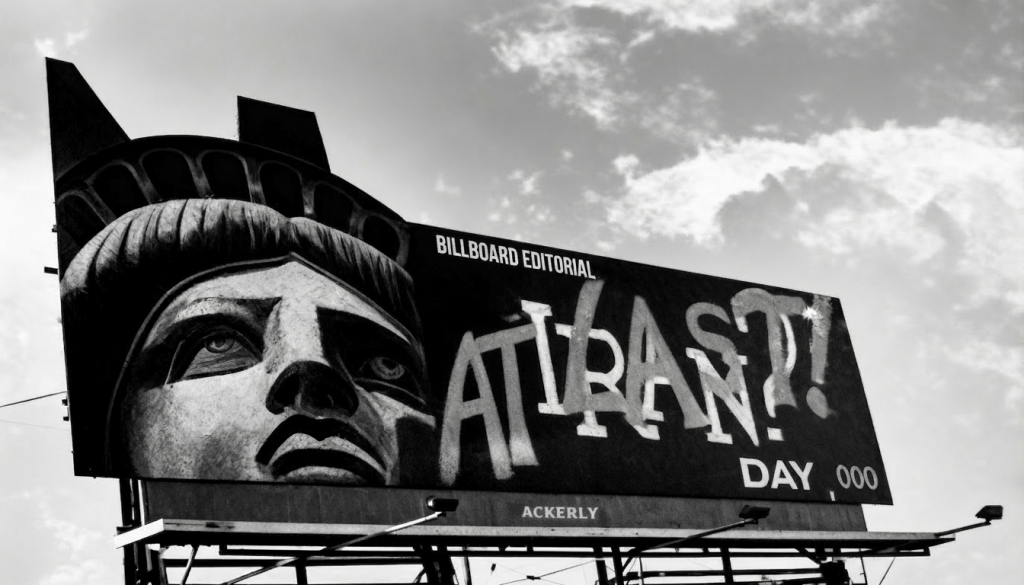
I was taking a photography class and had been strolling around Dedham looking for interesting subjects. The billboard pictured above stood facing Route One near the edge of the parking lot of the current Staples. It had been put up at the beginning of the hostage crisis, with the tally updated regularly until it reached 444 days. On January 21, a representative from Ackerly Communications, who had sponsored the message, added the words “At Last,” changed the count to zero and painted over the tears that had been streaming from Lady Liberty’s eyes.
A little over two months later, on March 30, the president was shot by John Hinckley, Jr. in Washington D.C. And before I would walk across the stage in May to receive my degree, the country would be shocked by yet another act of violence when Pope John Paul II was shot as he rode through St. Peter’s Square in Rome.
Recent events in the news brought me back to that unforgettable senior year. The exclamation point and question mark added to the billboard after the hostages were released reflected the mood of many of us then, as they do today.
Little did I know when I signed the visitor guestbook of the Dedham Historical Society over 50 years ago, that I would come back to work there after my retirement from teaching.
It’s been the opportunity of a lifetime researching and sharing some of Shiretown’s greatest tales with interested folks of all ages in my role as Museum Educator. Thanks for supporting Dedham history and this blog, and be on the lookout for new stories both here and on the Museum’s social media.
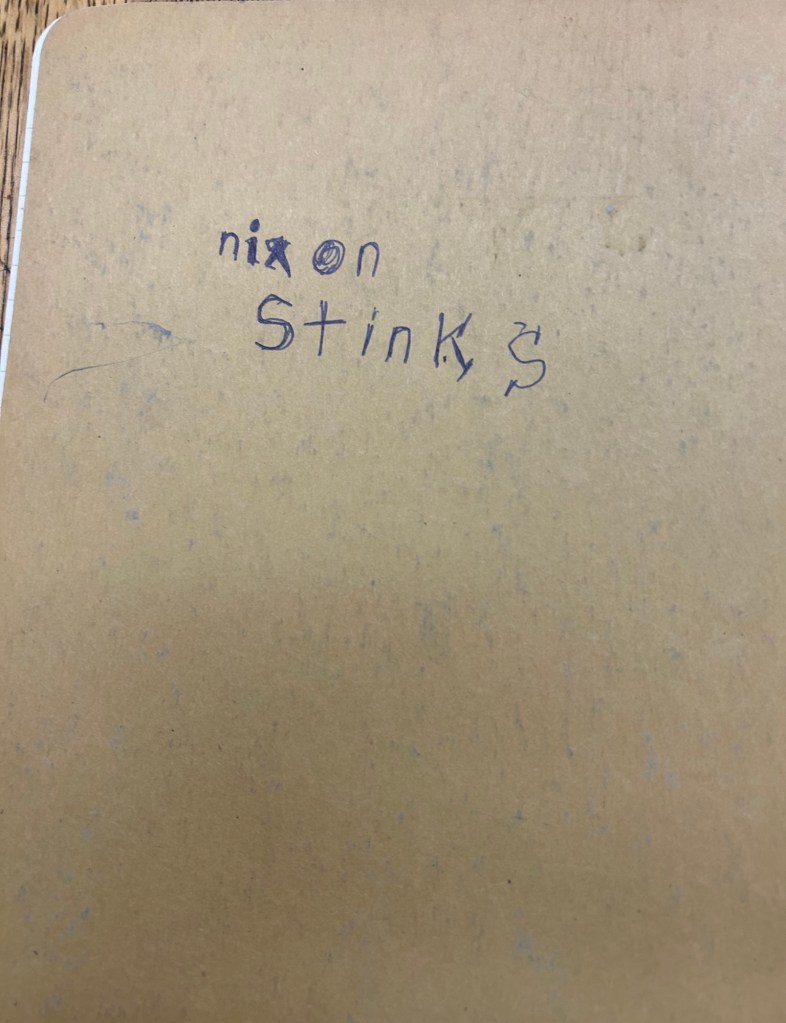
This is the back of the spiral bound sign-in notebook for student visitors. The graffiti certainly reflects the times. I know I did not commit this minor act of political protest- I was a rule follower and not particularly political. And I would have capitalized the president’s name- it’s a proper noun.
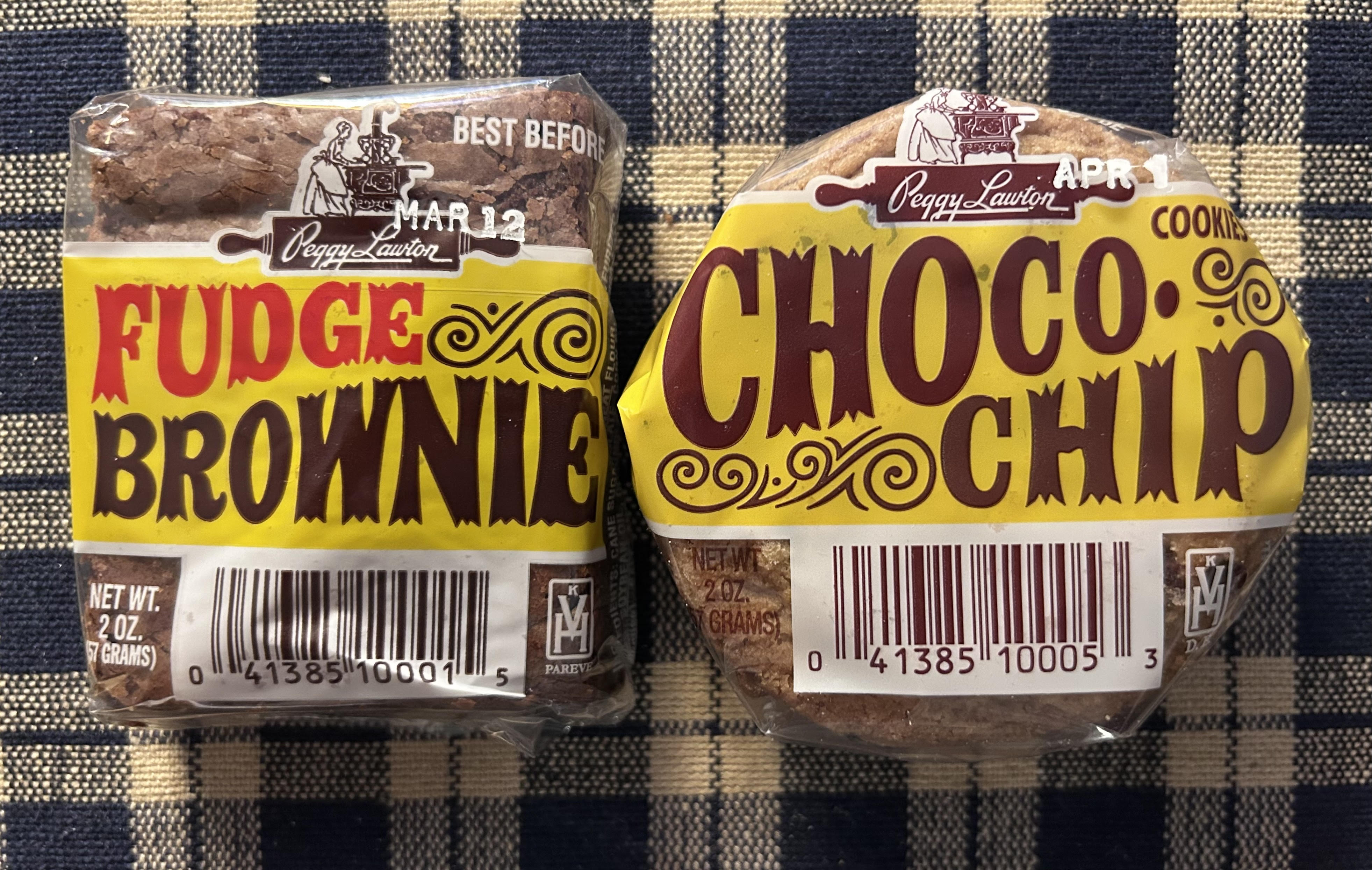
Well, that’s not exactly true. You see, Peggy Lawton is not a real person. But those delicious, fudgy brownies that are ubiquitous in supermarkets and convenience stores across New England were first introduced right here in Dedham Square.
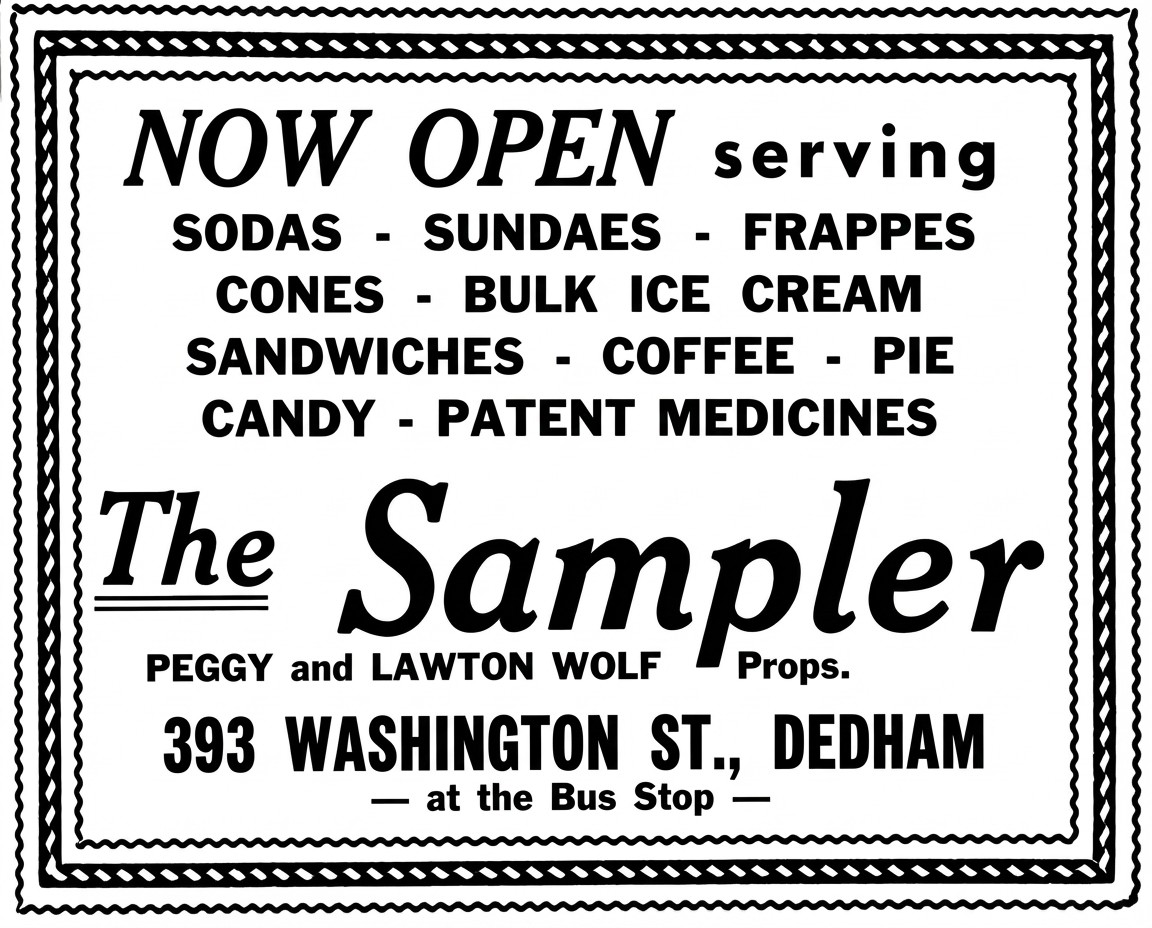
In September 1945, husband and wife Peggy and Lawton Wolf opened a restaurant called The Sampler on Washington Street near the corner of School Street. Within a short time, demand for Peggy’s homemade fudge brownies became so great that the couple decided to leave the restaurant business and open their own baked goods company. They combined their first names to create Peggy Lawton Kitchens, and added several varieties of cookies to the lineup alongside the popular brownies. The company operated in East Dedham and Hyde Park before locating to Walpole in 1961, where the beloved treats are still produced under the supervision of Peggy and Lawton’s son William Wolf.
If this story leaves you with a craving for more sweet history, be sure to check out the Dedham Museum’s first offering in our Spring Speaker series. This Wednesday, February 18, author Susan Bregman will share tales of iconic local goodies featured in her book “New England Sweets: Doughnuts, Bonbons and Whoopie Pies.”
Free to members; $10 for non-members (pay at the door).
The Speaker Series is held at the Museum, 612 High Street, Dedham, MA, and begins at 7:00 p.m.
Sampler ad from Dedham Transcript/September 21, 1945
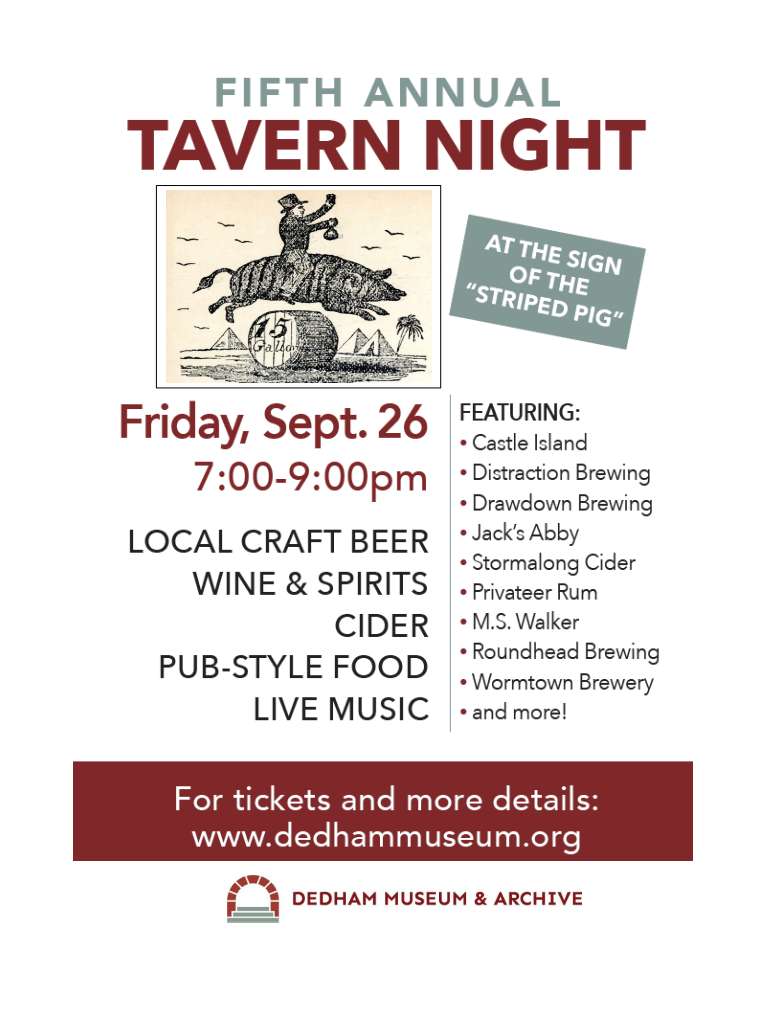
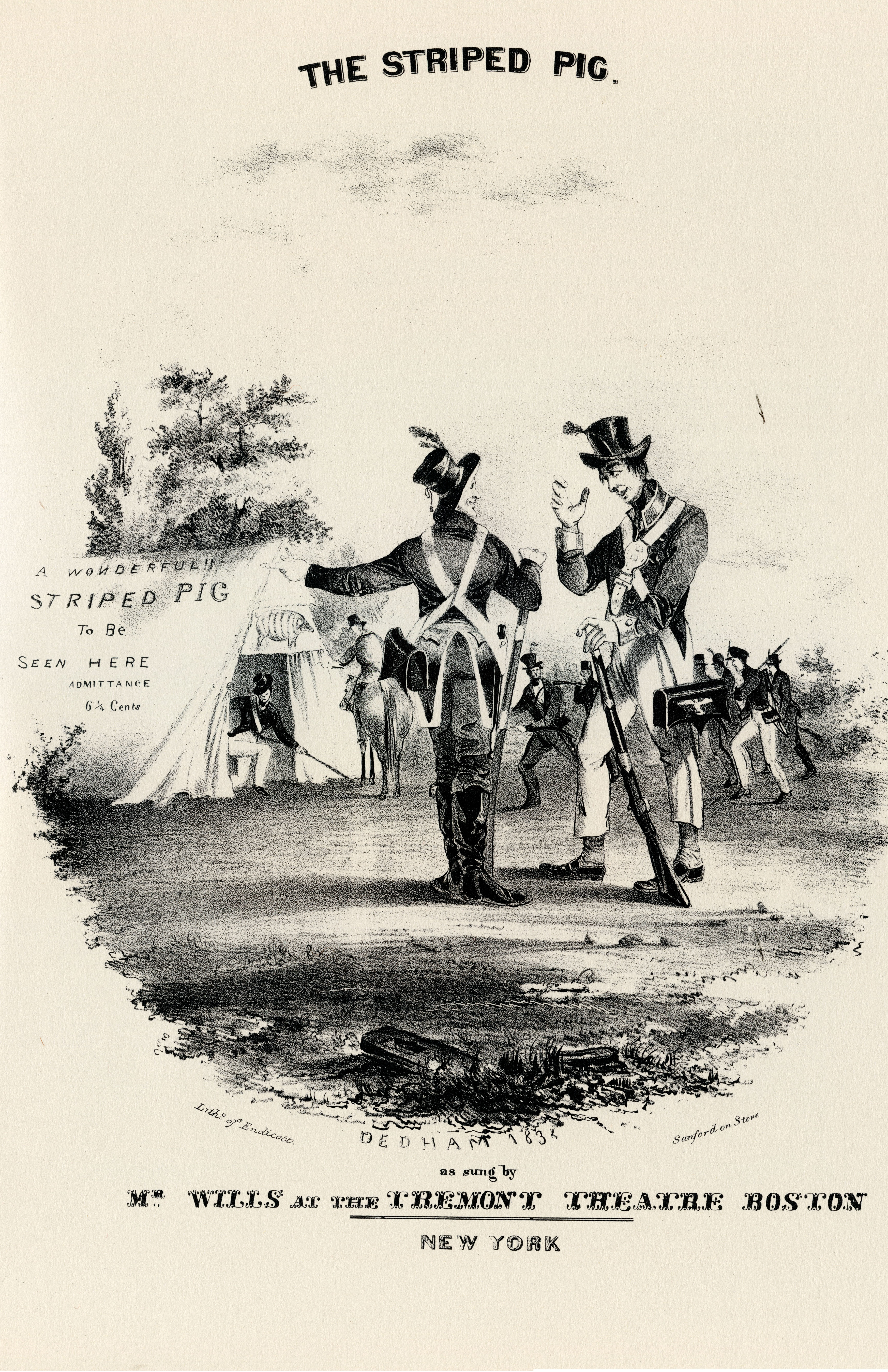
Don’t miss this fun event coming on Friday! This year’s theme is The Striped Pig, a unique event in Dedham history that I wrote about in my Dedham: Historic and Heroic Tales from Shiretown book. Read a short summary below. Hope to see you there!
Sheet music from the 1838 ballad
The Annual Military Muster in September 1838 on Dedham’s Lower Plain (present day Hyde Park) was looking like it would be a gloomy affair. Earlier in the year, temperance advocates had succeeded in getting the Massachusetts legislature to pass the “15-gallon law,” which prohibited the sale of alcoholic beverages in quantities less than 15 gallons. And what’s a military muster without access to abundant quantities of rum and whiskey?
Enter an inventive local who saved the day and unwittingly created a nationwide phenomenon that is still talked about to this day. The crafty vendor erected a tent on the field, with a sign inviting one and all to see the “Great Curiosity” of a Striped Pig. After paying their 6 and ¼ cents, patrons were indeed treated to the spectacle of a large and apparently contented pig, adorned with dark stripes looking suspiciously like fresh black paint. As a bonus, each paying customer was given a FREE glass of rum, thus quenching their thirst without breaking the law!
Within days the story of Dedham’s Wonder had spread across the country, and the Striped Pig was being celebrated in music halls and taverns far and wide. The phrase entered the nation’s vocabulary meaning both a ruse to skirt an unfair law (“We’ll have to try a Striped Pig device”) and a way to describe a drunken person (“Looks like he’s been riding the Striped Pig”). Striped Pig political parties were formed, some of which helped to bring an end to the 15-gallon law (and the re-election hopes of Governor Edward Everett who had signed it into law).
The Dedham Museum celebrates the creativity of that enterprising entrepreneur and his determined efforts to raise the “spirits” of Dedham’s citizens on that late summer night almost 200 years ago.
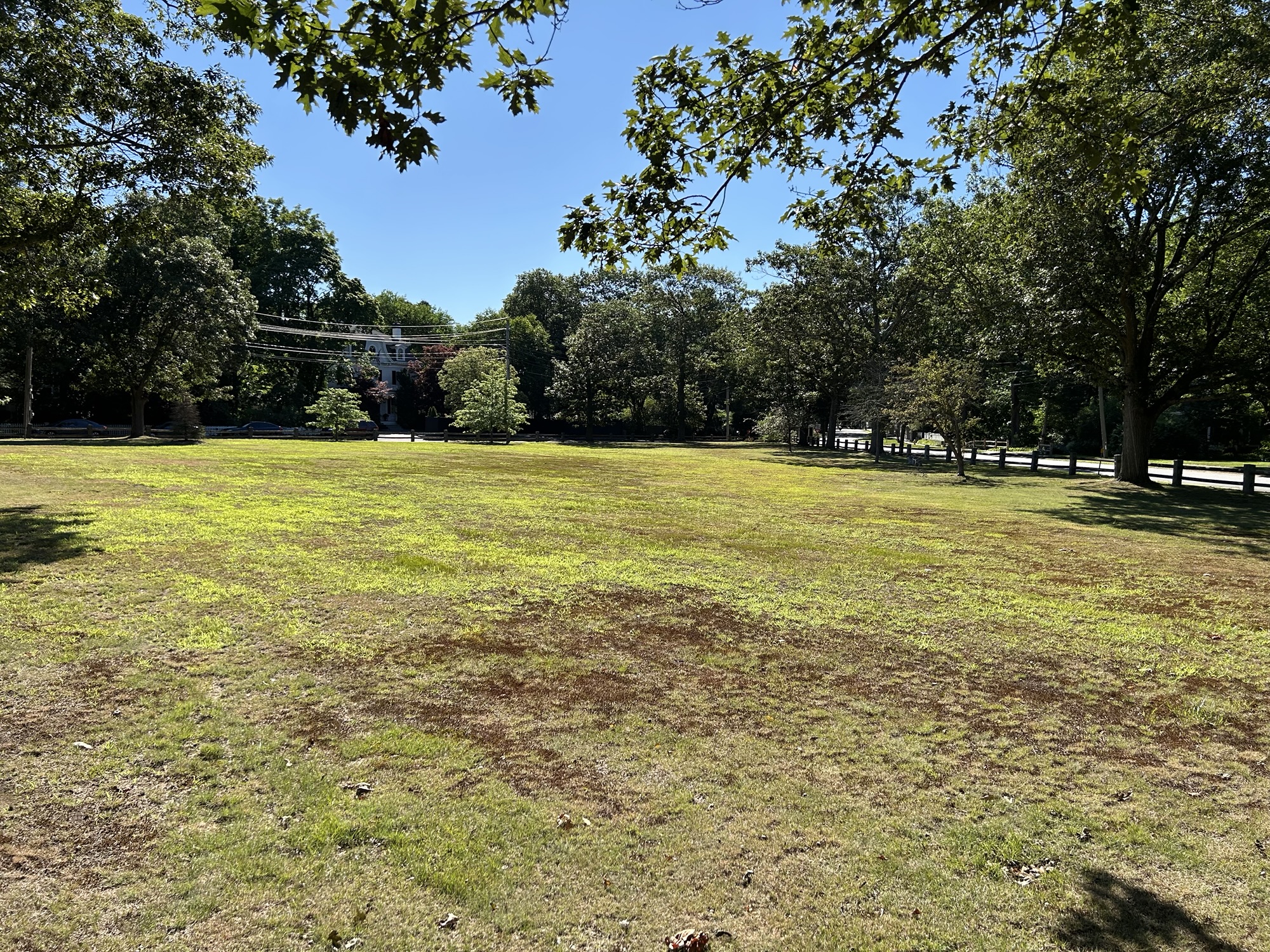
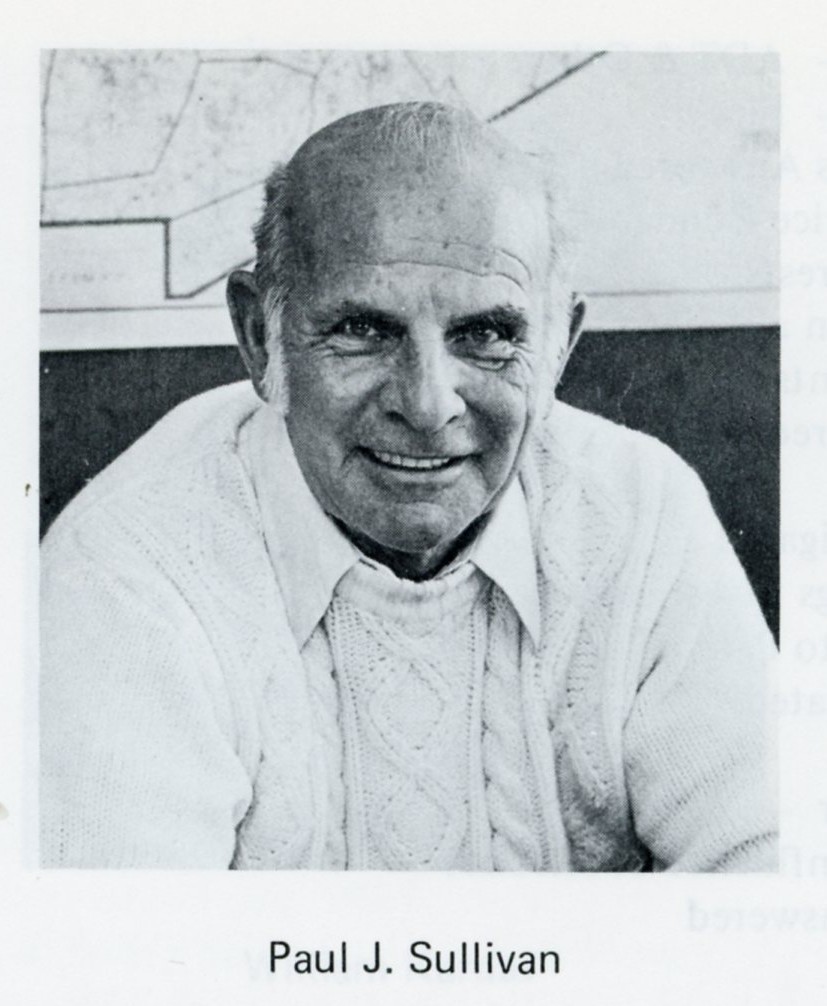
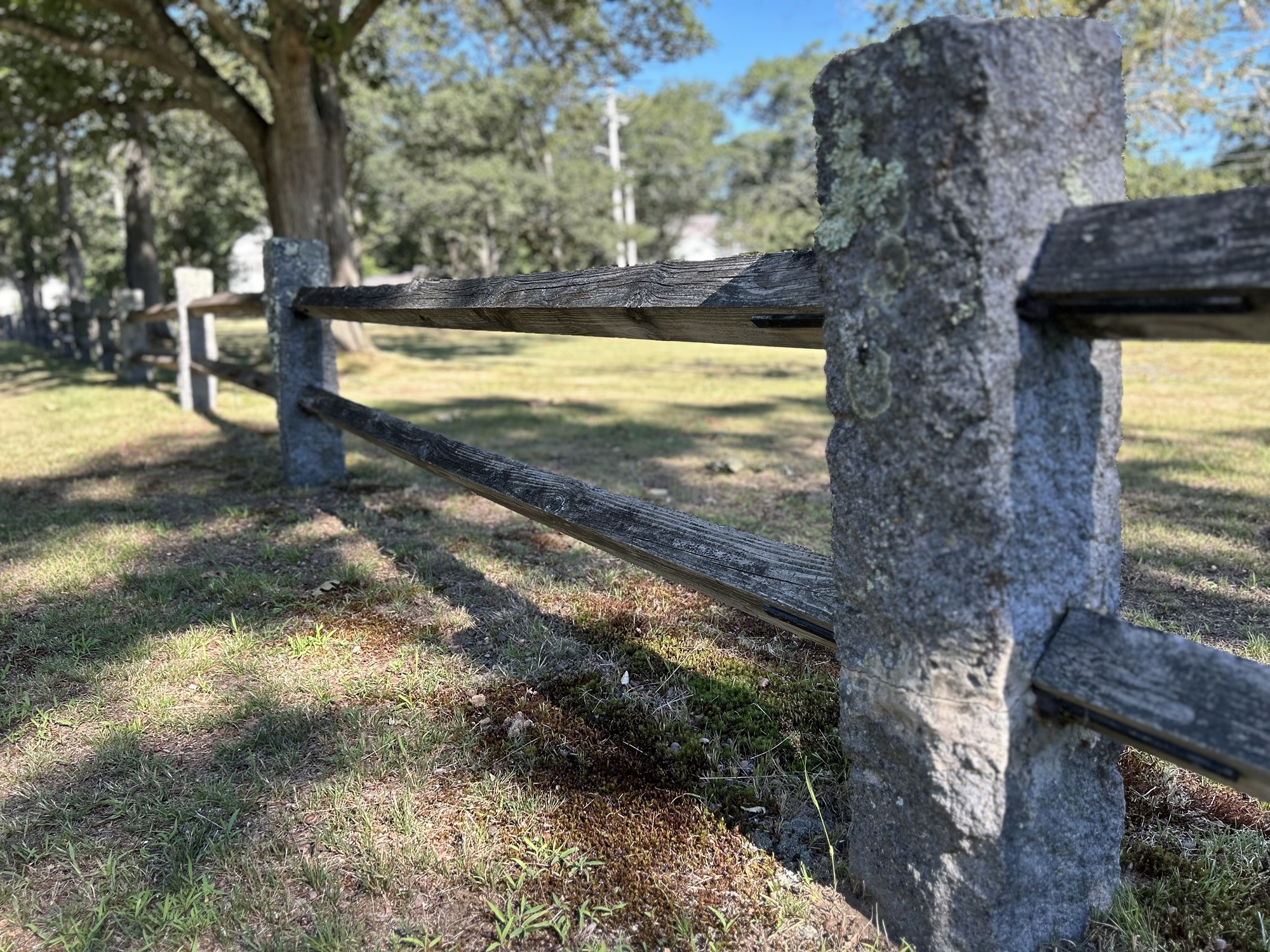
In early July 1975, DPW Commissioner Paul Sullivan authorized the white fence rails around the Dedham Common to be painted red, white and blue in honor of the country’s upcoming Bicentennial. The response by neighborhood residents was swift and overwhelmingly negative. At a special meeting of the select board attended by over 90 concerned citizens, the board voted 3-2 to keep the color scheme as is, despite the presentation of a petition signed by over 100 residents. After learning of several not-so subtle threats to repaint the fence, town officials posted a 24-hour guard at the Common for a few days.
Over the next few months, while there were several unsuccessful attempts to return the fence to its traditional white color, the newly formed Historic Districts Commission was able to meet and settle the matter once and for all. In September the Commission voted to make a request of the select board to repaint the fence by October 15. Commissioner Sullivan stated he would abide by the Commission’s request, and after a week’s rain delay the fence was repainted by volunteers on October 23.
Epilogue
On June 29, 1976, this headline appeared in the Patriot Ledger: Selectmen Order Common Grass Mowed. The article went on to describe the “harvest” of tall grass that had not been mowed since the fence painting brouhaha almost a year before. DPW Commissioner Sullivan explained that he thought the Common was under historic commission control, and would cut the grass only if ordered to by selectman. “It was nice hay,” he remarked, with the article noting that the commissioner was never one to forget a favor or a slight.
Aside from some Karen Read supporters setting up by the Common at the intersection of Routes 135 and 109, the past 50 years there have been free of excitement and controversy. Today, the rails of the fence are unpainted, and will most likely remain that way throughout the country’s semiquincentennial (250th) celebration next year.
You may have heard about the furor in Newton over the city’s decision to paint over the street lines that for years had traditionally been green, white and red, the colors of the Italian flag. This story is remarkably similar to the “Battle of Dedham Common” 50 years ago. Certainly, the emotions of those involved are just as strong as they were for Dedham residents of half a century ago. Read the linked story, and see if you don’t agree.
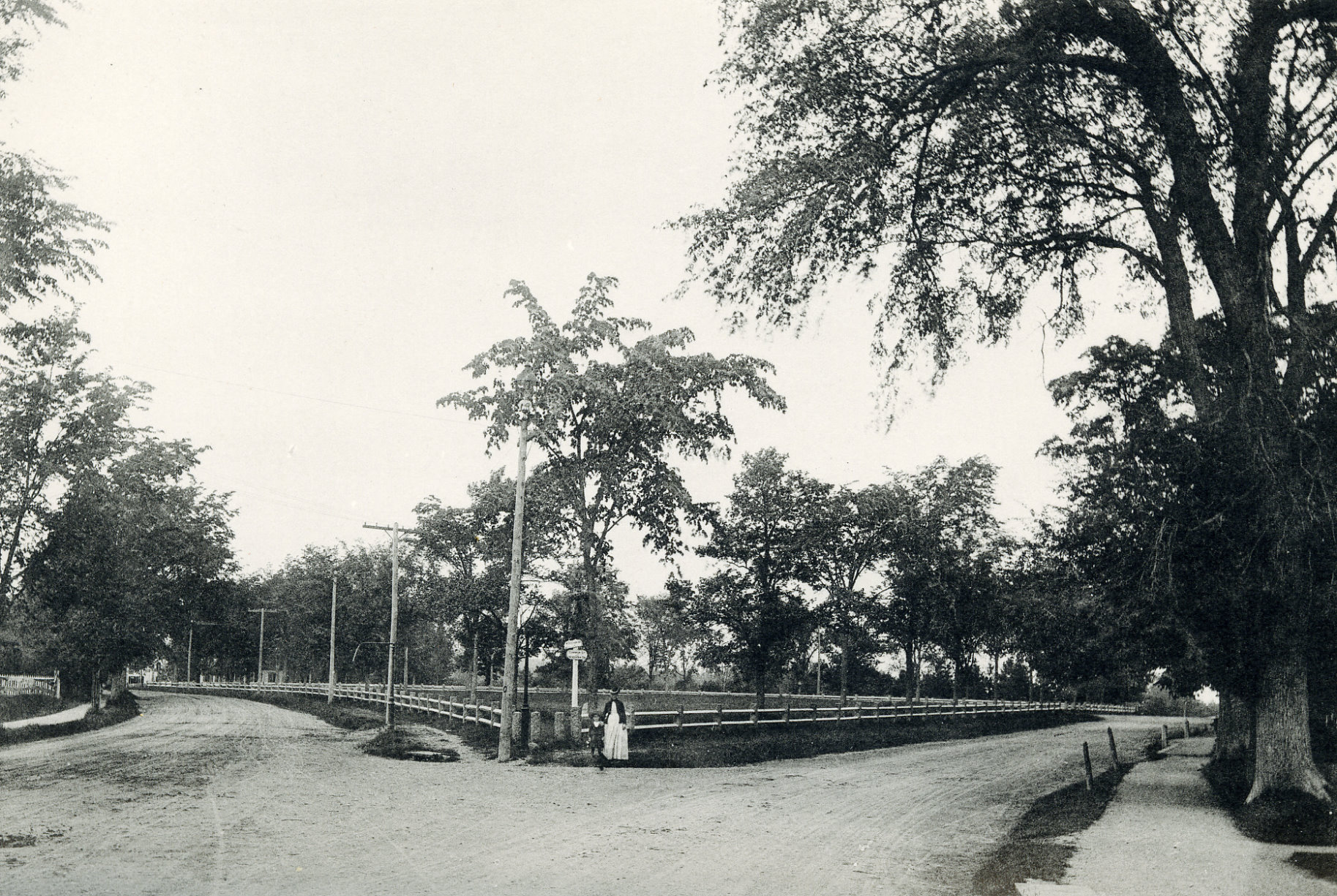
Dedham Common, 1890s- Courtesy of Dedham Museum and Archive
50 years ago, communities and businesses began observing the 200th anniversary of the founding of our country, beginning in April 1975 with celebrations and commemorations of the famous battles that marked the start of the Revolution. In the summer of ’75 the town of Dedham saw residents engaged in their own battle, one that could fittingly be described as “uncommon.”
Sometime around the 4th of July, residents in Precinct One were shocked to find the wooden railings surrounding the Town Common had been transformed from traditional white to a Bicentennial color scheme of red, white and blue. The reaction of the townspeople, especially those living on streets adjacent to the Common, was swift and strong. The new paint job was described as “garish,” “an aesthetic outrage,” “the worst of taste” and “inappropriate, incongruous and demeaning.” “It looks like the town trollop,” one woman remarked to a Boston Globe reporter.
Boston Globe July 13 1975
As equally enraging to locals was the process by which the fence received its tacky paint job. Despite the existence of a Bicentennial Commission and a recently formed Historical District Commission, neither group was consulted before Public Works Commissioner Paul Sullivan supervised the work. Sullivan explained that several benches in East Dedham had already been painted the patriotic colors with no public complaint, and when it came time to repaint the Common fence, it seemed like an appropriate way to honor the country’s Bicentennial. “I think it looks wonderful,” he said at a mid-July select board meeting. “Our forefathers would turn over in their graves if they could see it,” was one response to Sullivan’s remarks.
At the July 15 meeting, the select board voted 3-2 to keep the patriotic paint scheme, despite the vocal disapproval of most of the 80-plus in attendance and the presentation of a petition signed by over 100 townspeople demanding the fence be repainted white. At times the meeting became heated, with residents and members of the select board shouting at each other, questioning the taste of those in favor of the red, white and blue color scheme and the patriotism of those opposed. The meeting ended with more than a few attendees asserting that the fence would be repainted white again, one way or another. Hours after the crowd dispersed, a midnight caller to the Transcript calling himself “The Dedham Militia Man” stated “We do not like the fence red, white and blue. The fence now has black crepe paper on it and soon it will be white.” Such threats of civil disobedience were taken seriously by town officials, and a 24- hour police guard was posted at the Common for the next few days.
North Adams Transcript/August 11 1975
News stories throughout New England took a rather bemused tone when describing the kerfuffle, but Dedham residents, especially those living near the Common, took the matter very seriously. Throughout the summer, members of the various historical committees continued to meet to resolve this issue. But for the time being, the fence would keep its “Andy Warhol type pop-art” color scheme.
PART 2 Coming next week: A little history of the Town Common and the resolution to the ongoing disagreement
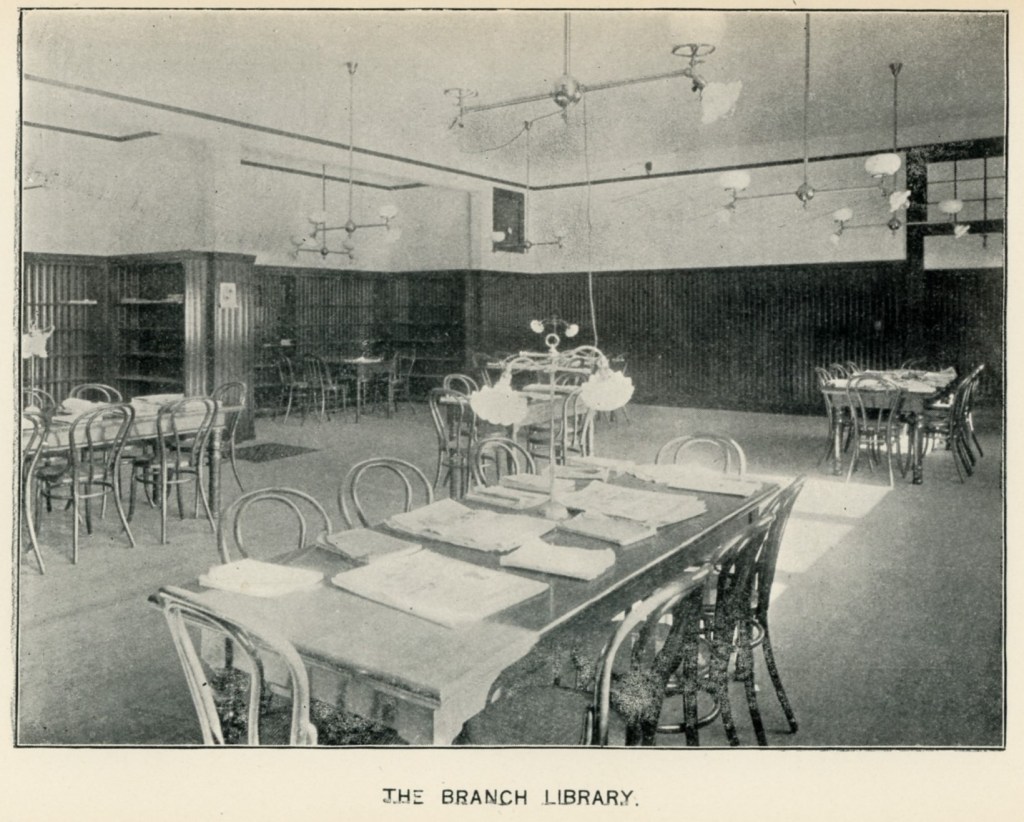
Many locals remember this building as the East Dedham Branch Library, which was in operation for an incredible 77 years from 1896-1973! This is what the library looked like when it first opened:
The branch Library opened on January 30, 1896. The library’s annual report at Town Meeting that year stated: “The warm interest already shown in the Library is proof that its advantage to the people of East Dedham will be deeply appreciated.” And it was, for the next 77 years!
Others will recall Gates Pharmacy, which relocated here after several moves and closed for good in 1995. Others remember going to the office of Dr. Glickstein the dentist who kept his office here for decades.
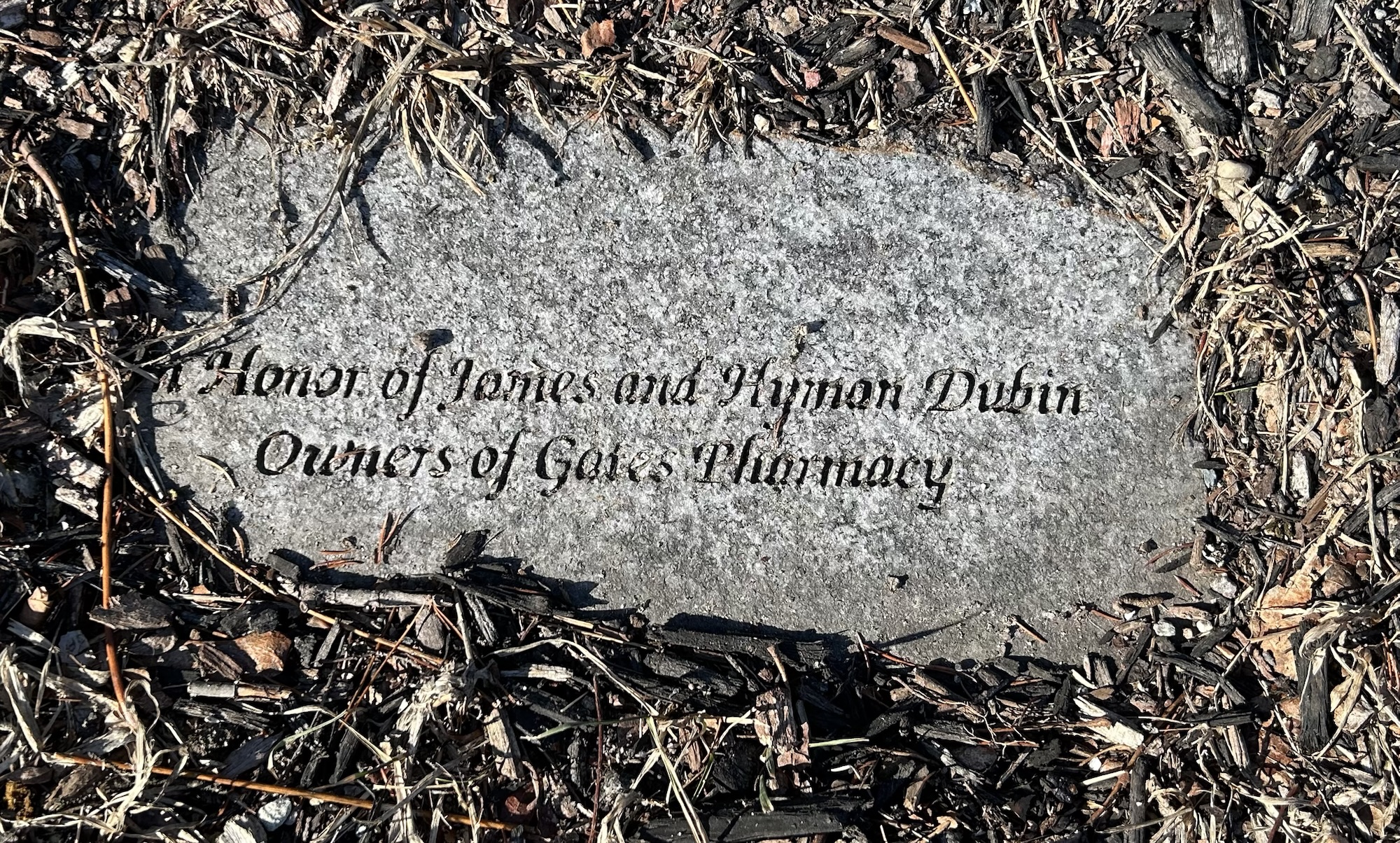
Gates Pharmacy opened for business at its original High Street location on May 13, 1952, and closed exactly 43 years later on May 13, 1995. This stone honoring the original owners, brothers James (Jimmy) and Hyman Dubin is located in the park next to 25 Milton Street.
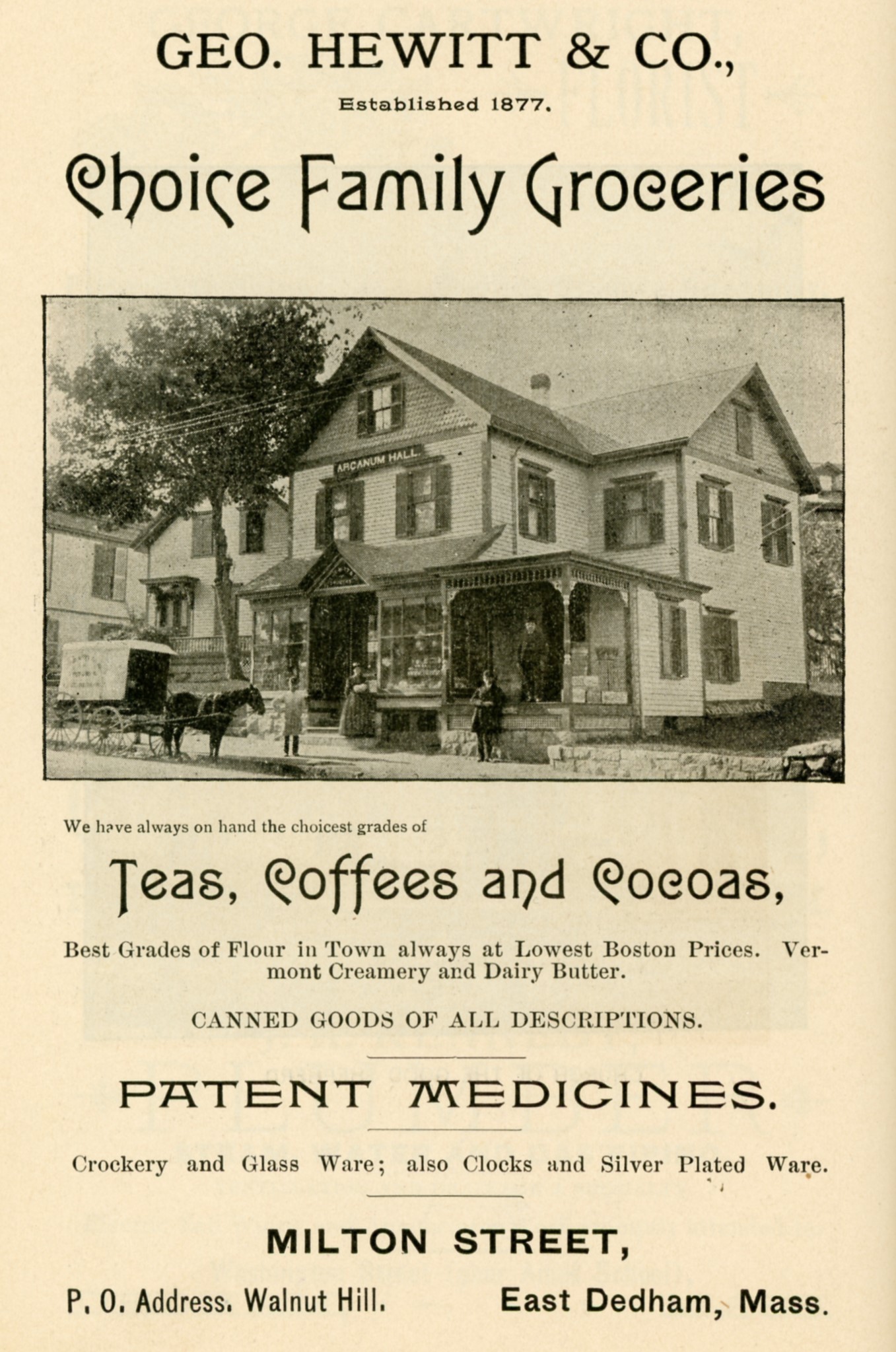
There are few, if any, who are old enough to recall the building’s earlier past. Here is the same building in an advertisement for George Hewitt’s grocery store from the 1893 Dedham Directory:
According to the 1895 publication Boston’s Picturesque Southern Suburbs, “there is no room to doubt that so far as East Dedham is concerned the store par excellence, to patronize, is the family grocery house of Messrs. Geo. Hewitt & Co., on Milton Street…” Hewitt’s shop carried a full line of groceries and meats, as well as clocks, silverware, stoves and ranges.
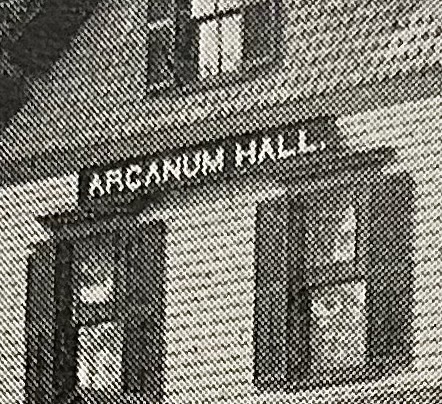
George Hewitt was an English immigrant who supervised the weaving operation at the Merchant’s Woolen Mills before opening the grocery in 1877. Until his death in March 1902 Hewitt, lived above the store with his wife and nephew Sam, who helped run the business. Tragically, 26-year-old Sam contracted meningitis and died just a few months after his uncle. The property and business were then taken over by Benjamin Rose. Both Rose and Hewitt were members of a fraternal benefit society known as the Royal Arcanum, which explains the sign hanging above the windows.
When Hyde Park merchant and Russian immigrant Moses Guber purchased the property after Rose’s death in 1912, the sign was repurposed.
Moses, wife Annie and daughters Ida and Martha lived above the store, which was operated into the 1940s. Guber purchased several other properties in East Dedham Square, most of which were taken by the town and demolished during the “urban renewal” of the mid-1960s. Moses died in 1955, Annie in 1968. His daughters continued to live together in Dedham until the early 2000s. Ida was one of the first female graduates of the Massachusetts Pharmacy School and worked as a pharmacist at the Faulkner Hospital for 35 years. She passed away in 2004 at the age of 92.
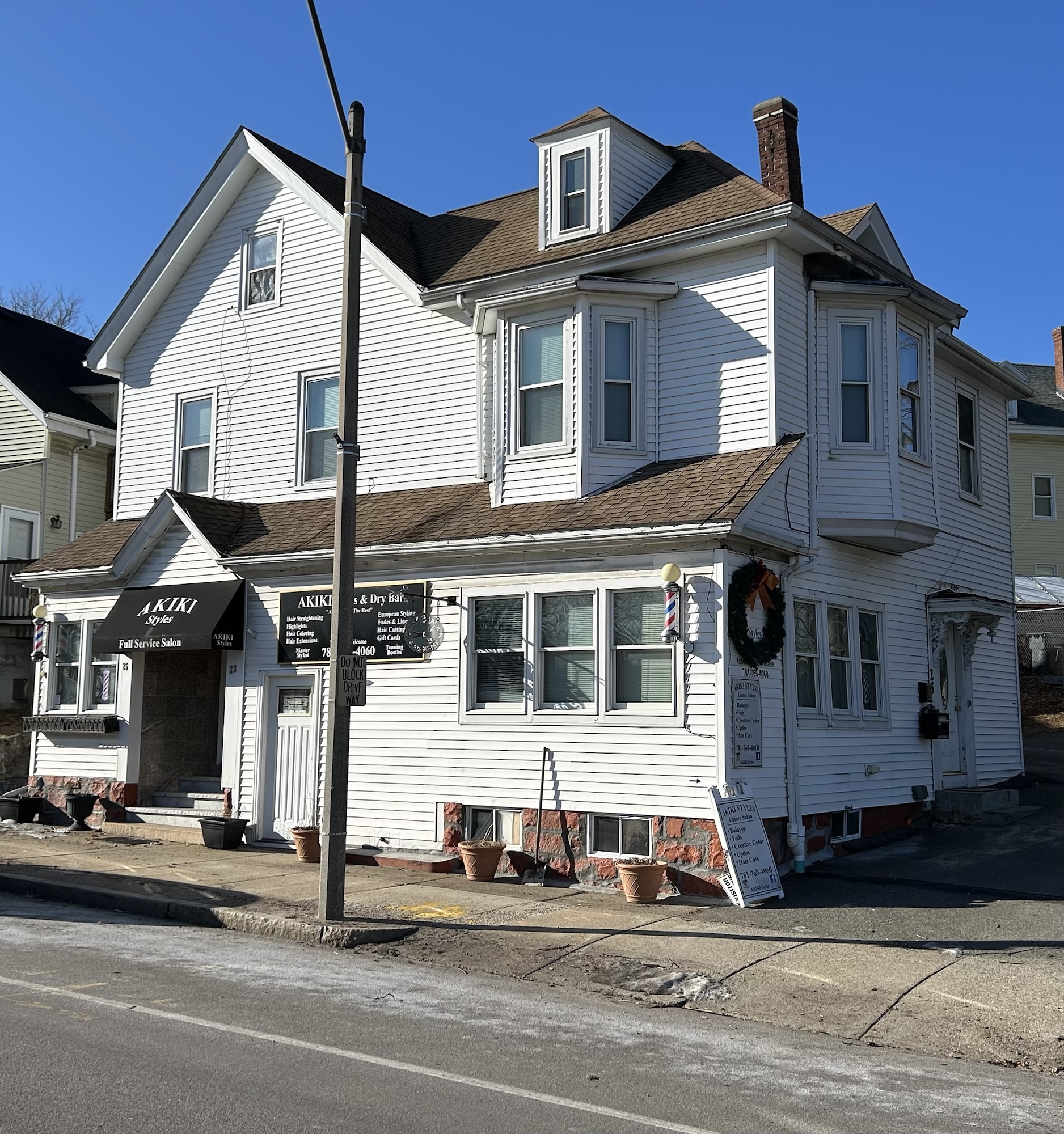
Today, the building houses Akiki’s Styles and Dry Bar, continuing a tradition of business at this location for almost 150 years!
Come to the Dedham Museum and Archive and see the M. Guber sign that sparked this deep dive down the rabbit hole of East Dedham history. If you look closely, you will see faint traces of the original lettering for Arcanum Hall! All historic photos courtesy of the Dedham Museum and Archive.
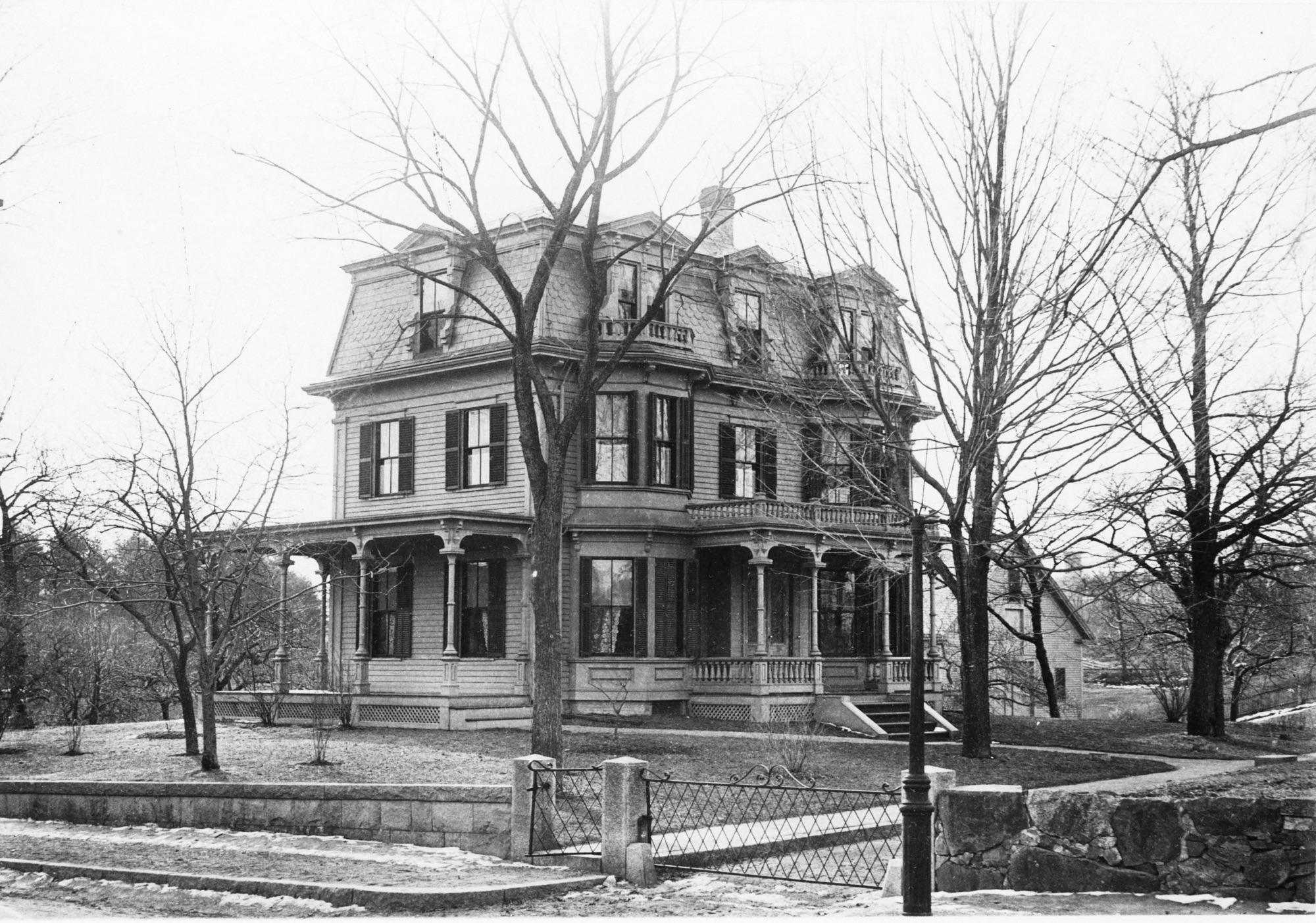
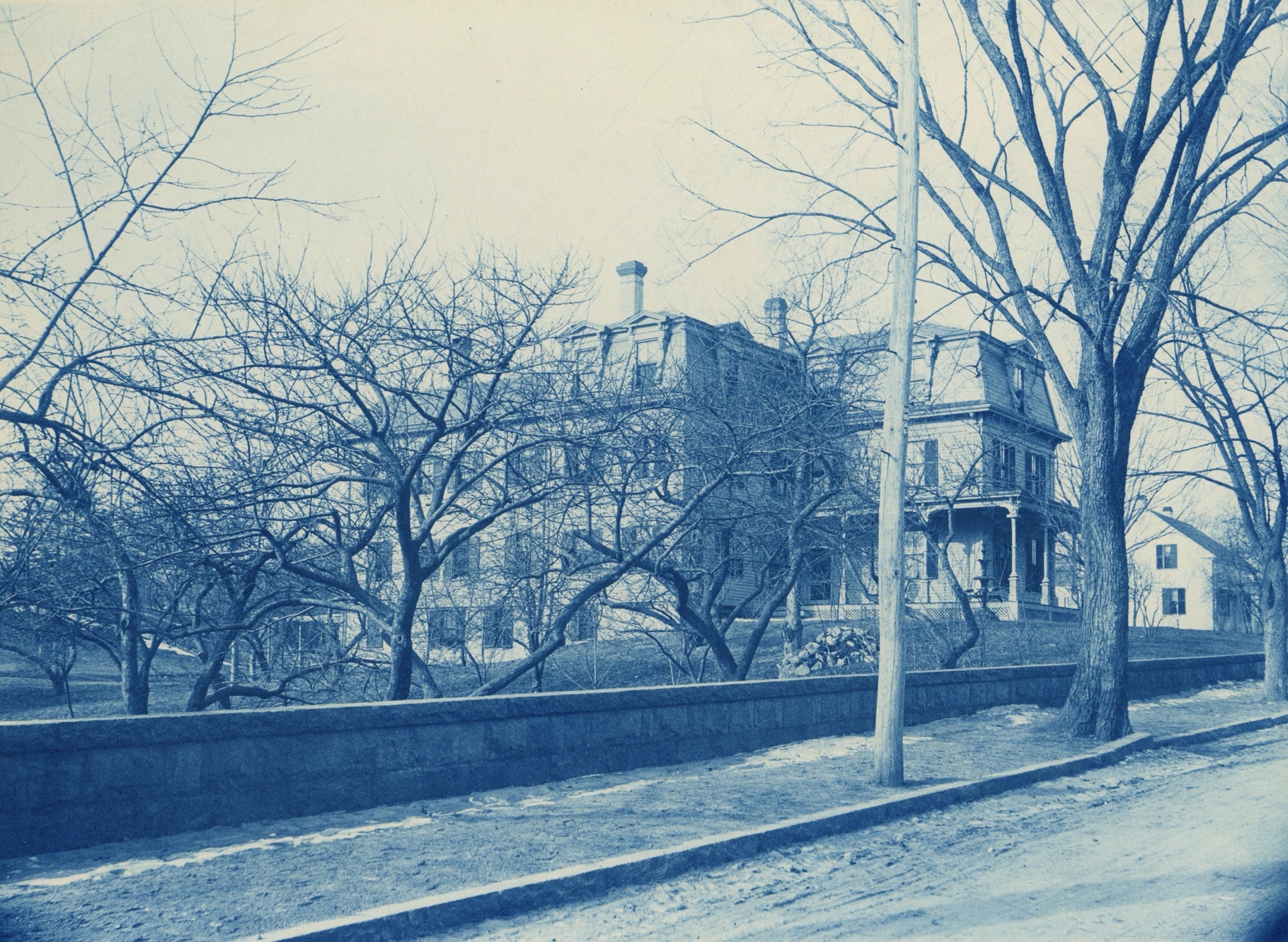
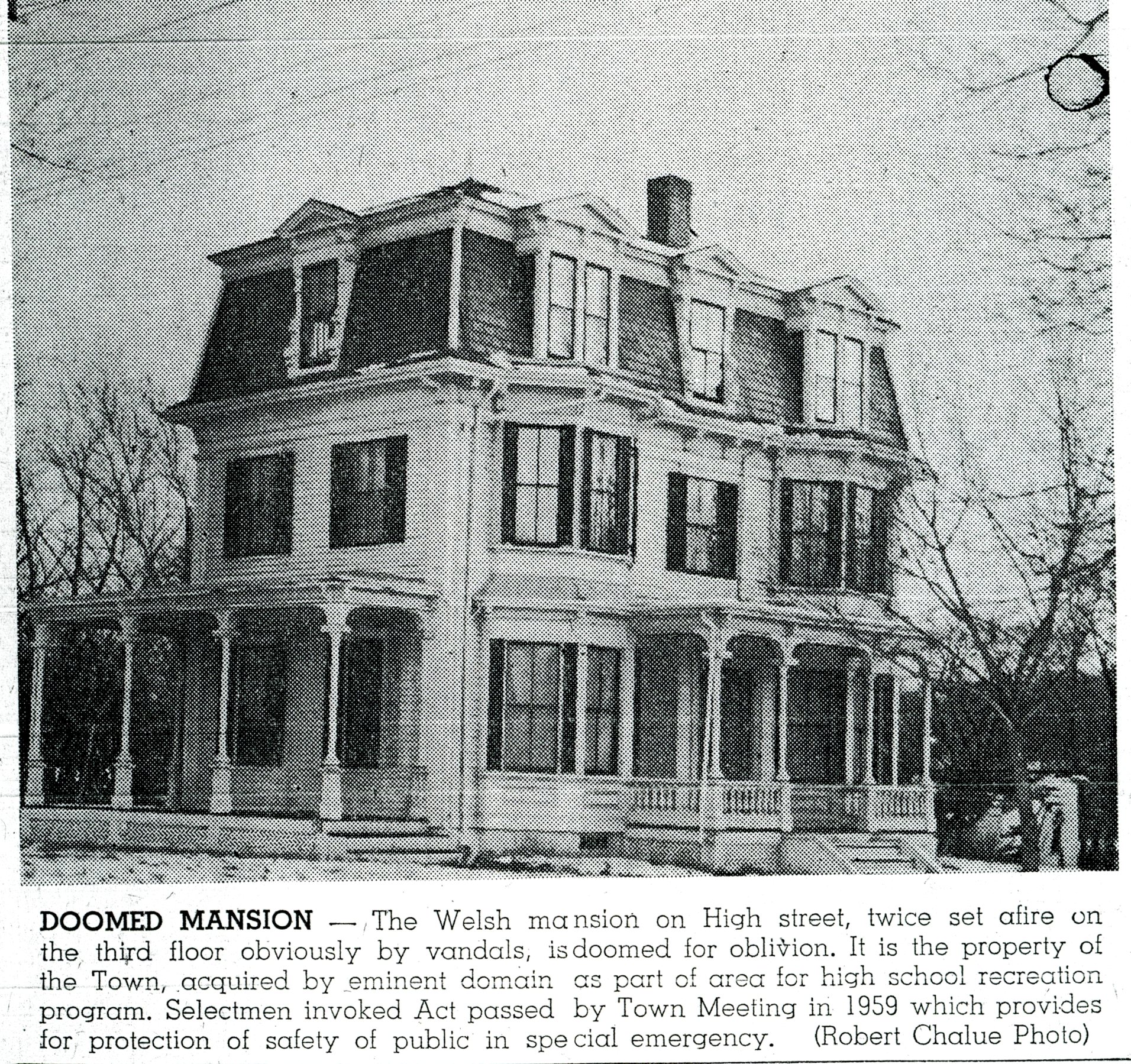
This is the third lost Dedham house featured in my Stone Secrets series, and, it is the only one that was still standing during my lifetime. Although I was only six years old when it was torn down, I do have a memory of it, perhaps because of its resemblance to the Addams Family house from a favorite TV show of the time. The Storrs/Welch house, constructed by local contractor Otis Withington c. 1870, stood south of High Street and east of Mt. Vernon, diagonally across from the Thomas Barrows estate (St. Mary’s parking lot) featured in the last Stone Series post. The large house with its Mansard roof, pedimented windows and decorative porch features is a good example of the Second Empire style, popular in the mid-to-late nineteenth century. The first occupants of the house were Royal Otis (R.O.) Storrs, his wife Lora, and three children.
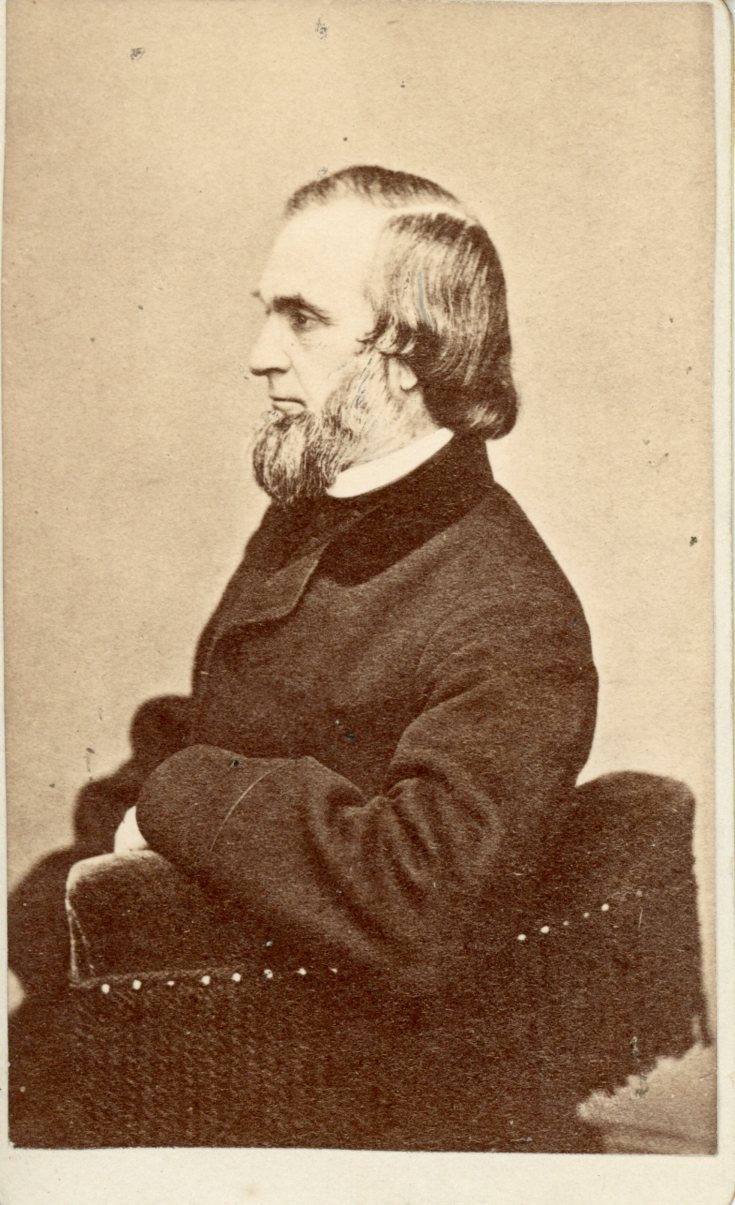
Royal Otis (R.O.) Storrs
A Connecticut native (his younger brothers Charles and Augustus founded the University of Connecticut), Royal Storrs came to Dedham in 1868 and leased the Merchant’s Woolen Mill on Mother Brook, before purchasing the Stone Mill on Milton Street, which he ran with his son Frederick. Storrs quickly immersed himself in Dedham town affairs, serving on the school committee, select board, and library committee, among many other boards and committees. Financial misdeeds, however, resulted in Storrs running up a half million dollar debt to his creditors, forcing him in 1882 to declare bankruptcy and sell the mill. He died on May 25, 1888 at the age of 73, and a few years later his widow put the estate up for sale.
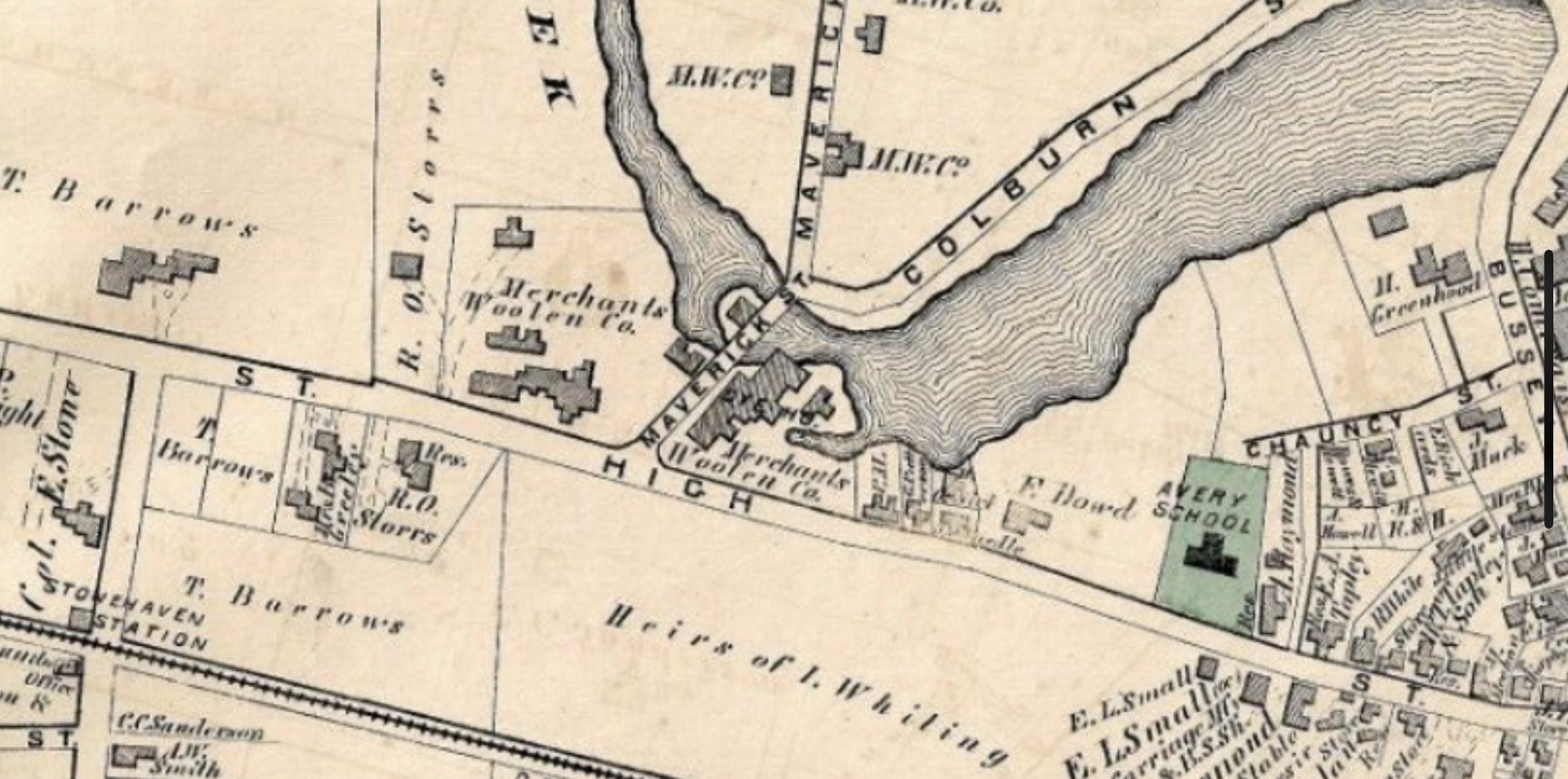
The Storrs property as seen on an 1876 map. Interestingly, Storrs lived across the street from Thomas Barrows, a previous owner of the Stone Milland the subject of the previous Stone Secrets post.
The property was purchased in 1892 by Boston contractor Stephen Tarbell, who only resided there a short time before passing away on January 18, 1894 at the age of 69.
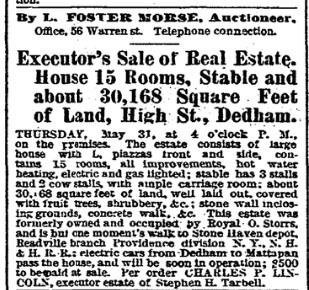
Boston Herald, May 27, 1894- the house has grown to 15 rooms after a large addition was built on the back
The next owners, David and Isabel Greenhood, also occupied the home for a short time, before it was sold to wool merchant James H. Welch.
Welch was an Irish immigrant working as the wool broker for the Merchant’s Woolen Mills. He and his wife Ellen moved into the large house with their six children and Irish servant in 1897. Welch died in 1909, but for the next five decades the house would be occupied by several of his children and their families. As the twentieth century rolled on, the Welch family witnessed the changes that modernization brought to Dedham and the country. Neighborhoods grew where farms once stood, railroads were replaced by paved roads and highways, obsolete buildings replaced by up-to date ones.
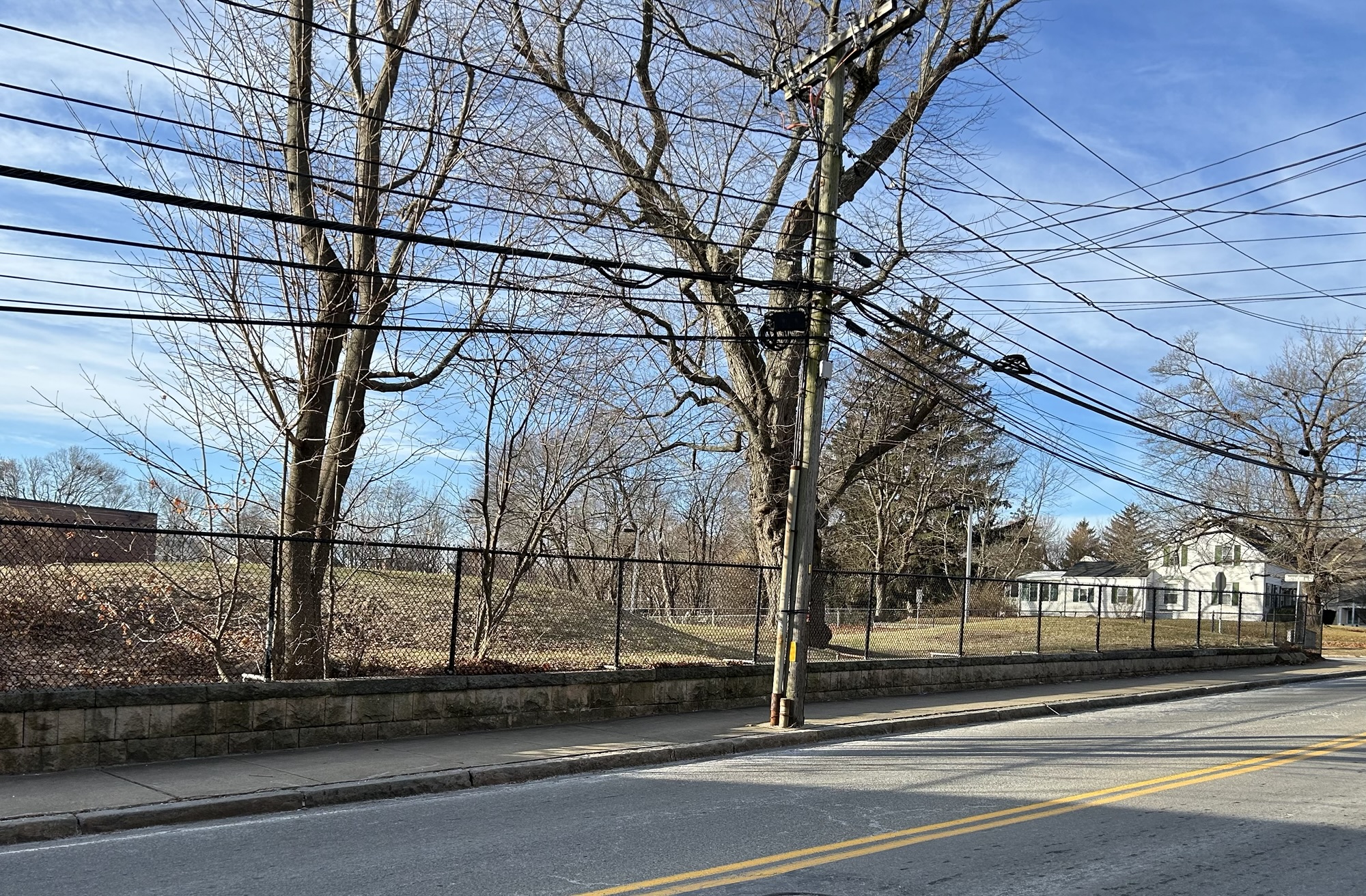
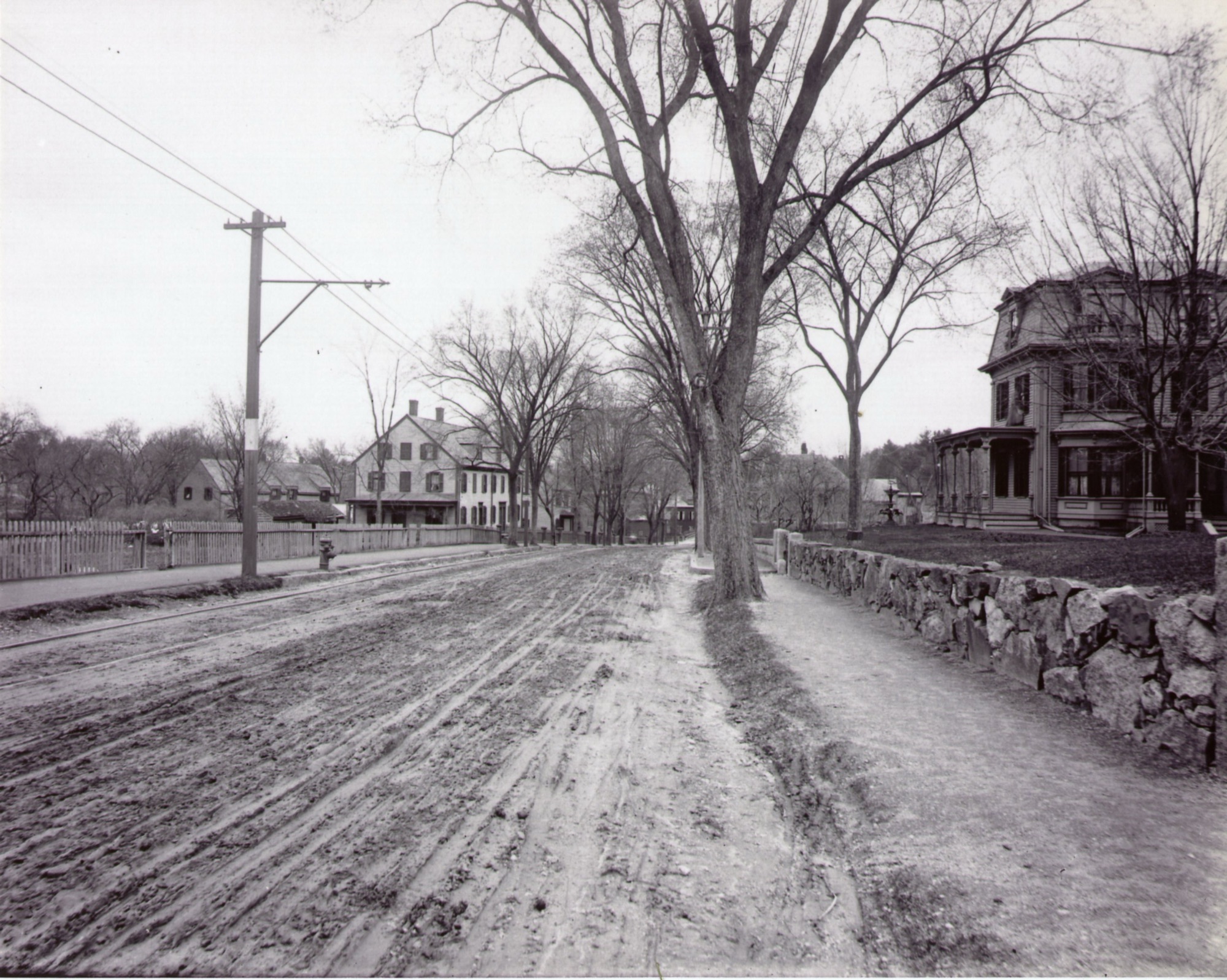
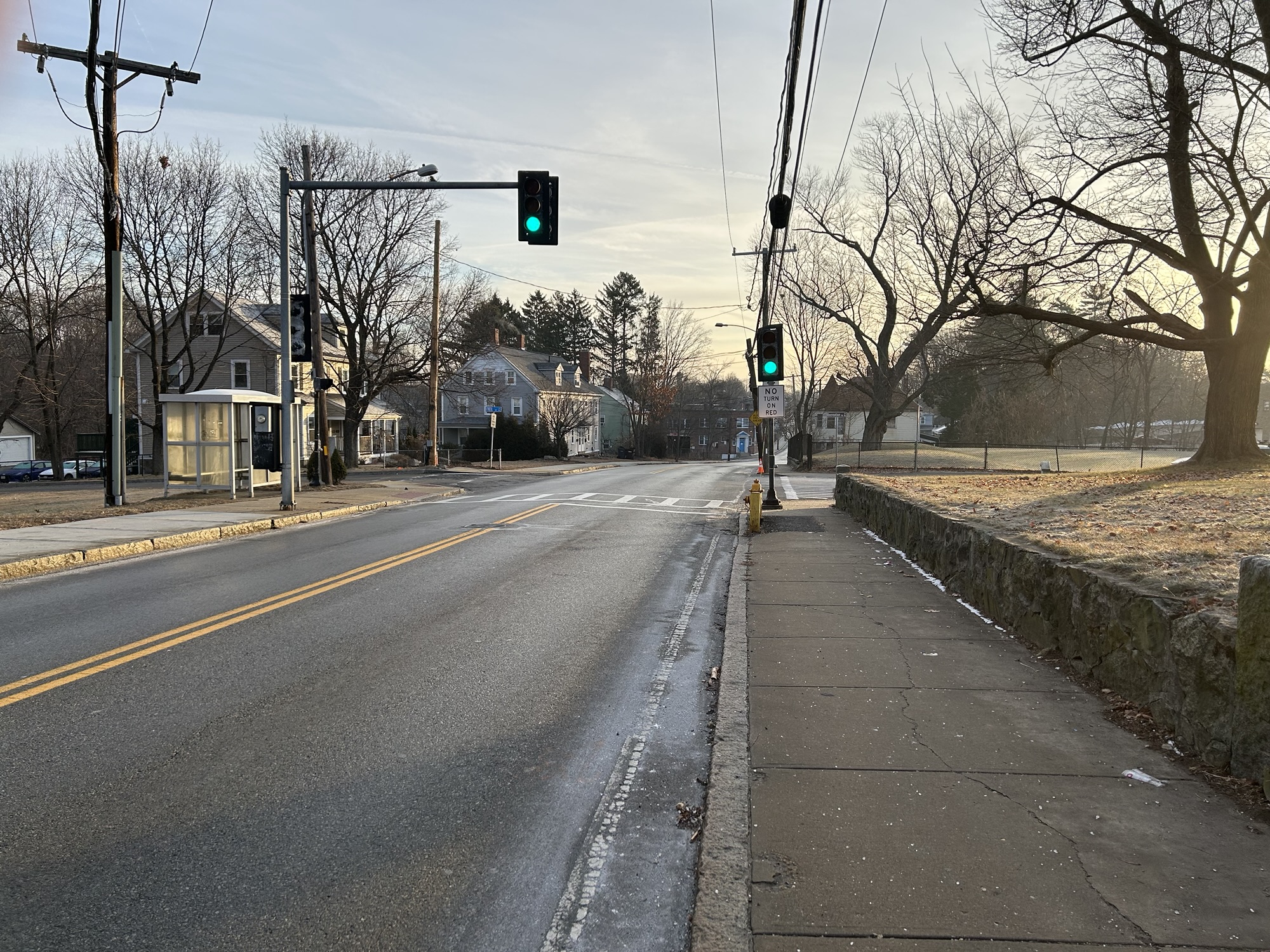
A view down High Street in 1895 and in 2025. The large building with dormers on the north side of High Street, visible in both images, served as housing for employees of the woolen mills.
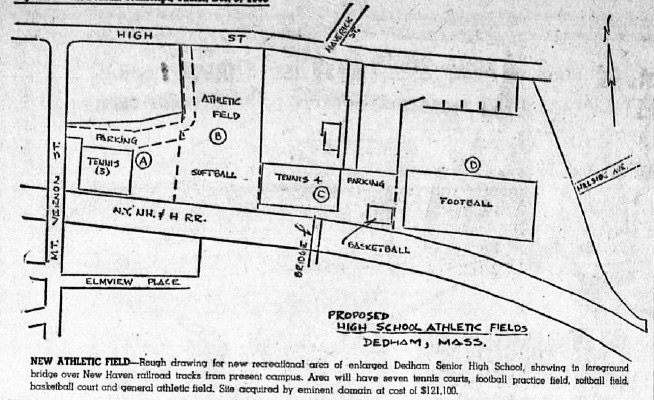
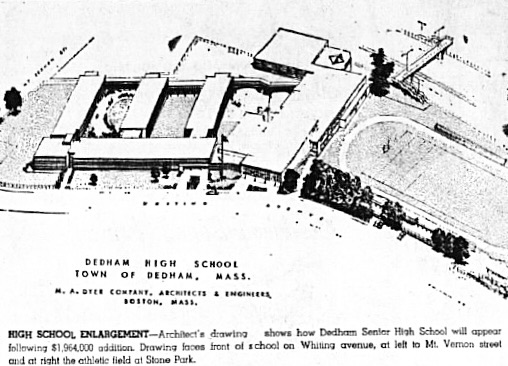
One of those buildings was the high school on Bryant Ave, which the Welch children had all attended. That school was replaced in 1915 by a large four story brick building on Whiting Ave., which, in turn was replaced by the current high school complex in 1959. Despite the sprawling size of the new facility, and its two million dollar price tag, town officials were aware before the doors even opened that it was not adequate for the growing student population. In early 1965, the town approved an addition that would include twenty-eight new classrooms, a small gym, practice athletic fields and tennis courts. Situated on the other side of the New Haven Railroad tracks, it would seem as if the Welch home was safe from the proposed expansion, but the architect’s plans included the construction of a pedestrian bridge, making the land along High Street the perfect location for the fields and tennis courts. In August, the town voted to take by eminent domain several properties on Elmview Place and High street, including the Welch property.
From the Transcript December 9. 1965. The Welch House stood on Site B where a new athletic field would be built. The driveway would become Recreation Road.The addition would also include a new wing of classrooms facing Mt. Vernon Street.
The house was unoccupied at the time of the taking, and town officials were concerned about vandalism after a copper weathervane was stolen from the barn. The barn burned down in a suspicious fire the following summer, and by September the house had been razed and construction begun.
Transcript/January 6, 1966
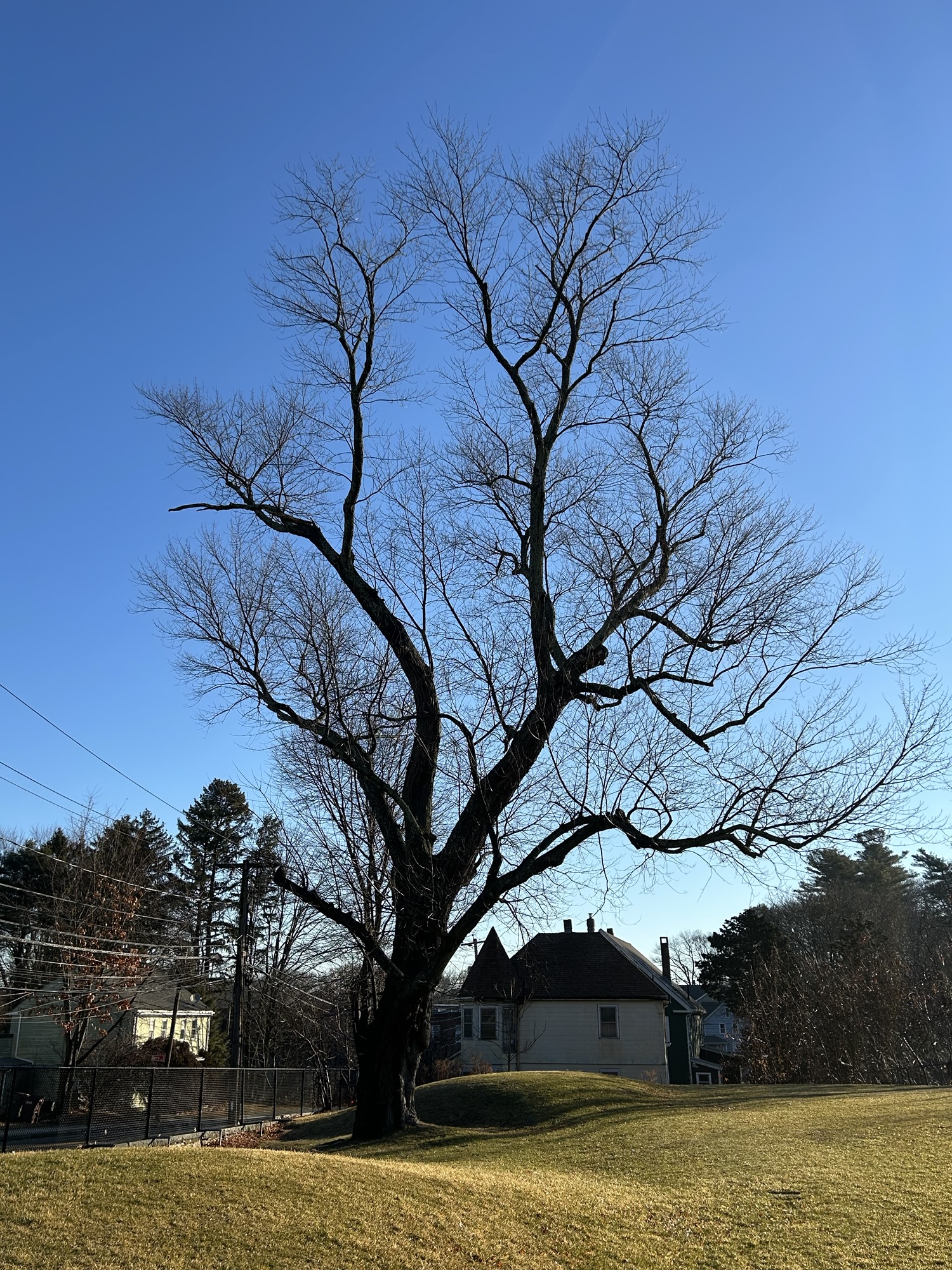
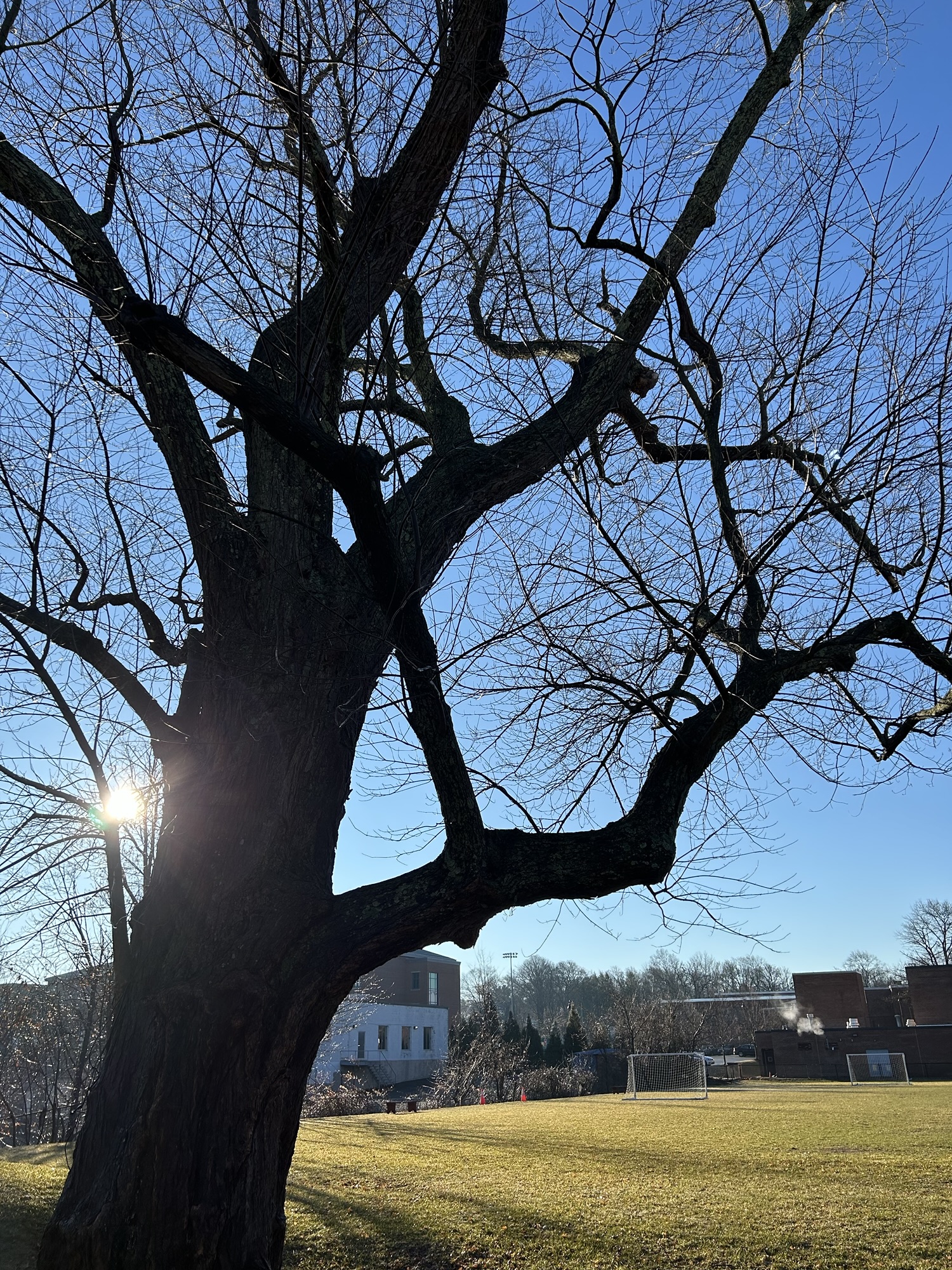
During negotiations with the town at the time of the taking, Mrs. Ella Welch, wife of youngest Welch son William, petitioned the town to save some of the “beautiful shrubbery” and the “two fine spruce trees” on the property, but town officials denied her request. Amazingly, several gnarled oak trees along High Street were spared, and today, along with the stone wall, are the only reminders of a once majestic house and the families who lived and died there.
All historic images courtesy of the Dedham Museum and Archive. 19th century photos of the house were taken by Jonathan F. Guild, a well-known photographer who had a studio in Dedham Square for many years.
I am James L. Parr. I grew up on Tower St. and went to St. Mary's and Dedham High (Class of 1977). I teach school in Framingham and co-wrote a book of Framingham history, which led me to write a book of weird Dedham history called Dedham: Historic and Heroic Tales from Shiretown. That book led to this blog. To order your own copy of the book, e-mail me at jameslparr@yahoo.com





 Jim Parr
