Author Archive

75 Years Ago: The Dedham Drive-in Opens: Part 1

August 11, 2023

It’s the summer of 1948. Athletes from around the world are gathering in London for the first Olympics in 12 years. In the White House, Harry Truman is gearing up for a presidential run in the fall. The Boston Braves are a few months away from their first National League pennant, (and just a few years away from abandoning the city for Milwaukee). Here in Dedham kids are beating the heat at Mother Brook, East Dedham’s Mill Pond, Cox’s Cove on the Charles or down the river at the new day camp at Noble and Greenough School (still going strong after 76 summers!). Midget auto racing is featured at Norwood Arena which just opened on Rte. 1. You can get a new Motorola television set for $49.95 at Henry’s Radio and Electronics (but you’ll only have programming from WBZ-TV, which commenced broadcasting in early June). Movies and quiz contests are being offered at the 21-year-old Community Theater in the square, and, starting on August 11, movie fans will have a second option for viewing as the Dedham Drive-in opens just off the Providence Pike.

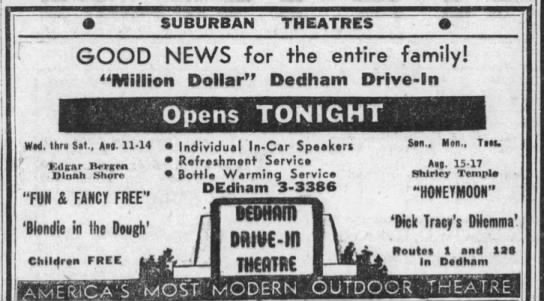
Hundreds of cars are lined up along Elm St as selectmen and local business leaders gather with owner and operator Michael Redstone to cut the ceremonial length of movie film stretched across the drive-in’s entrance. Tonight, a double feature of Disney’s Fun and Fancy Free along with the comedy Blondie in the Dough are shown on the “million dollar” drive-in’s 60′ x 42′ screen.

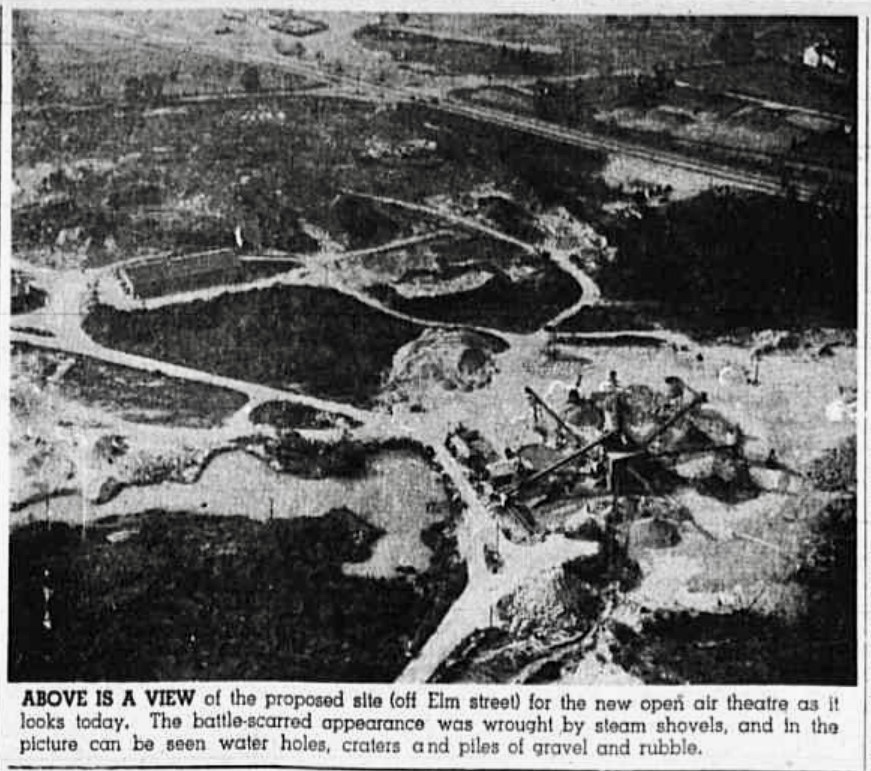
In the fall of 1947, the Board of Selectmen granted Michael Redstone a permit to build an “open air theatre” on 23 acres of land that had at one time been the site of Farquhar’s Nursery, but in recent years had become an eyesore, after gravel and loam was repeatedly removed, creating an unattractive and unsafe moonscape. Redstone, a Boston native, had been successfully operating an outdoor theater on Long Island for ten years, and the Dedham location would be an exact copy.

The drive-in concept was introduced to the world in Camden, New Jersey in 1933 by entrepreneur Richard Hollingshead. Since then, some 800 theaters had been built across the country with the first Massachusetts location opening in Weymouth in 1936. Dedham was about the 20th drive-in theater to be built in the state.

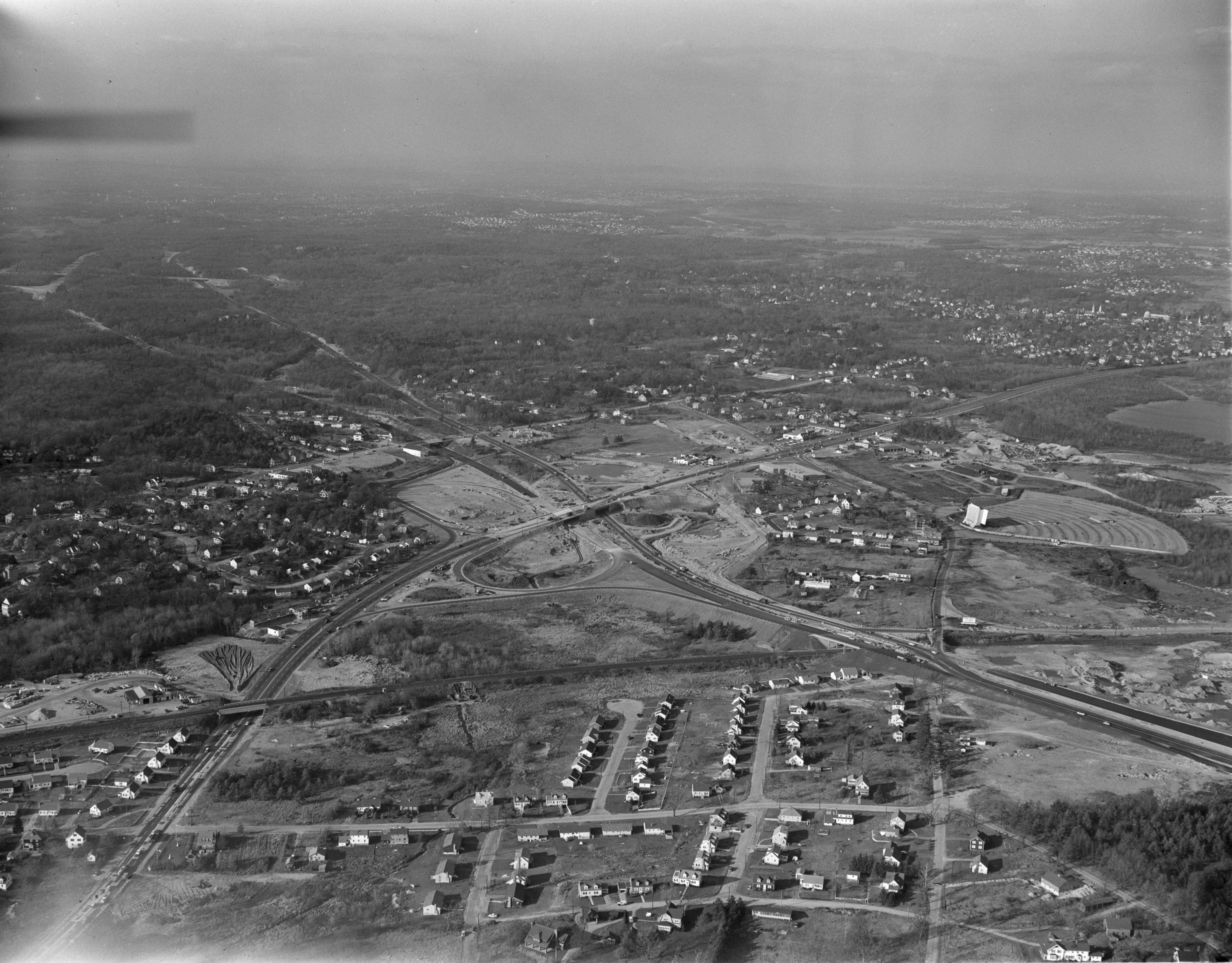
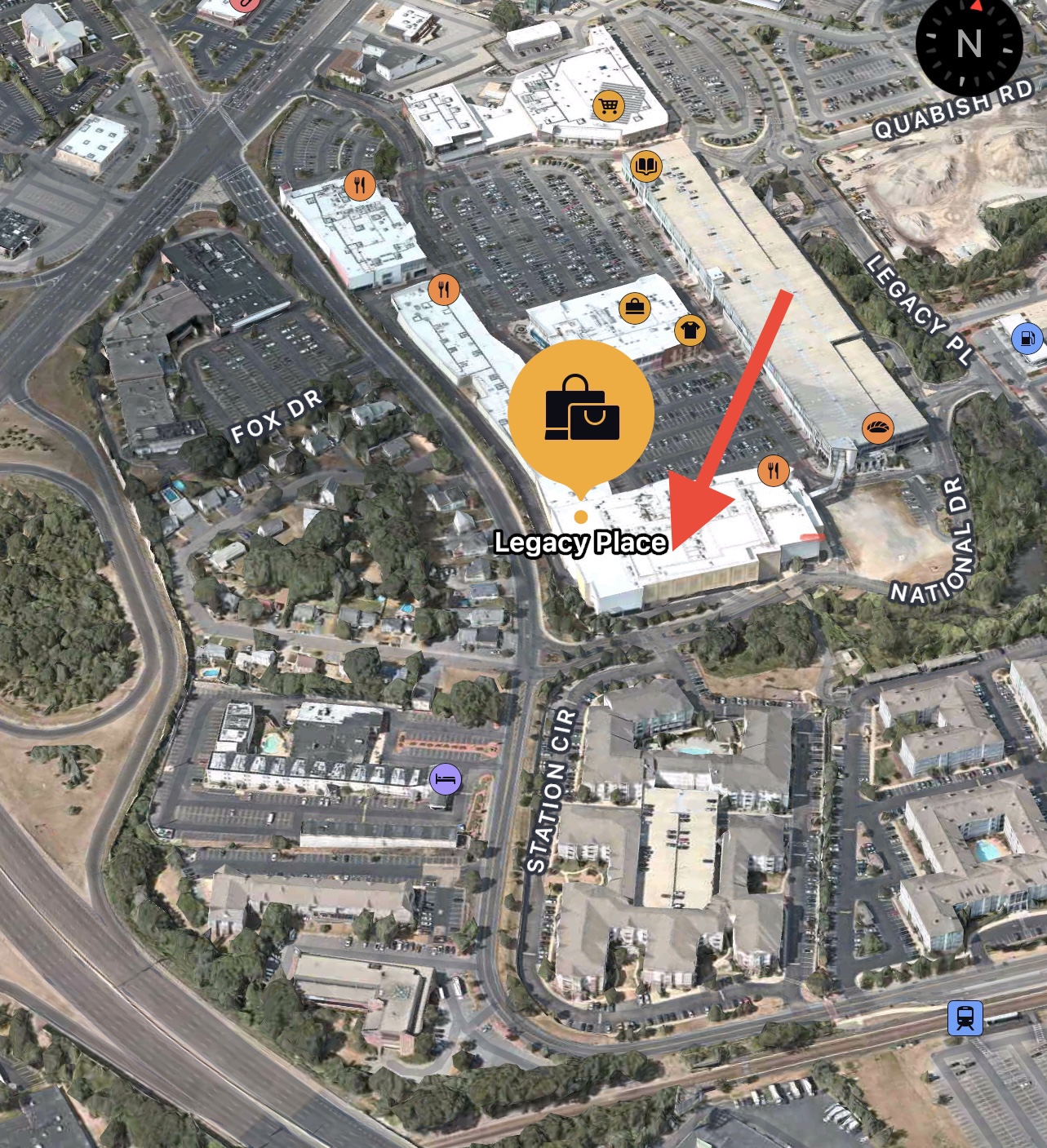
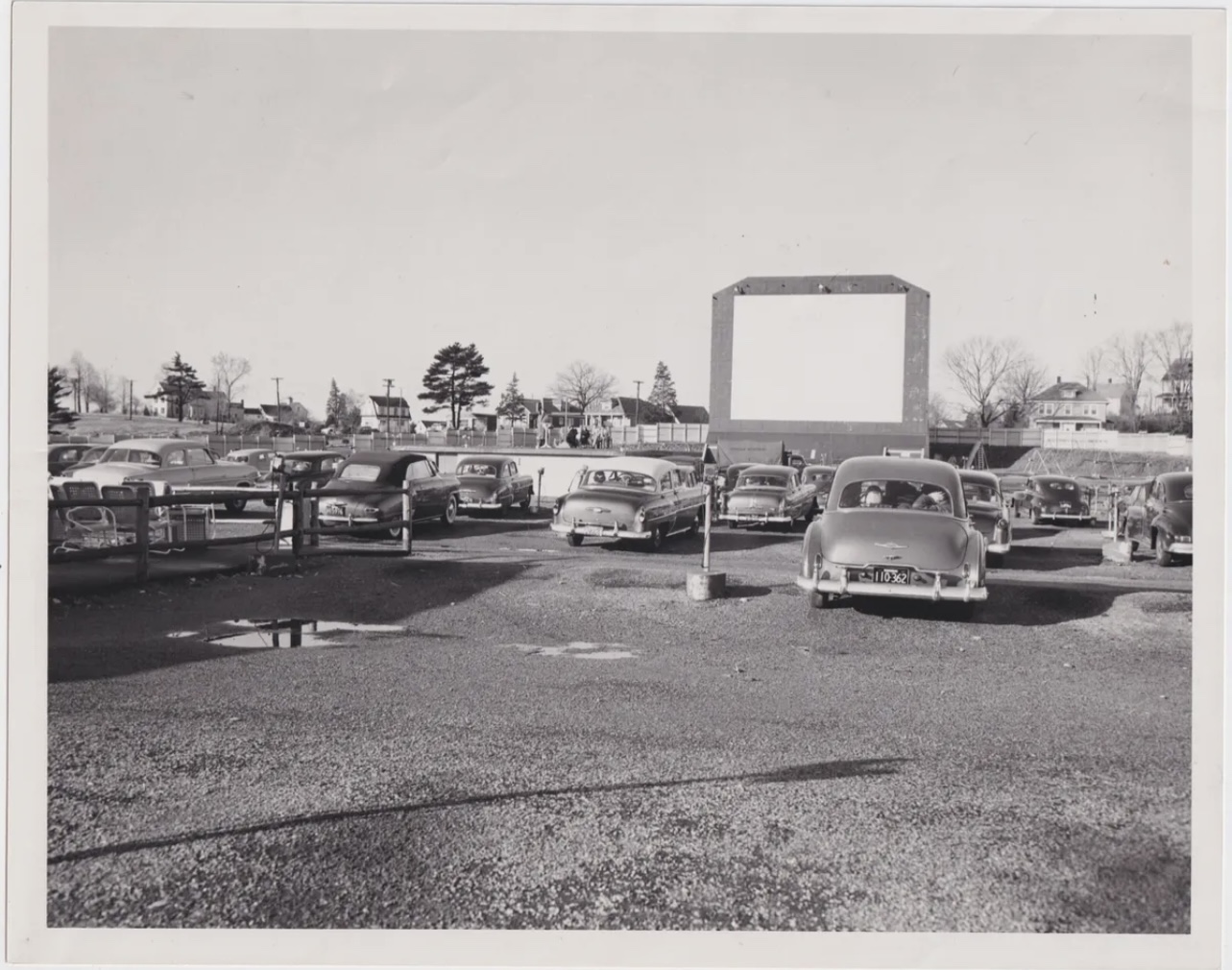
The Drive-in, as seen in this mid-fifties view, was located on Elm Street, the screen standing in nearly the exact same location where the Showcase Cinema de Luxe at Legacy Place now stands.

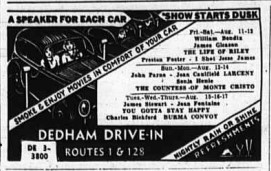
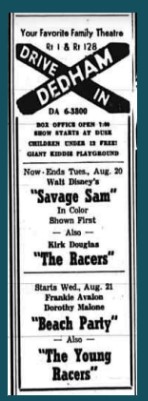
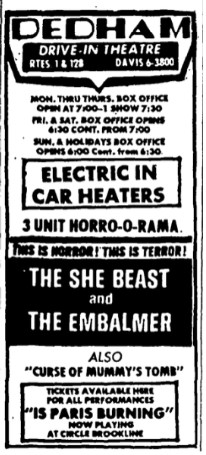
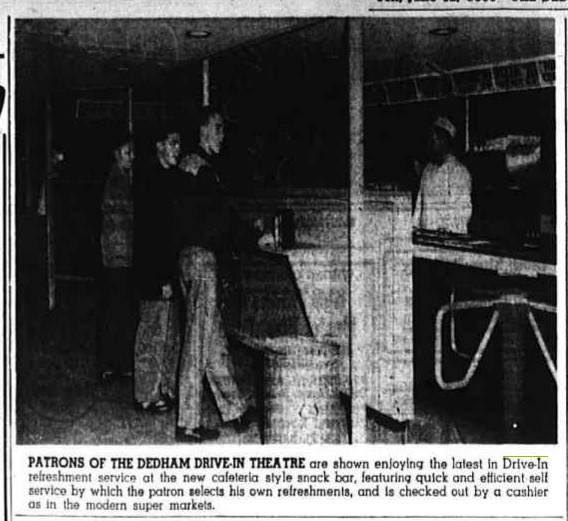
Initially, the drive-in was marketed as a family-friendly place you could take the kids in their pajamas to watch a movie, eat a meal, play on the playground, and enjoy a smoke. Over time, first run movies were replaced by “B” movies that were popular with teens, who probably didn’t really care what movie was playing. Throughout its history, Dedham offered a mix of wholesome entertainment and schlocky horror/beach flicks, as evidenced by the ads below:

1950
1963
January 1967- there were some years that the drive-in was open year-round!

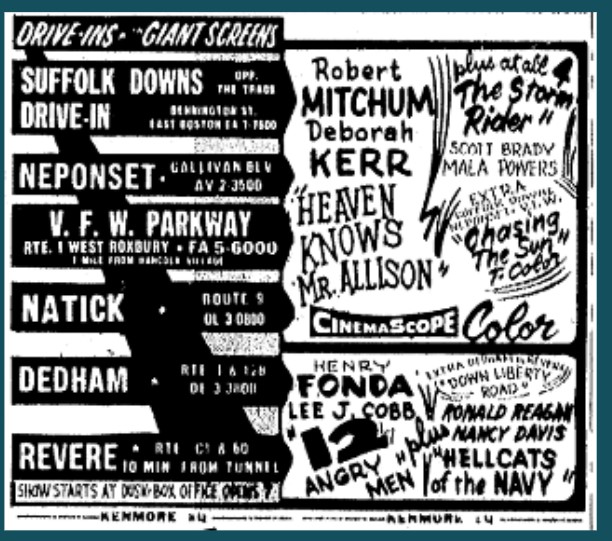
The Dedham Drive-in was the first theater in Redstone’s Massachusetts Drive-in empire. The Revere location opened 2 weeks later, followed by Neponset Circle, VFW in West Roxbury, Suffolk Downs, and Natick (a joint venture with another company). Redstone’s sons Edward and Sumner eventually took over management of the company, and Sumner Redstone transformed it from a regional theater operation to a multi-billion-dollar company when he purchased Viacom, Inc. (CBS, Paramount, Nickelodeon, MTV) in the 1980s. Today National Amusements is headquartered in Norwood and operates about 1,500 theaters across the US and Canada. Sumner Redstone passed away on this date in 2020 at the age of 97 leaving an estimated $2.6 billion estate.

The Redstone Drive-in Empire in 1957

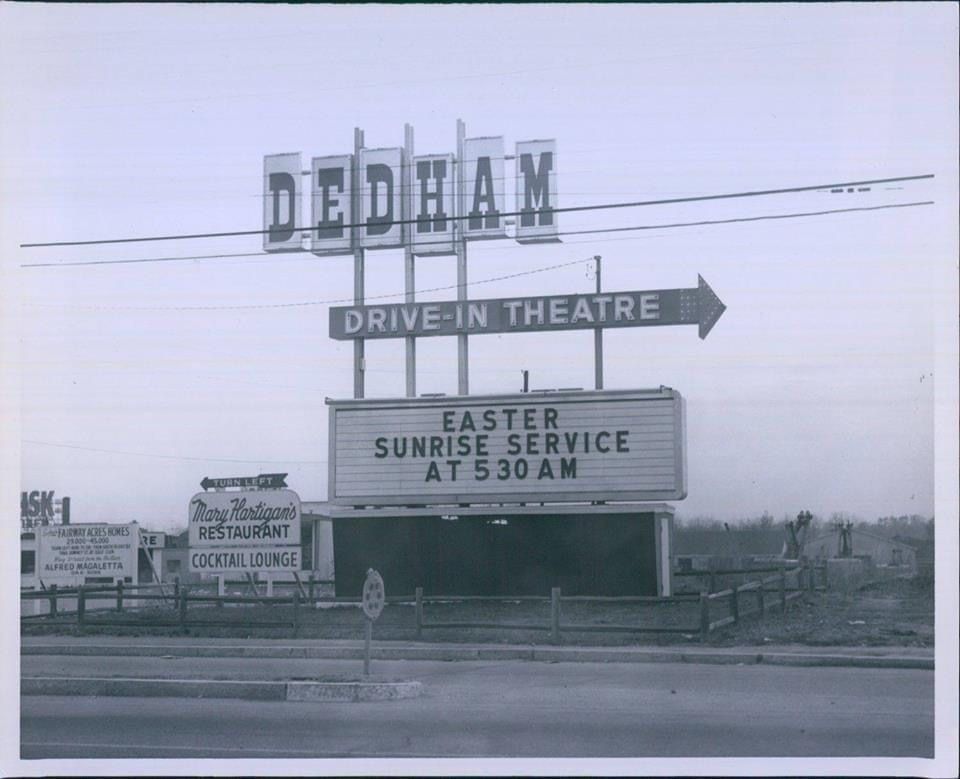
One of the traditions at the theater was the annual sunrise Easter service, which began in 1954. The first service was sponsored by the United Christian Youth Movement with 500 in attendance. St. Luke’s Church on East St. began hosting the services in 1961 and continued to do so through at least 1977.

Easter Sunday, April 18, 1954. Note the large cross to the left of the screen on the roof of the projection booth. The screen was enlarged at some time before the fall of 1955. Photo by Frank Van Pelt/Parkway Photo Service

The drive-in was in operation until about 1979; although some sources state it closed in 1982. The Showcase Cinema 1-3 (a Redstone operation) opened next door in 1973. In part 2 of this tale, I will share the one and only time I went to the Dedham drive-in, as well as the controversy that nearly cost the theater its license in 1970. Here are a few more images. Please feel free to share your stories in the comments section!

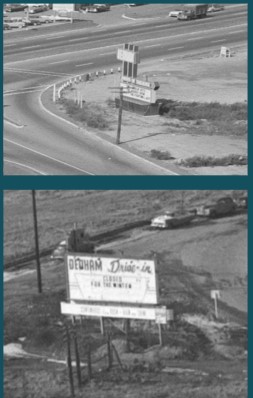
Mid-fifties signs at Rte 1 and Elm Street (top) and Elm St facing 128 (bottom)

Circle the Wagons! (Repost from 2010)

July 2, 2023


Transcript, 1963

I’m pretty sure that Dedham is the only town in the U.S. with a town ordinance that reads like this:

“No person shall set fire to or burn, or cause to be moved through any way or street of the Town, any waste material, paper, wood or any inflammable substance on any wagon, cart, buggy, push–cart or on any vehicle, with the intention of setting fire to or burning same on any way or street of the Town.”

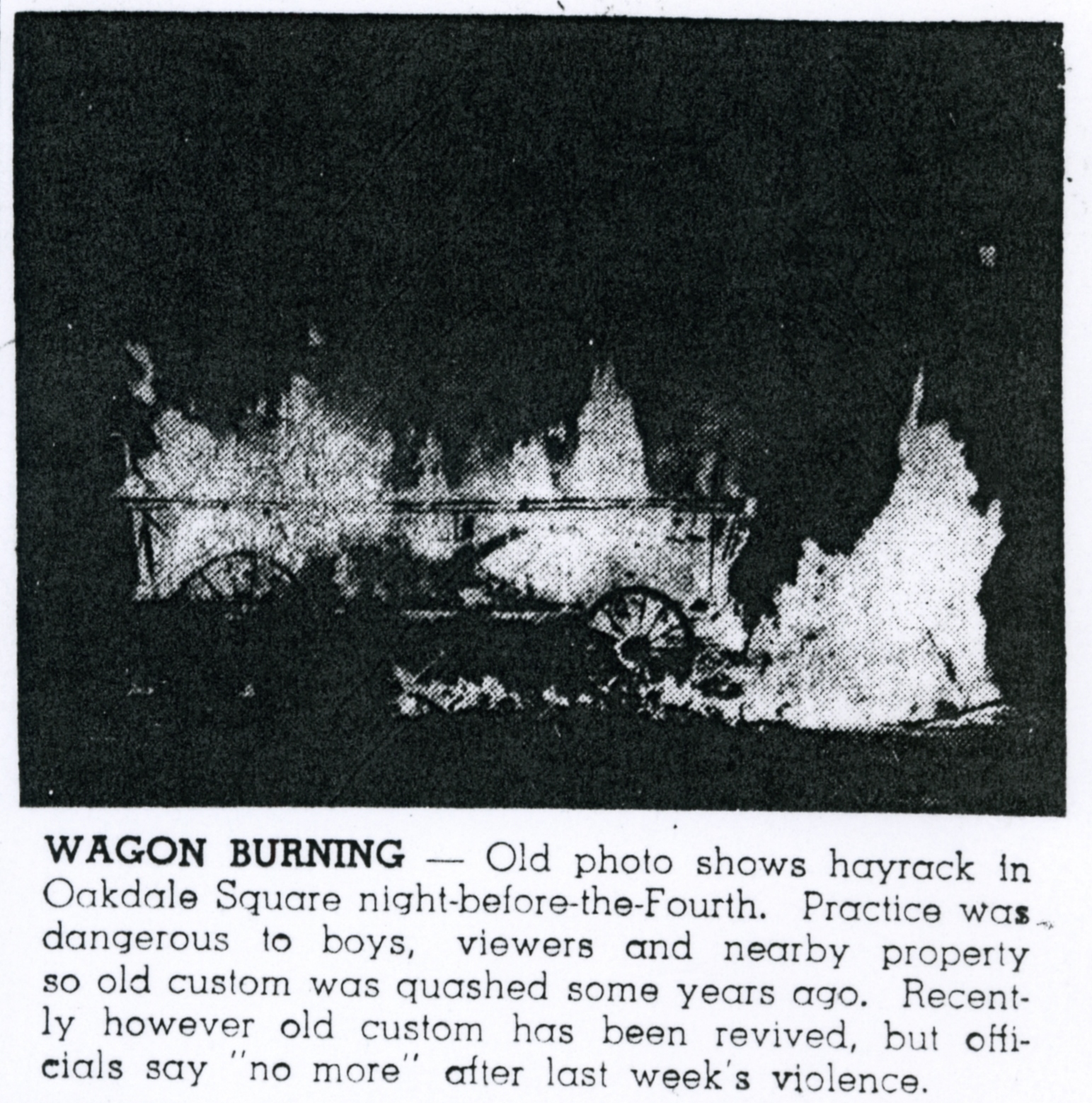
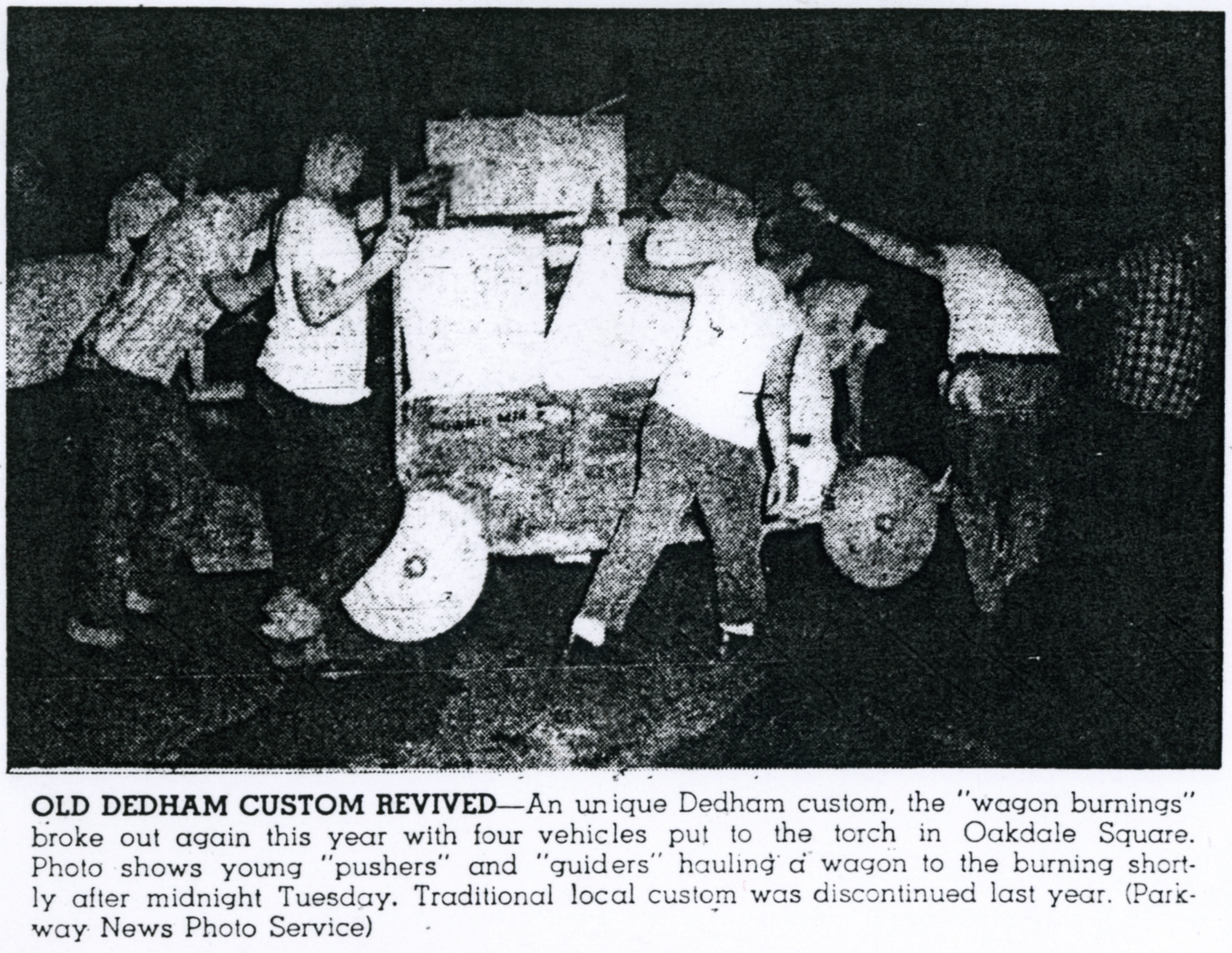
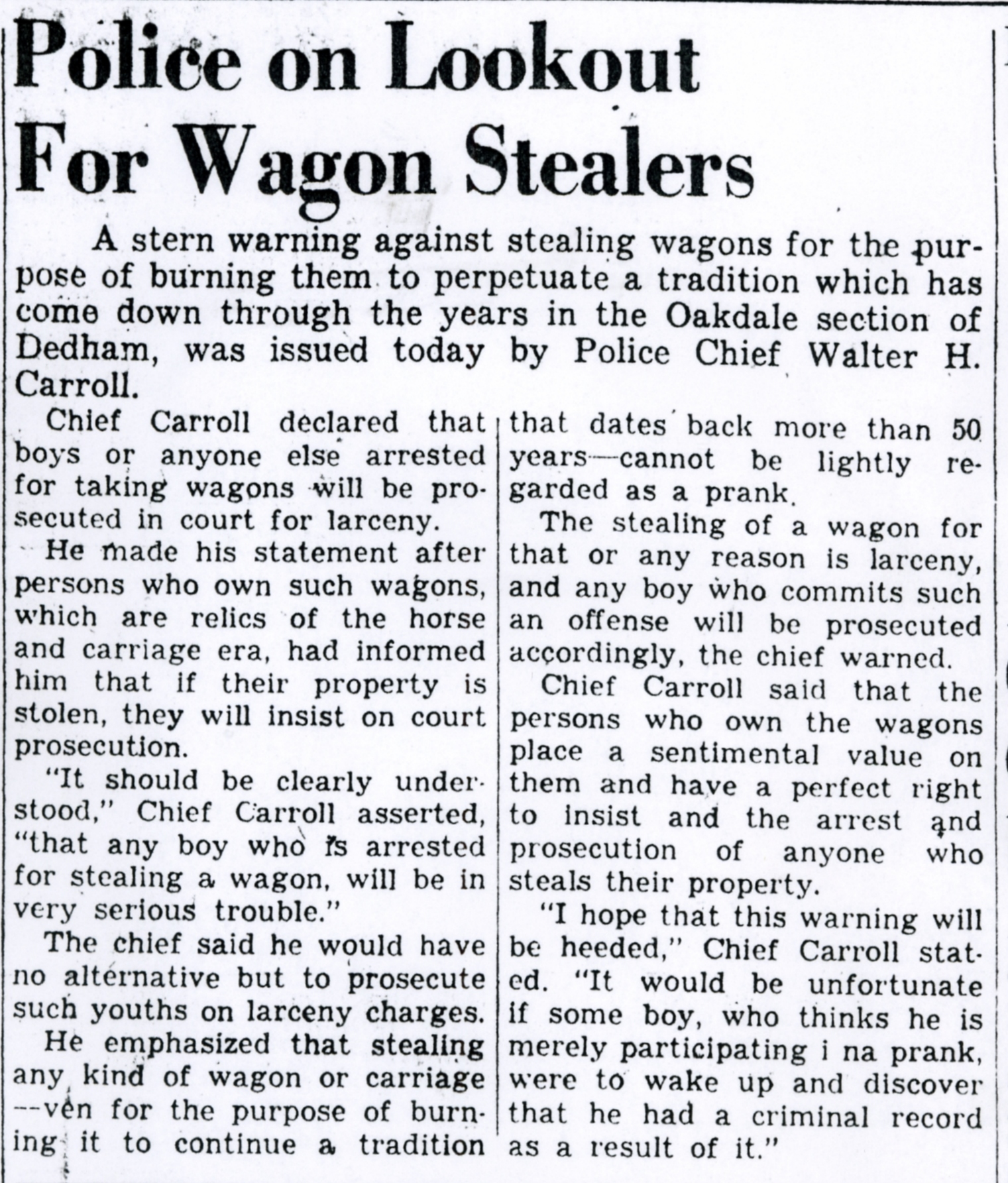
The bylaw was adopted in 1959 in response to the resurrection of a dangerous, unique, and beloved Dedham tradition- the burning of old farm wagons in Oakdale Square on either “the night before” of July 3rd, or the night of the 4th itself. Beginning some time in the early 20th century (my research found the oldest recorded reference to be 1922) thousands of people would gather in the square to witness the event. In the 20’s and 30’s, police and fire officials merely watched and made sure nobody got hurt. The spectacle usually began at midnight when some brave youth would climb the roof of the Good Shepherd Church and ring the bell.

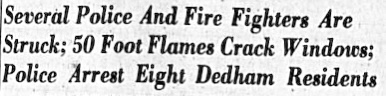
The wagons came from local farms in Dedham and surrounding towns. As authentic farm wagons became scarcer, teenagers would make their own and hide them in back yards and garages until the big night. In 1938, no wagons were found or made, so an old outhouse had to do. Usually the fires got so intense the windows of the stores in the square would crack and the tar underneath would melt. The last Oakdale Square burning was in 1963, when revellers threw rocks and full cans of beer at police and firefighters when they arrived on the scene. After that the burnings disappeared for a few years before the tradition was revived in the Manor. After an explosion and the melting a vinyl-sided house in 1990, police chief Dennis Teehan finally put an end to the burnings.

1963 was a pretty memorable 4th of July in Dedham. On the positive side, 40.000 people turned out for the annual parade which featured 20 bands and some 5,000 marchers. The town’s fireworks display was described as “the best ever.” However, the rowdy element put a damper on the festivities with their actions; hurling rocks and bottles at firemen, ignoring police directions, and tossing cherry bombs into the crowd, one of which landed on the parade float carrying Miss Massachusetts, who abandoned the float for the safety of a car for the remainder of the parade. Ah, the good old days.

I remember hearing about the wagon burnings when I was a kid, but I never witnessed one. After the publication of my Dedham book, the wagon burnings was the most popular topic brought up at book signings and talks.  Maybe you have some more tales to add to the collection? Pass them along and have a Glorious Fourth!


New England Telephone and Telegraph Building (Verizon)

June 24, 2023

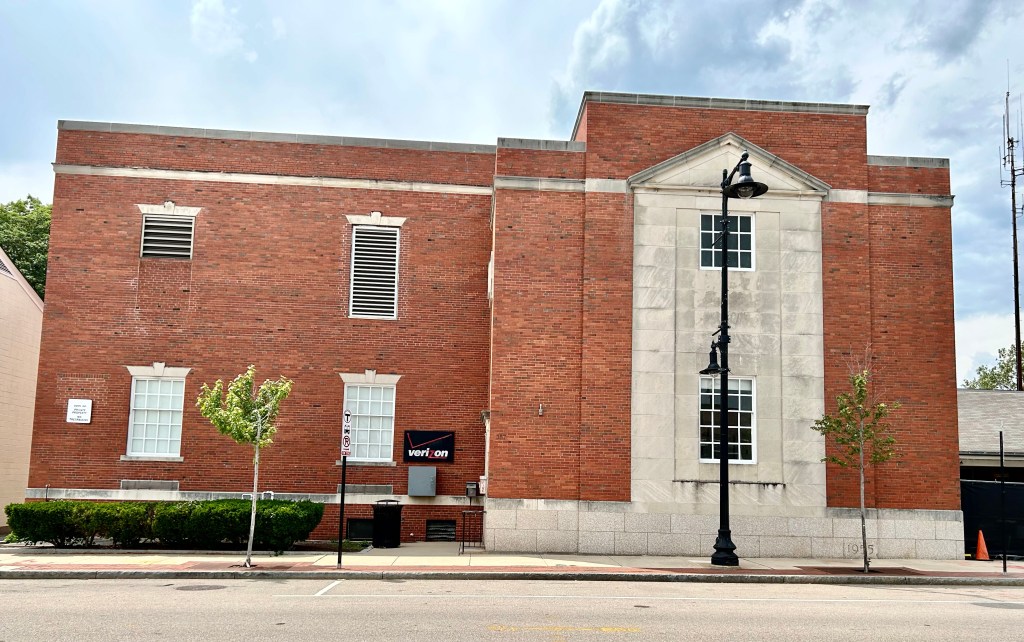
Brian Keaney correctly identified the Verizon building on Washington Street. I remember in 6th or 7th grade scrounging thin multi/colored wire from their trash so I could give it to the girls in my class to make rings out of. I bet most of us have never been inside this building. Here’s a little history:

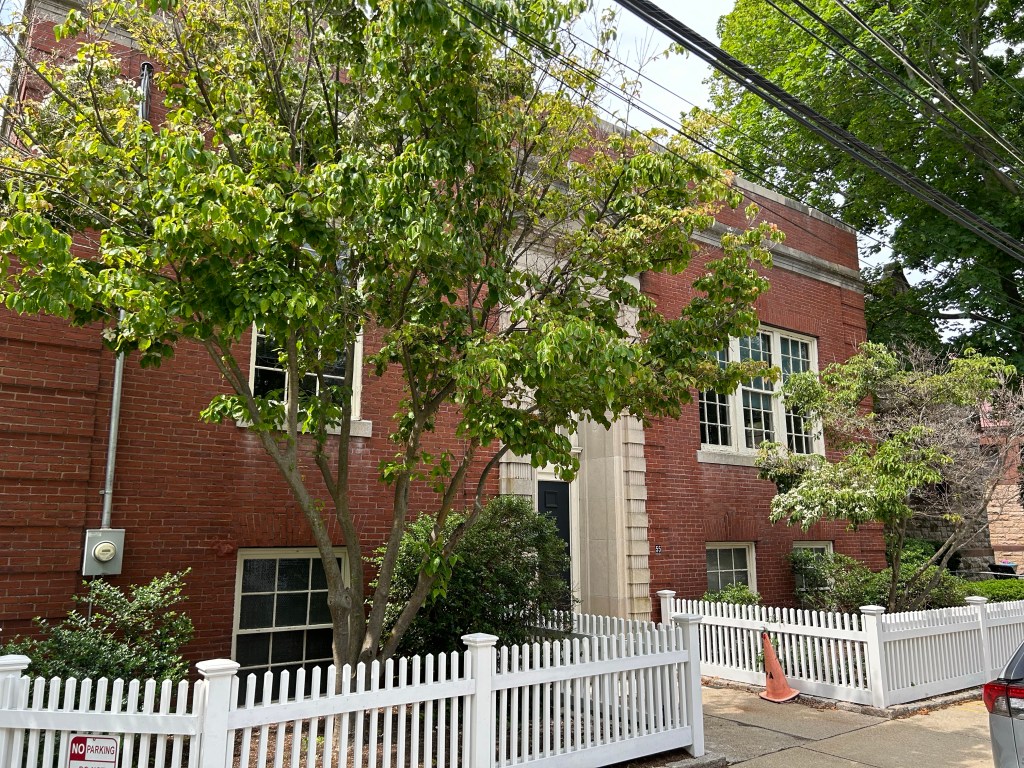
387 Washington Street. The cornerstone is visible on the right behind the tree.
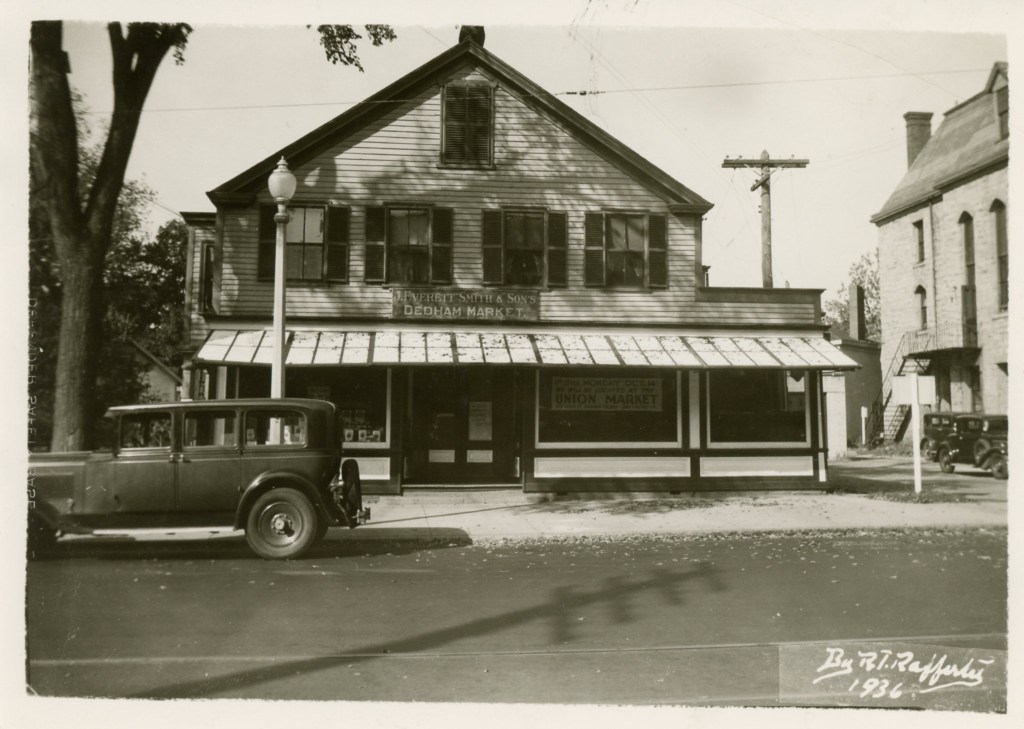
Smith Market on Washington Street, 1936.
Memorial Hall (future site of the new Town Green) is to the right
Image courtesy of the Dedham Museum and Archive

In July of 1954 the 88-year-old wooden J. Everett Smith Market building on Washington Street next to Memorial Hall was knocked down to make way for the New England Telephone and Telegraph Company’s new telephone exchange building. Construction began on the buildig in late 1955 and the cornerstone was laid on April 4, 1956. Inside the cornerstone a metal receptacle was placed which held “records and memoranda which describe fully and graphically the town of Dedham as it exists today” (Dedham Transcript)The gathered crowd included selectmen, telephone company officials, the town’s postmaster, police chief Walter Carroll, State Representative Francis Harding, Father William Kennedy of St. Mary’s Parish who delivered an invocation, and Reverend Leland Maxfield of the Westwood Baptist Church who delivered a benediction.

The old telephone exchange building on Church St, built around 1920.

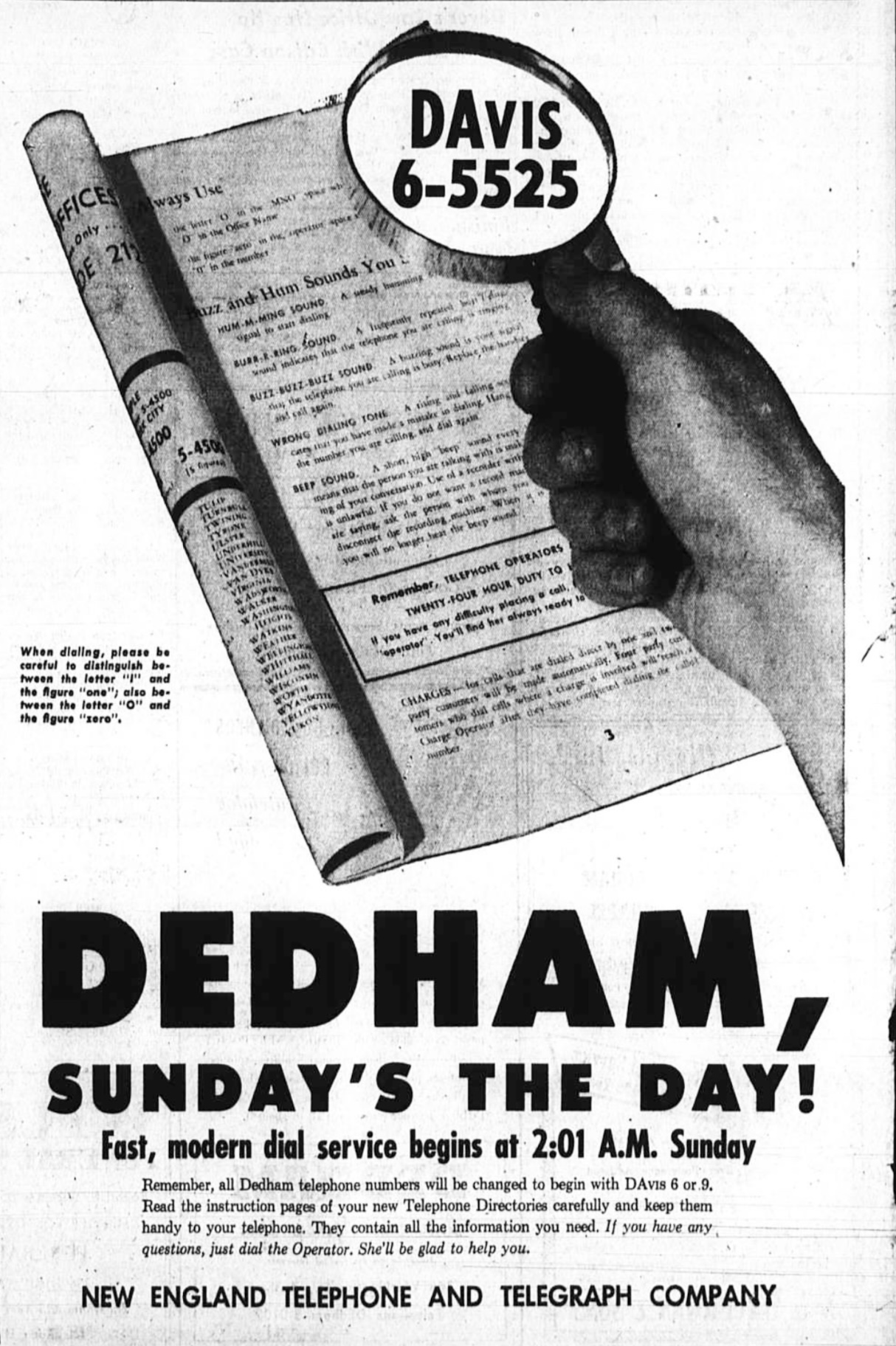
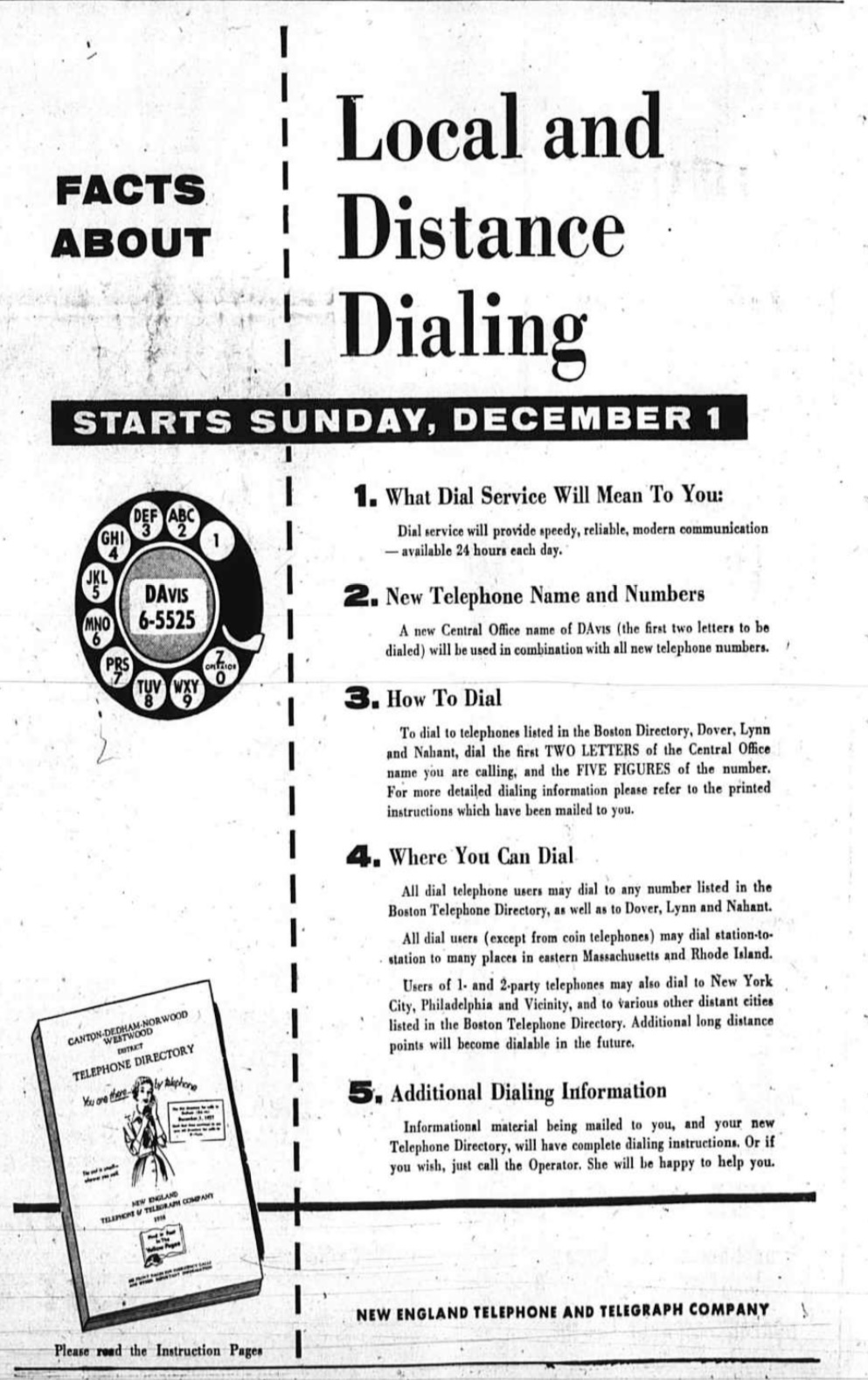
The construction of this building brought about a significant change for Dedham residents: the introduction of direct dialing. For years residents could only make operator assisted calls; the Dedham telephone exchange was DEdham 3. Calls were forwarded by operators at the telephone building on Church St. next to the library. Beginning at 2:01 AM on Sunday, December 1, 1957, customers could dial directly and had their numbers switched over to the new Dedham exchange of either DAvis 6 or DAvis 9. Ads began appearing in the Transcript in the fall informing customers of the change and instructing them how to use dial servce. The Avery School PTO even had a workshop for telephone users complete with an instructional film.

Workers had been busy since the beginning of the year, installing wires and cables, and attaching dial inserts to the older phones of customers. Residents also had the opportunity at this time to obtain a new phone in a variety of colors other than the usual black. The changeover to the new service caused the layoff of 176 operators who worked out of the Church St. building.

To commemorate this historic achievement, a long-distance call was made to Dedham, England. The call was placed by Dedham Historical Society president-emeritus Dr. Arthur Worthington from the society’s headquarters on High Street and included members of the society, telephone company executives, and Dedham Country Day 6th grader Sally Reed who got to speak with her English pen-pal. Also on-hand were Selectman Arthur Lee and Miss Margaret Dooley, who had been the chief operator at the Church St. facility for 39 years.

Telephone exchange names were phased out in the 1960s, but live on in popular culture, as in the Glen Miller song Pennsylvania 6-5000 and the book and movie Butterfield-8.

While there are still some customers with land lines who are connected through the building, today it is mainly a switching center for FIOS internet/telephone/television users.

Where in Dedham?

June 24, 2023

Be the first to identify the location in the picture below and win a copy of my book Dedham: Historic and Heroic Tales from Shiretown! You must post your answer in the comments below, not on Facebook. I will announce the winner and identify the location in another post. Good luck!

50 Years Ago…

June 12, 2023

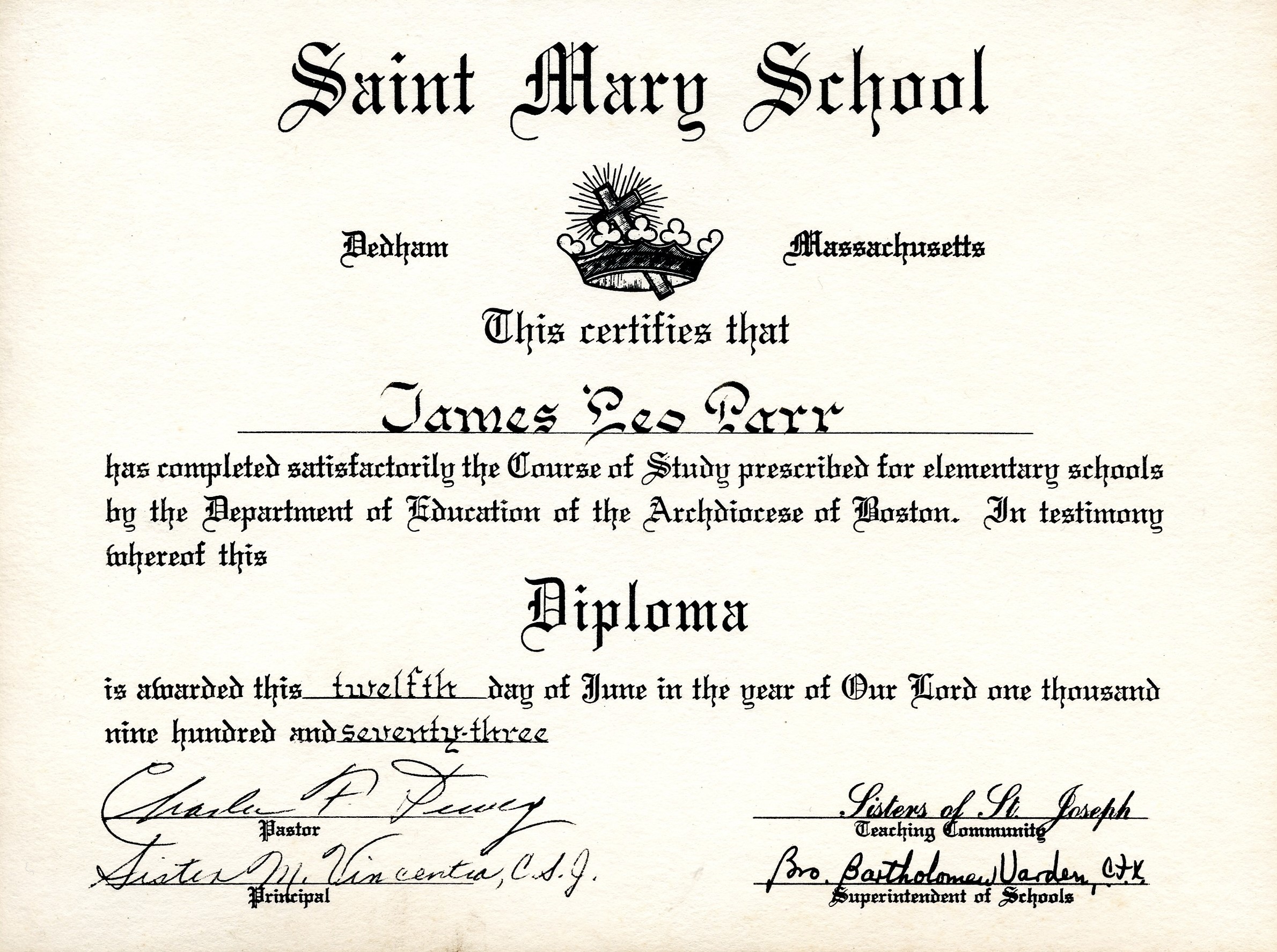
On June 12, 1973, I ended my 8 years at Saint Mary’s when I received this diploma in a graduation ceremony in the upper church on High Street. I was the last of 5 siblings to graduate from St. Mary’s; the school would close permanently in June 1975 before my younger brother was old enough to attend (despite having been enrolled at his christening in 1969).

In December 1972, Monsignor Charles Dewey, pastor, announced that the Sisters of St. Joseph would no longer be staffing the school effective June 1975. At the time there were 9 nuns teaching the 16 classes of approximately 525 students. The possibility of continuing the school with lay faculty was discussed, but in the end the decision was made to close. The school served as home to several other educational institutions including the British School of Boston and the Rashi School, before being torn down in 2010.

The cornerstone for the original building (we called it “the old school”) was laid on June 16, 1935, with 500 people attending the ceremony. The “new school” opened in the fall of 1958 and increased the school’s capacity to 650 students. My 1st, 2nd and 4th grade classrooms were all in the “old school,” where the desks still had holes for ink bottles and were bolted to the floor. There were about 85 graduates in the Class of ’73, which means there were over 40 students in each classroom with just one teacher. Some of those classmates are still good friends, and I hope to see many of them as we gather for a reunion in August.

My grandparents sent me this card for my graduation

A Navy “Contraband”

May 20, 2023

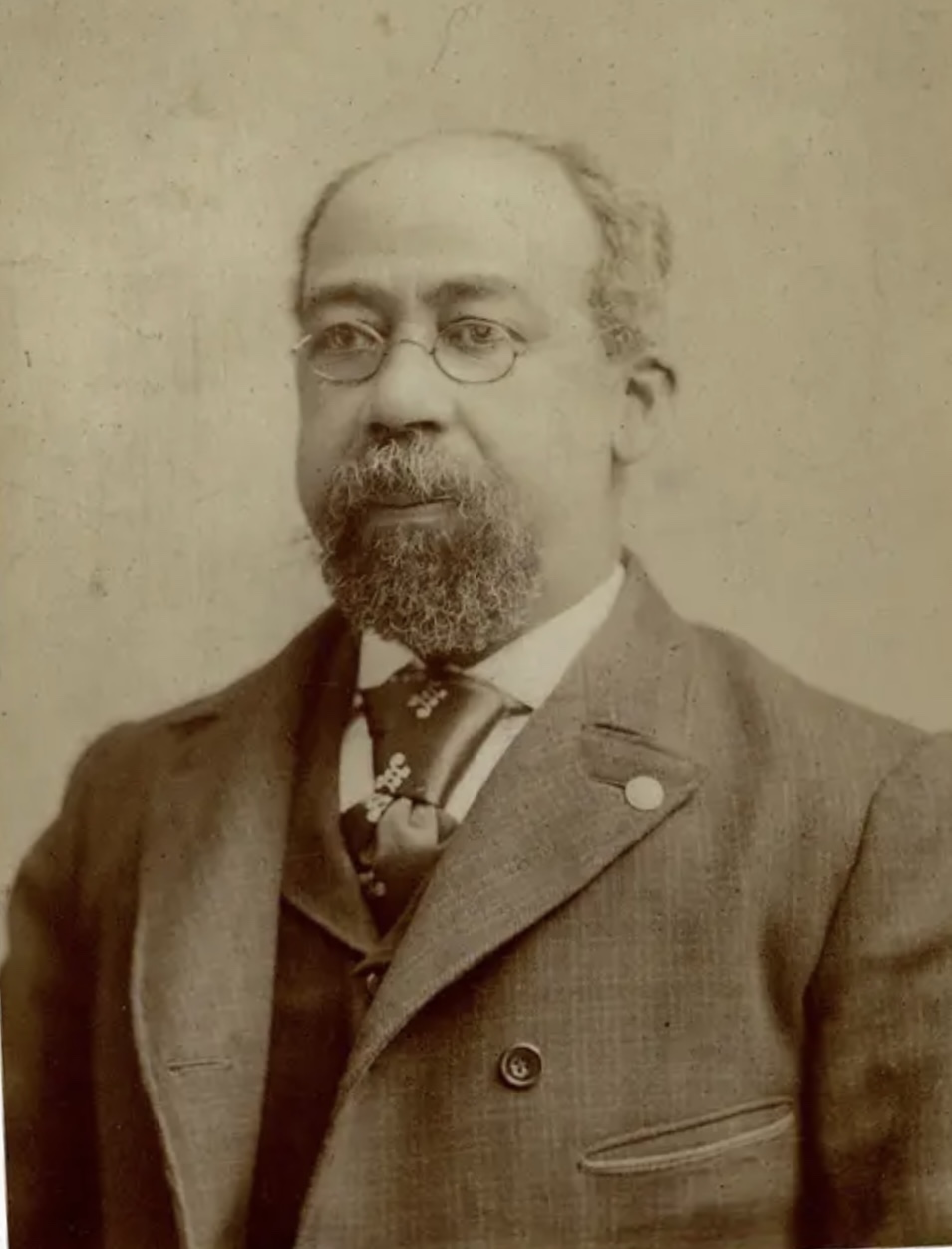
On Sunday, May 28, a statue will be unveiled in East Dedham to honor the memory and service of William B. Gould. The ceremony will take place at Gould Park on Milton St., just down the street from where Gould, along with his wife Cornelia, raised his family. Red Sox announcer Joe Castiglione will emcee the event and the keynote speaker will be Princeton University’s Professor Tera Hunter. For more information on the ceremony, you can visit the Gould Park website: https://gouldmemorial.org/ The following is an excerpt from my book Dedham: Historic and Heroic Tales from Shiretown which summarizes Gould’s extraordinary story.

An obituary appearing in the Boston Globe on May 24, 1923 describes the accomplishments of 86-year old William Gould of Dedham, including command of the local GAR post, and his service on the Union ships Cambridge, Ohio and Niagara. The notice states that Mr. Gould enlisted in the navy in 1863, which while is a true fact, does not tell the complete story.  What is not stated is that Mr. Gould was born enslaved in North Carolina and escaped to the Navy in a daring move with seven other slaves.

On the night of September 21, 1862, twenty-four-year-old Gould and his seven companions set their plan into action. After darkness had descended, the men boarded a small boat in Wilmington, North Carolina and began rowing south on the Cape Fear River, heading for the open sea.  If they could manage to maneuver their boat downriver twenty-eight miles, slip past the Confederate held Fort Caswell and get picked up by a Union ship, they would have their freedom.  Such escapees were considered “contraband” of war, property seized by the Union forces.

Gould and his mates reached the Atlantic Ocean in the morning hours of September 22, and hoisted their sail.  They were soon spotted by crew members of the U.S.S. Cambridge and taken aboard. A few days later they took an oath of service and were made crew members.

William Gould was an extraordinary man.  He was educated and literate as evidenced by the diary he began shortly after his escape and continued through most of his naval service.  Amidst the many passages describing the routine life of a sailor, Gould expressed his passionate insights against the southern way of life and the institution of slavery.  Gould served until the end of the war and eventually made his way to Dedham in 1871, where he and his wife Cornelia raised a large family on Milton Street.

Gould was a master plasterer, and in the 1880s was awarded a contract to do the interiors of St. Mary’s Church on High St. He was a respected and honored citizen of the town, serving as the commander of the Grand Army of the Republic post and writing for various publications. Gould was also a founding member of the Church of the Good Shepherd in Oakdale Square. In the late 1950s, his grandson William Gould III discovered a diary kept by the original Gould.  This diary was annotated and published by Gould’s great-grandson William Gould IV.  It is an important document of American and African American history, being one of only a few diaries written by black sailors.

No Tonic Allowed in the Gym

April 19, 2023
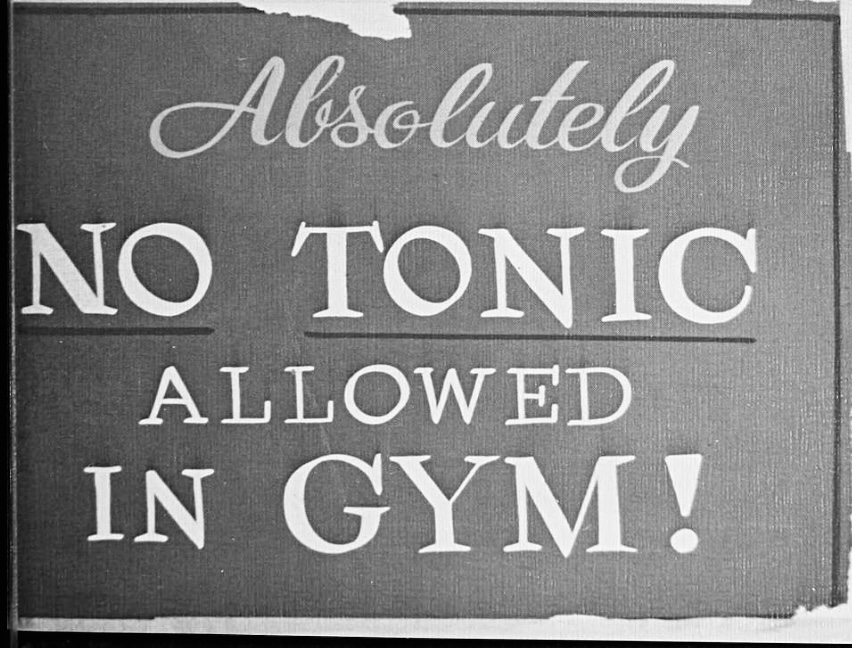
From the 1973 DHS yearbook.

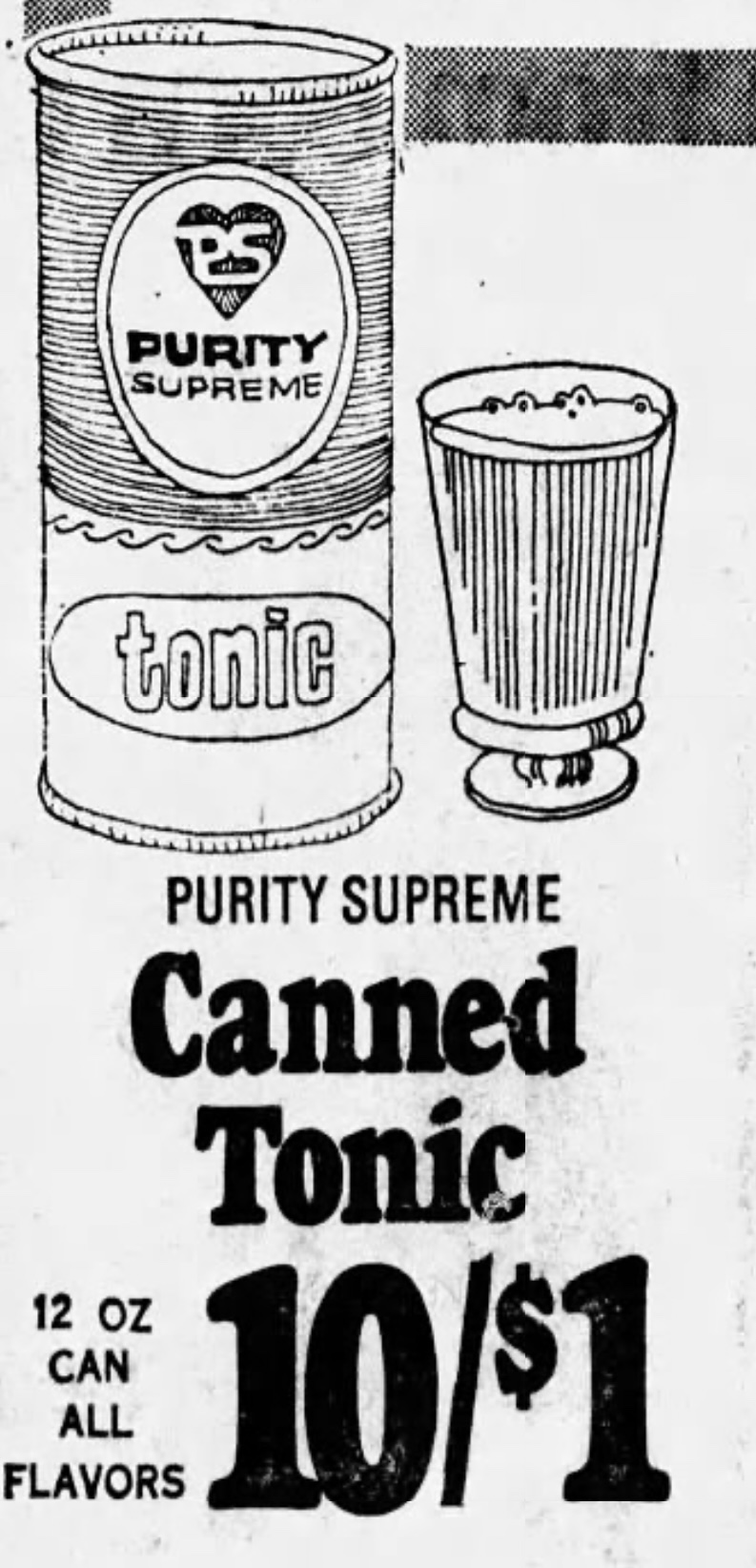
This sign hung on the door to the Dedham High gym 50 years ago, and there’s no doubt that every one of the 2,000 or so students in the school knew exactly what it meant. Hang that sign on the gym door today and you’ll get a lot of confused looks and questions…Hair tonic? Gin and tonic? Those of us who grew up in the 60s and 70s know that “tonic” was another word for soda. Orange ade, root beer, ginger ale, even Coke were referred to collectively as tonic. It was a common and widespread term around here back then, as seen in this ad from the Globe in 1972:

According to the Globe, the first printed instance of the word to describe carbonated beverages was in 1888 in an article describing the theft of ’10 bottles of tonic’ from a Boston store. For close to a century, folks in Massachusetts and other parts of New England could be assured of getting served a carbonated soda when asking for a tonic. The term has been pretty much abandoned these days (Wikipedia called it “antiquated!” Boy that makes me feel old). It joins these other words from my youth that have faded from modern day usage:

Hassock (ottoman)

Divan (couch- this was my father’s word, not mine)

Dungarees (jeans- see my February 2023 post about Dungaree Day)

Supper (dinner)

Cellar (basement)

Crueler (a horizontal donut, now called a stick)

Feel free to share your own “antiquated” words or phrases from back in the day. And keep that tonic out of the gym!

Hop on in…

April 1, 2023

to the Blue Bunny and pick up a copy of my Dedham book; also available are Framingham Legends and Lore, Murder and Mayhem in Metrowest Boston and 2 books of fun family poetry- perfect for National Poetry Month!

From the Dedham Times 3/31/2023
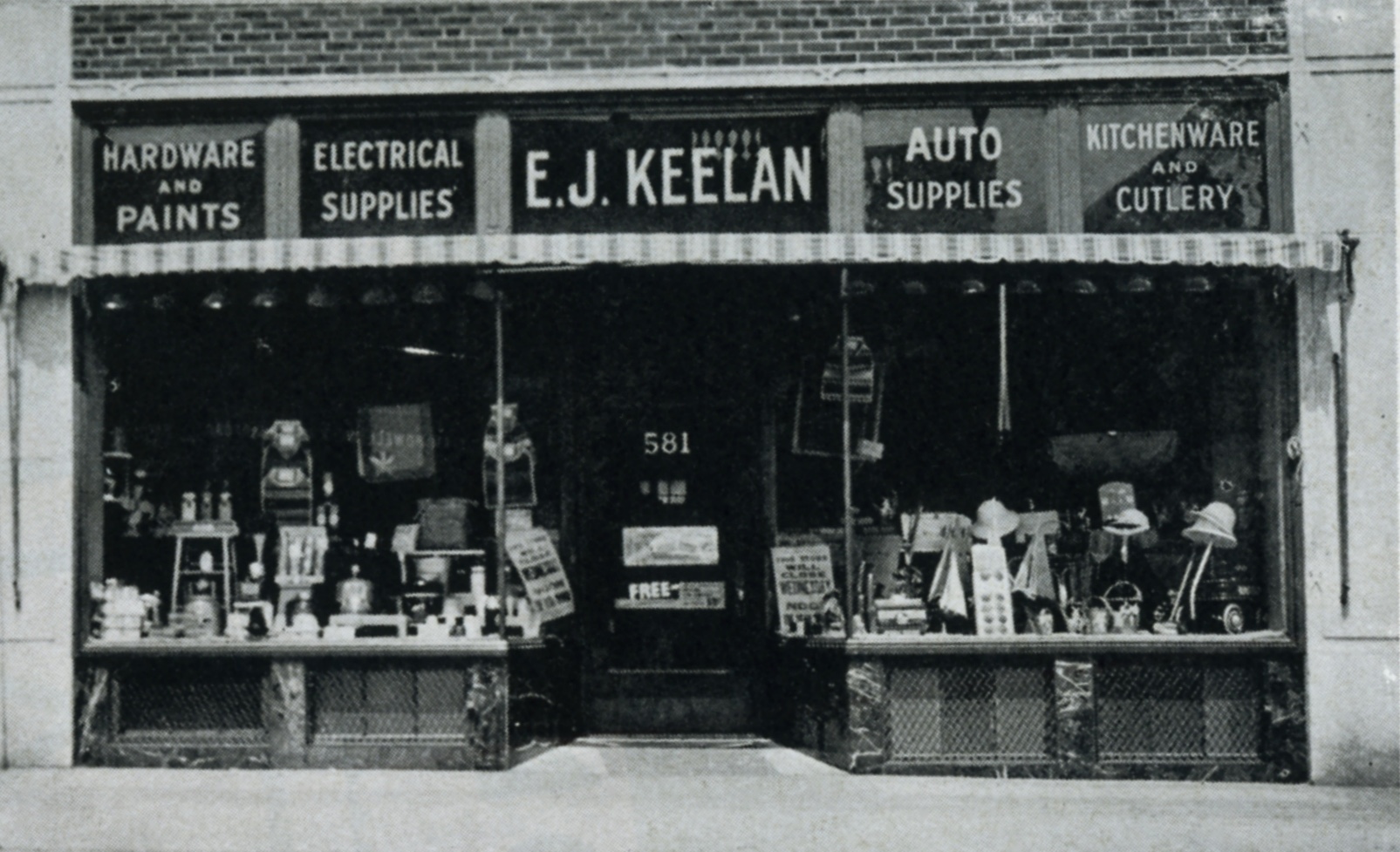
The Blue Bunny is located at 577 High Street- if you haven’t been to the Square in a while, head for Keelan’s Hardware (same spot, updated address).

Where in Dedham? The Dedham Police Station

March 11, 2023
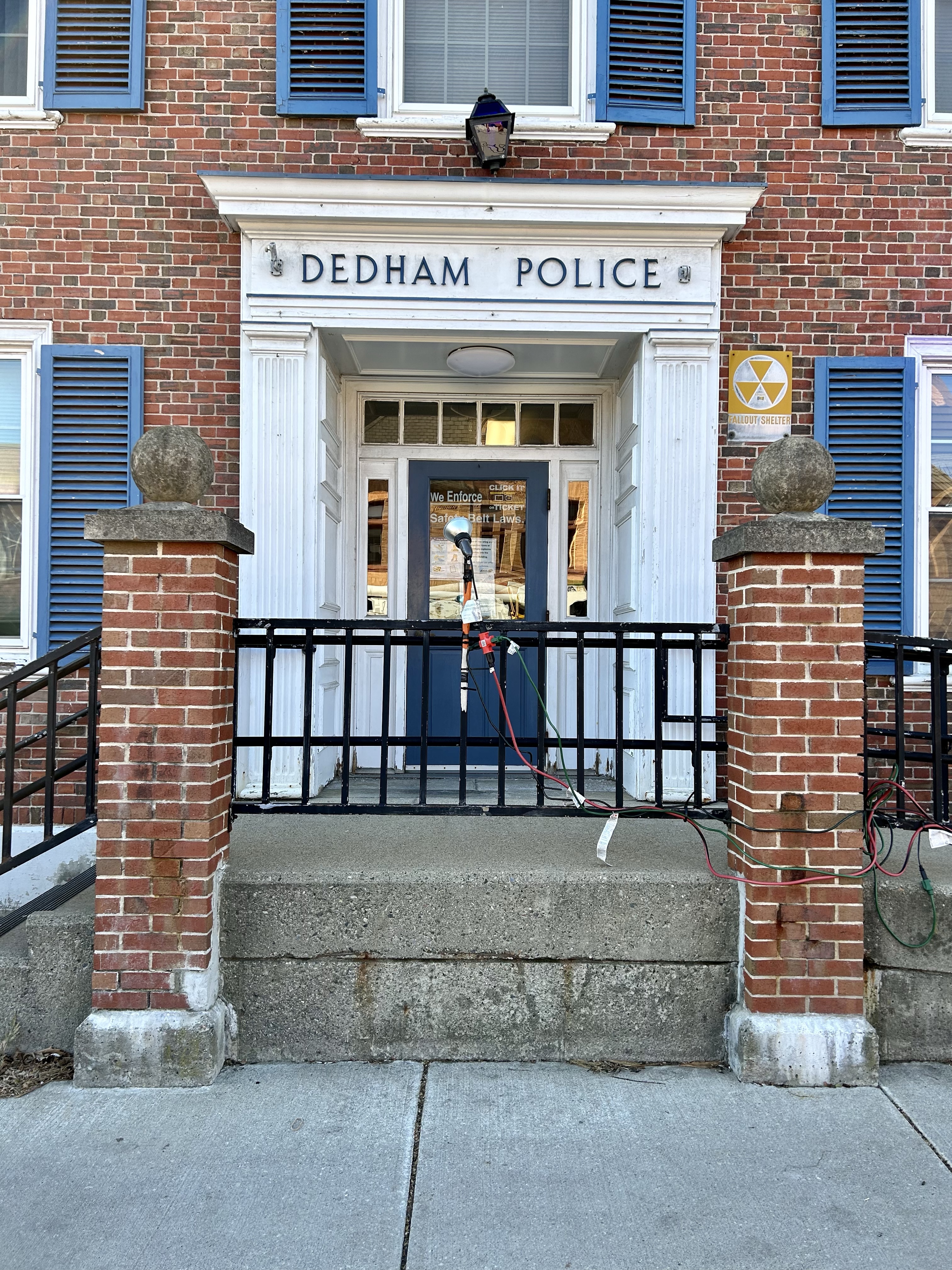
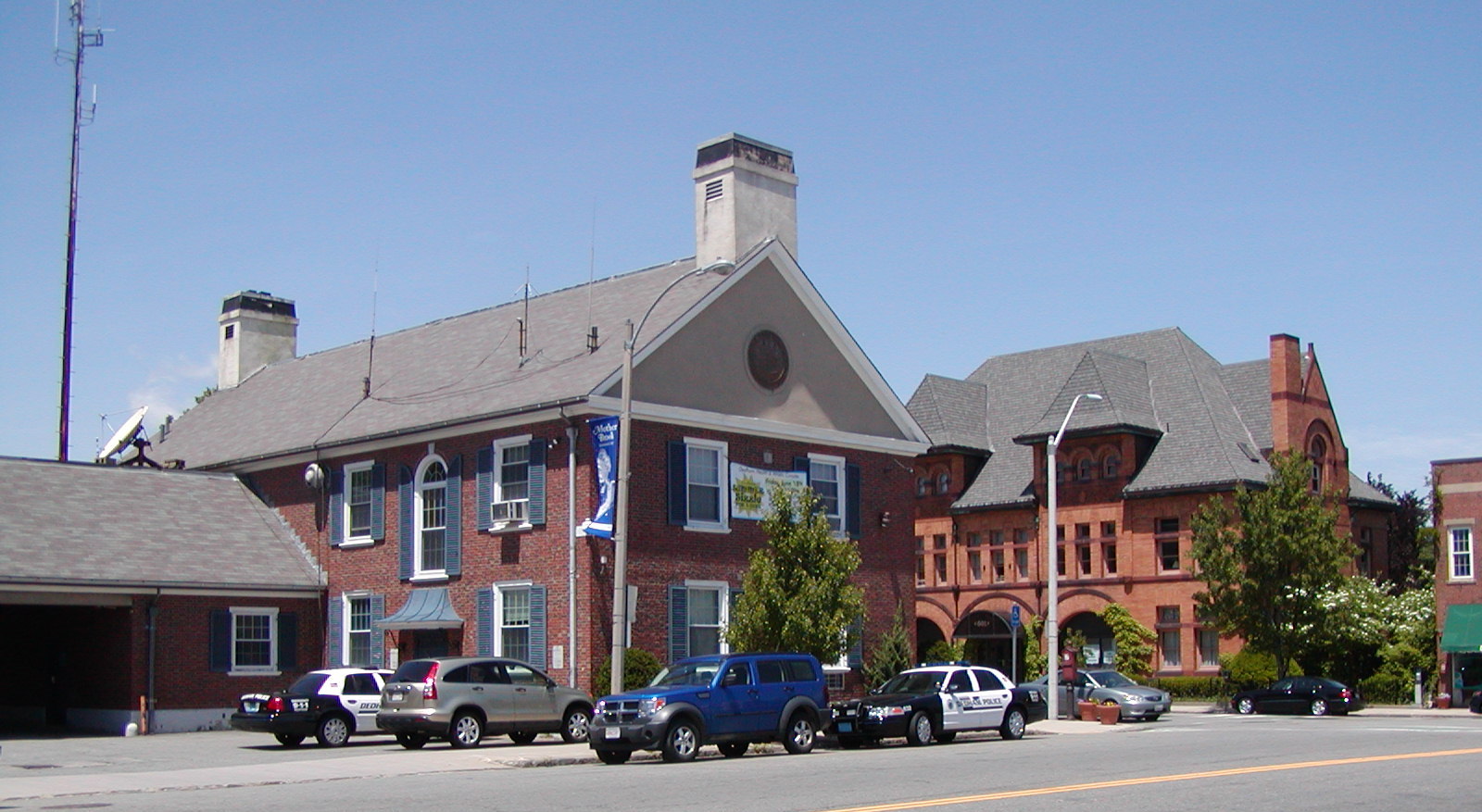
The fallout shelter sign has been hanging in this spot since the building was dedicated 60 years ago. The fallout shelter was located in the basement behind 6-inch walls of reinforced concrete and housed the Civil Defense Communication Center. A lead shield was available to be placed over the window for protection from radioactive fallout.

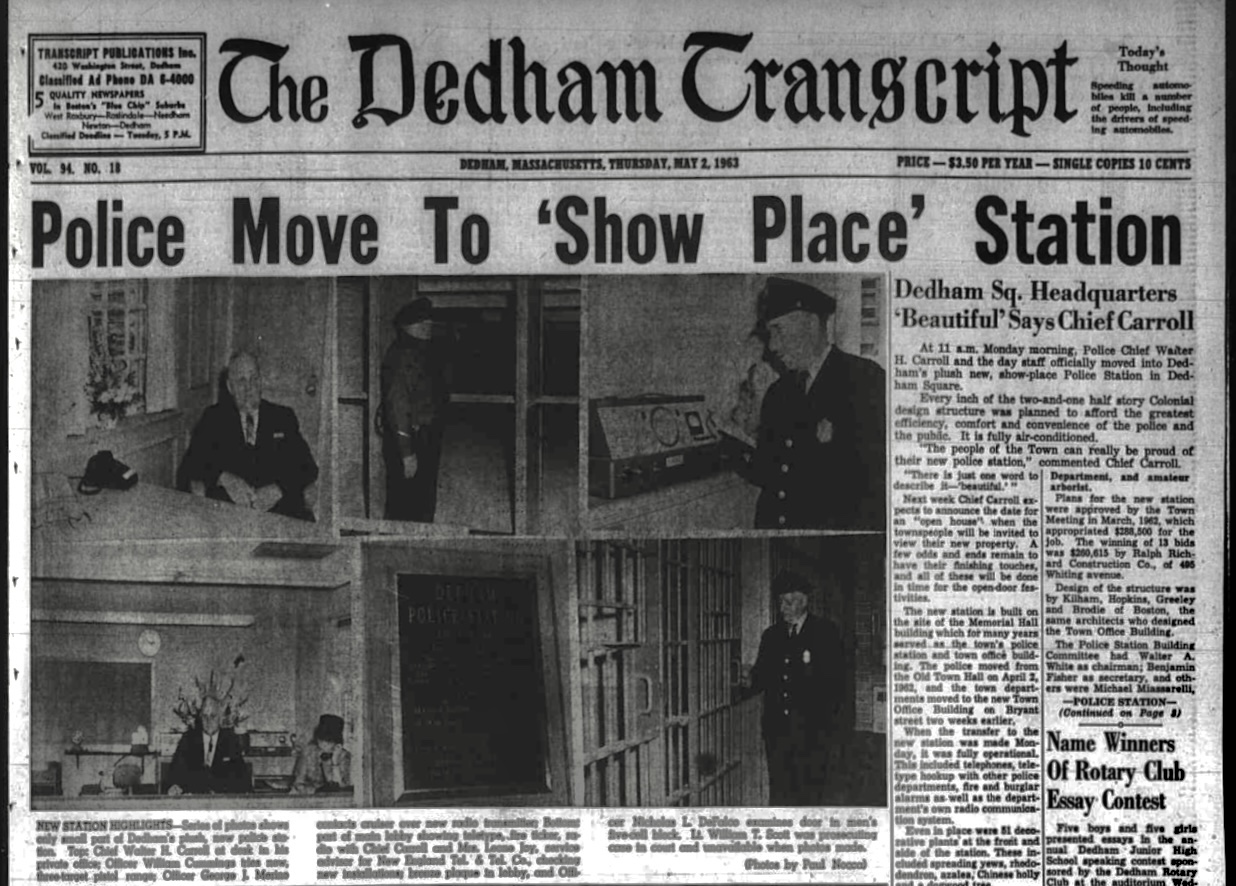
The Dedham Police Department moved into their new headquarters on April 29, 1963, almost 60 years ago. The department had been in temporary headquarters at the new town hall on Bryant Street after vacating their original home in Memorial Hall which was torn down the year before.

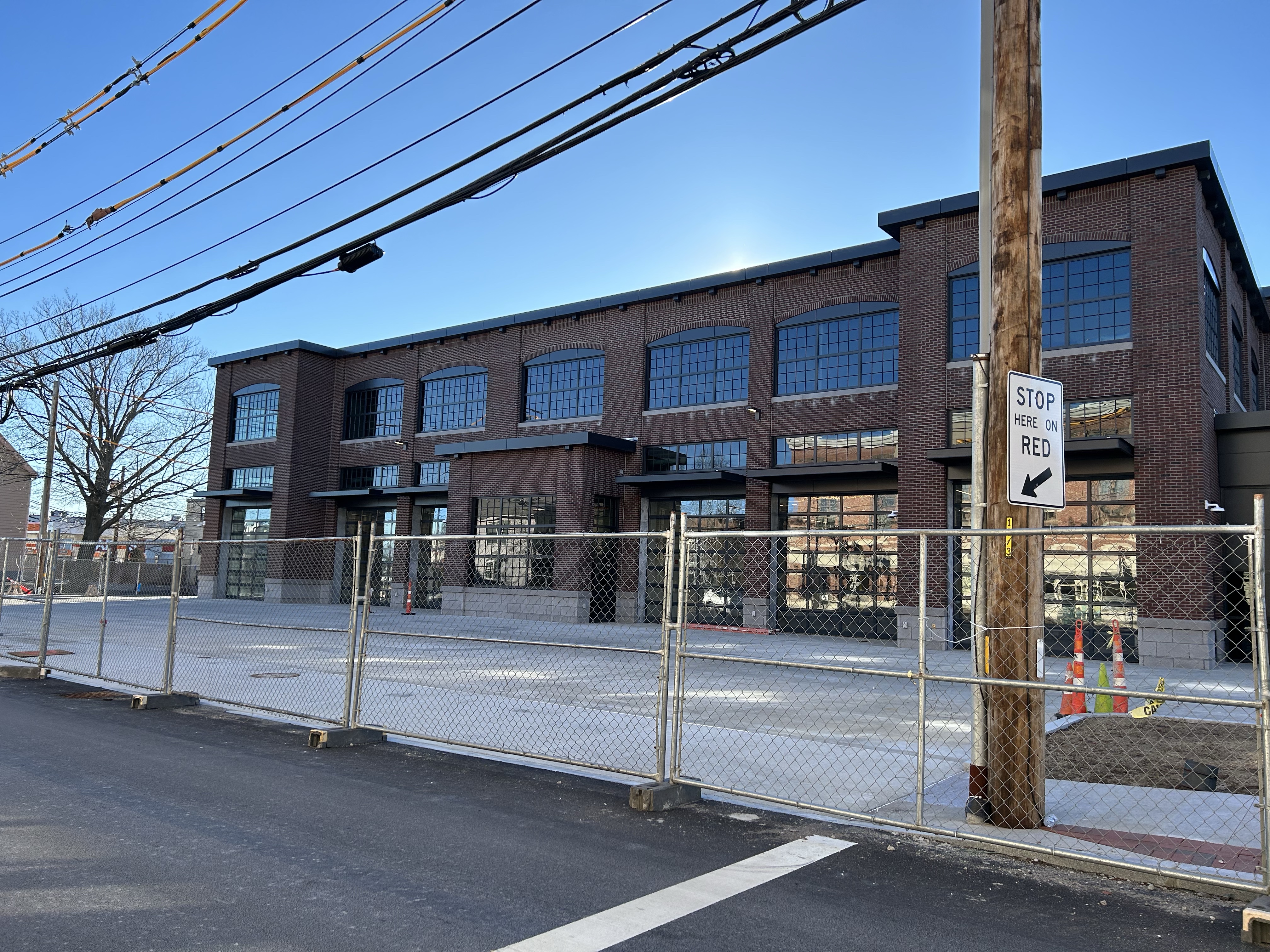
This was the first and only building built exclusively as a police station in Dedham. Tomorrow, the new public safety building on Bryant Street will be dedicated at a ribbon cutting ceremony at 1:00. Guests are invited to attend the ceremony and tour the new police/fire facility.

The new building at 26 Bryant Street. The combined fire/police facility will also replace the 1930 Central Fire Sation on Washington Street. The Dedham Square Planning Committe recommended in December 2021 that the former police station be demolished, and the site be developed as green space.

I’ve been inside the police station exactly two times. The first time was as an eighth grader doing a report on police work. Some officers showed me around and gave me a blank fingerprint card as a souvenir. About 20 years ago my car was rammed by another one in the Dedham Plaza parking lot and I went to the police station to file an accident report. Feel free to share stories of any time you’ve spent in the Dedham Police Station!

Congratulations to Mary Fontaine who was the first to correctly identify the location!

Where in Dedham?

March 11, 2023

Be the first to identify the location in the picture below and win a set of historic Dedham note cards! You must post your answer in the comments below, not on Facebook. I will announce the winner and identify the location in another post. Good luck!