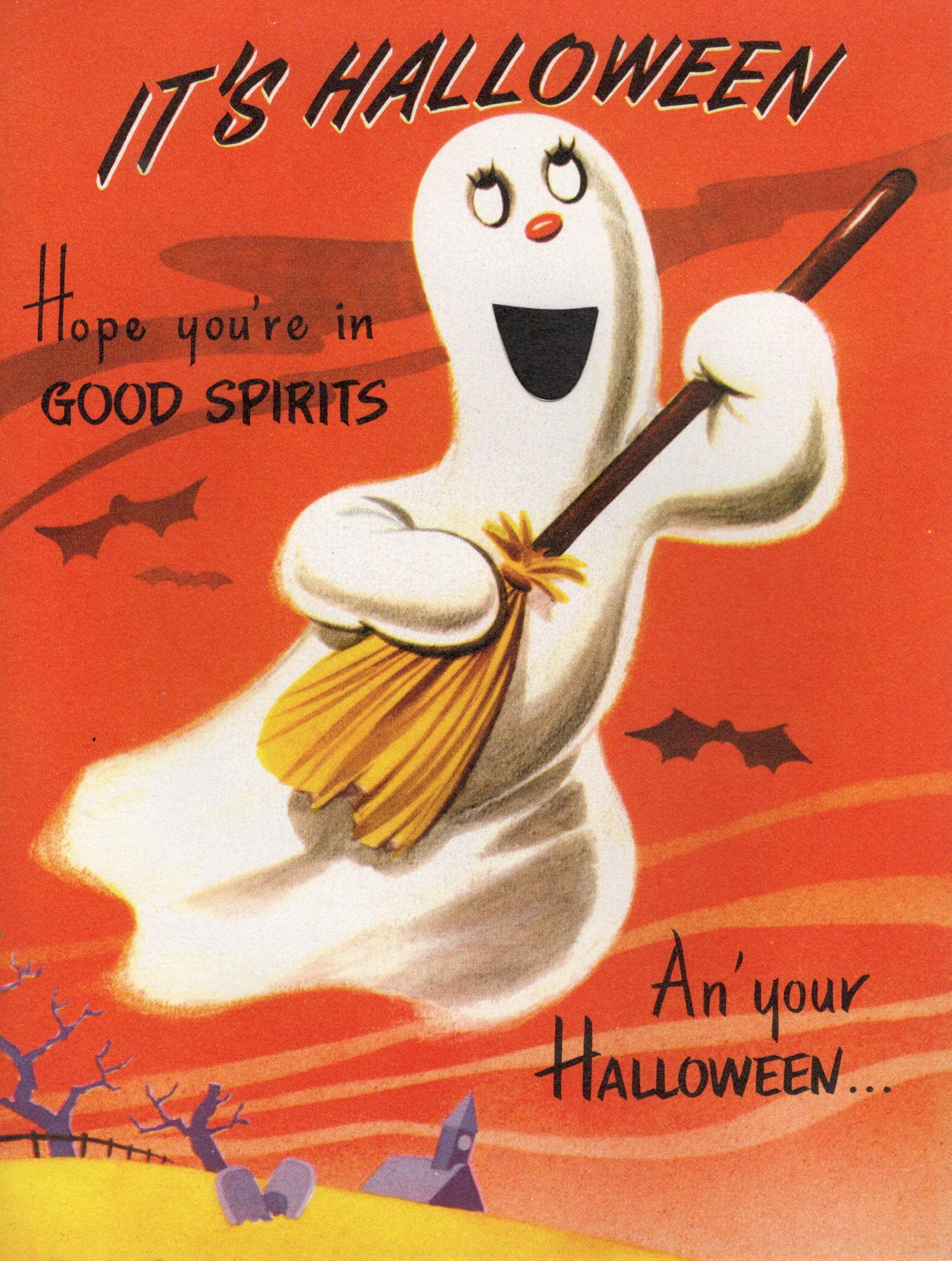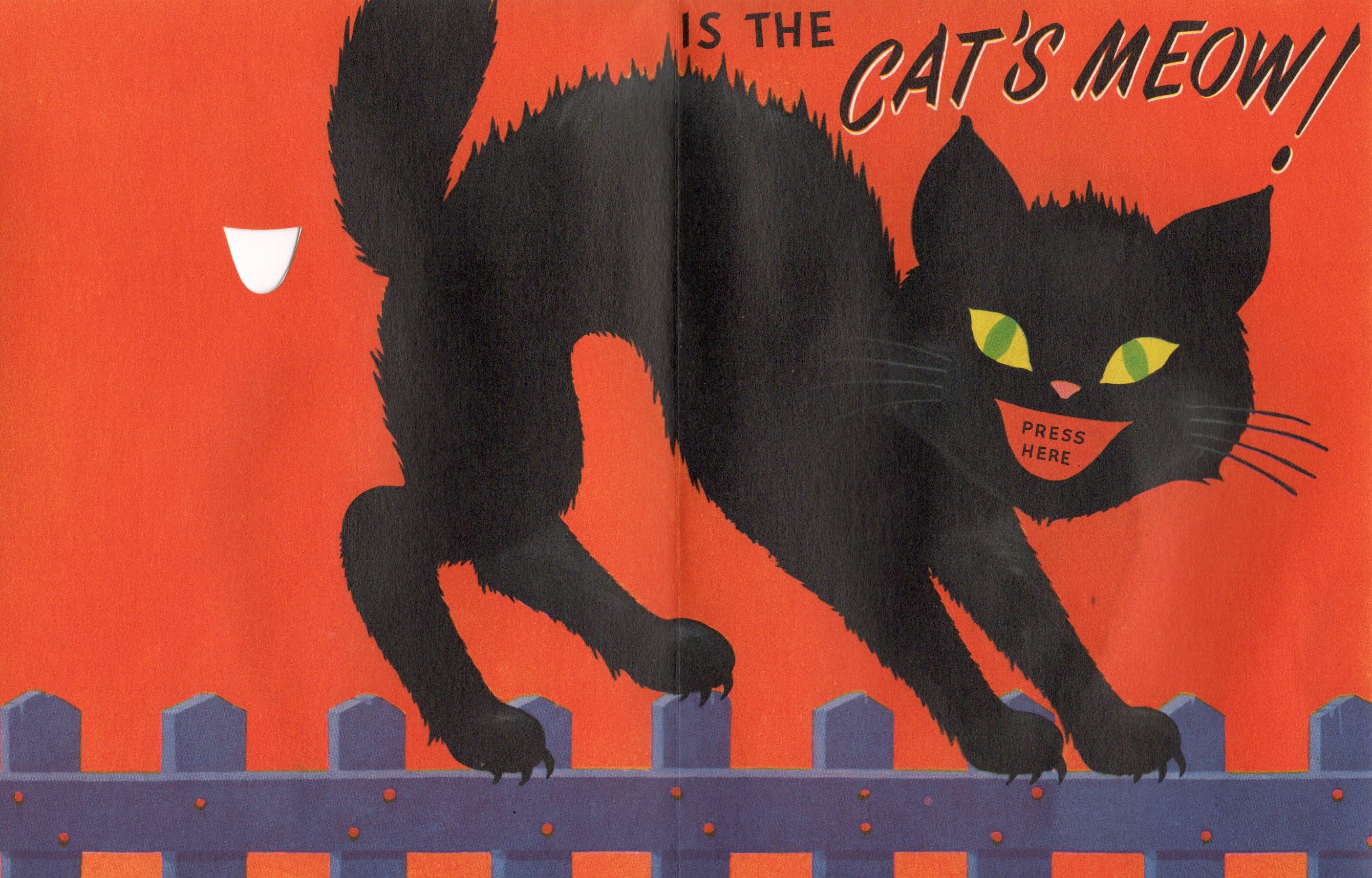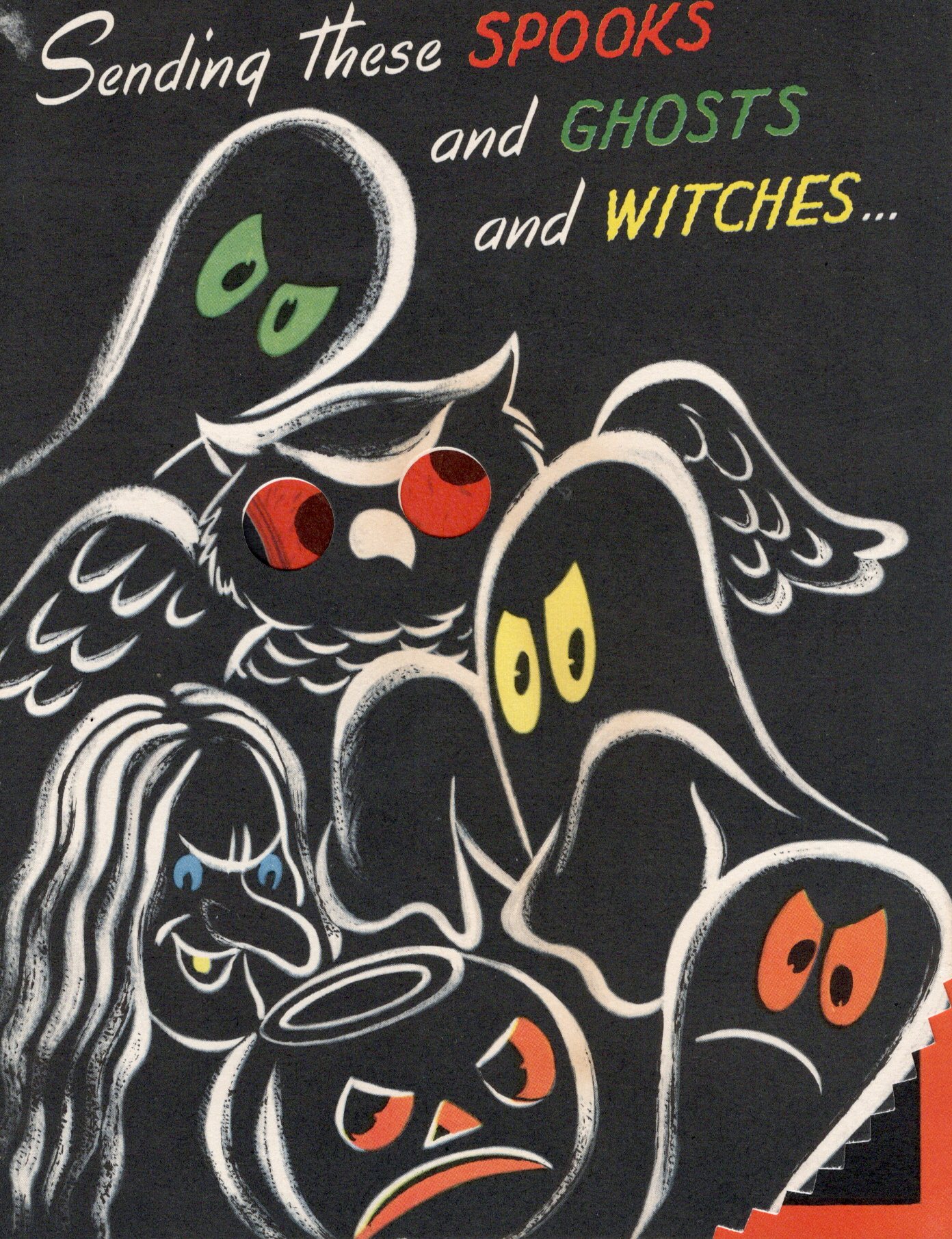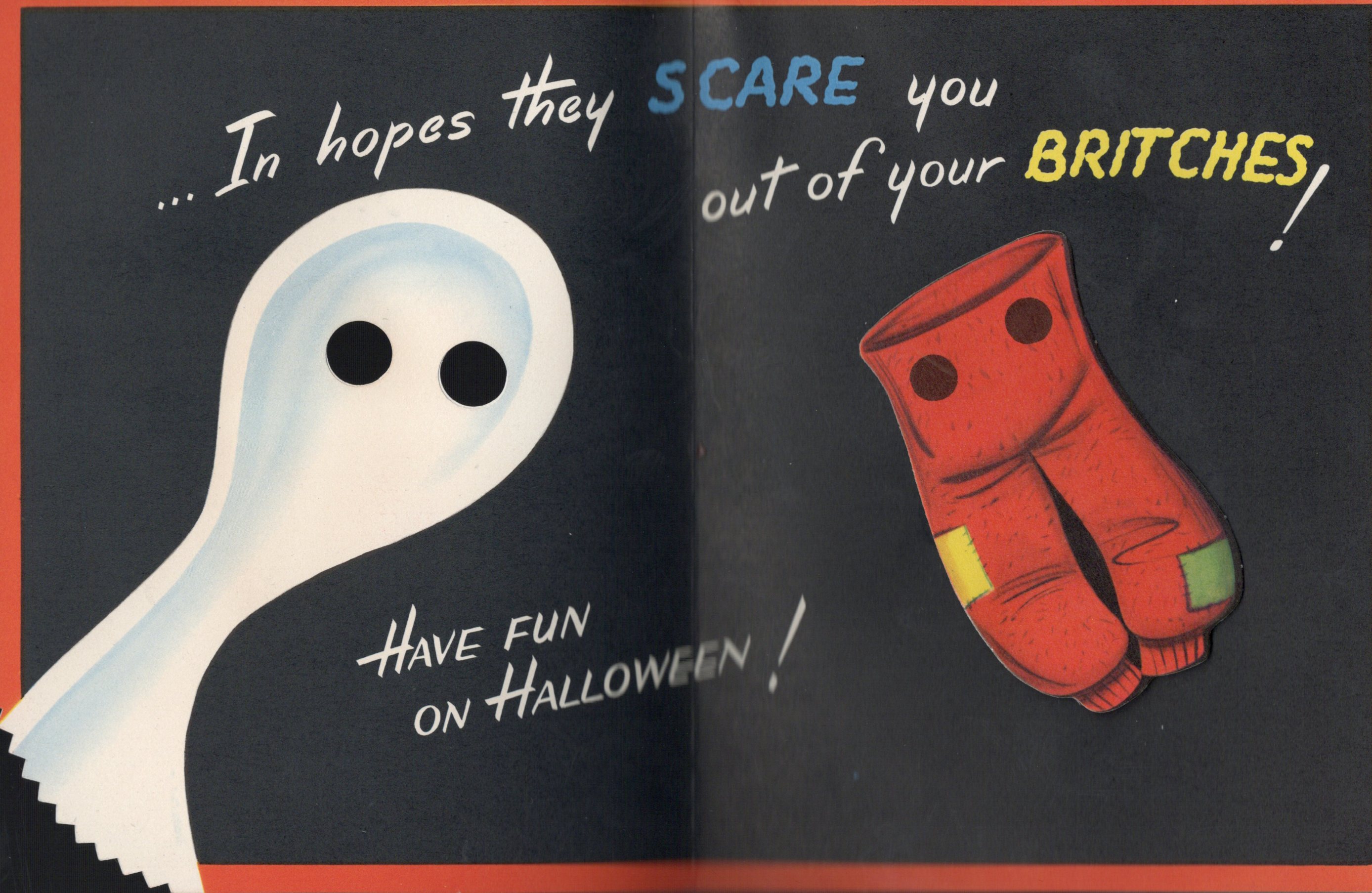
These cards were made by Rust Craft in the late 1950s. The colorful graphics and clever novelty additions (the cat in the above card made a meowing sound when you pressed it, the britches in the card below were on a spring) were characteristic of the company’s output during their early years in Dedham.
The Dedham Museum and Archive will be celebrating the card company’s creativity with its new exhibit : Rust Craft: A Quarter-century of Artistry in Dedham, coming in November. On display will be dozens of cards from Rust Craft’s Dedham years (1955-1980) as well as photographs, artifacts and original artwork from one of the company’s artists. A reception, which is free to the public, will open the exhibit on November 12 from 6:30-8:30. Light refreshments will be served after welcoming remarks by Museum staff and Christine West, daughter of Vincent Battaglia, long-time Rust Craft artist, whose original artwork is featured in the exhibit. If you worked for this company, or just enjoyed sending or receiving one of their clever and colorful greeting cards, you don’t want to miss this exhibit.
Walking Tours presented by Dedham Museum and Archive October 18 and 25
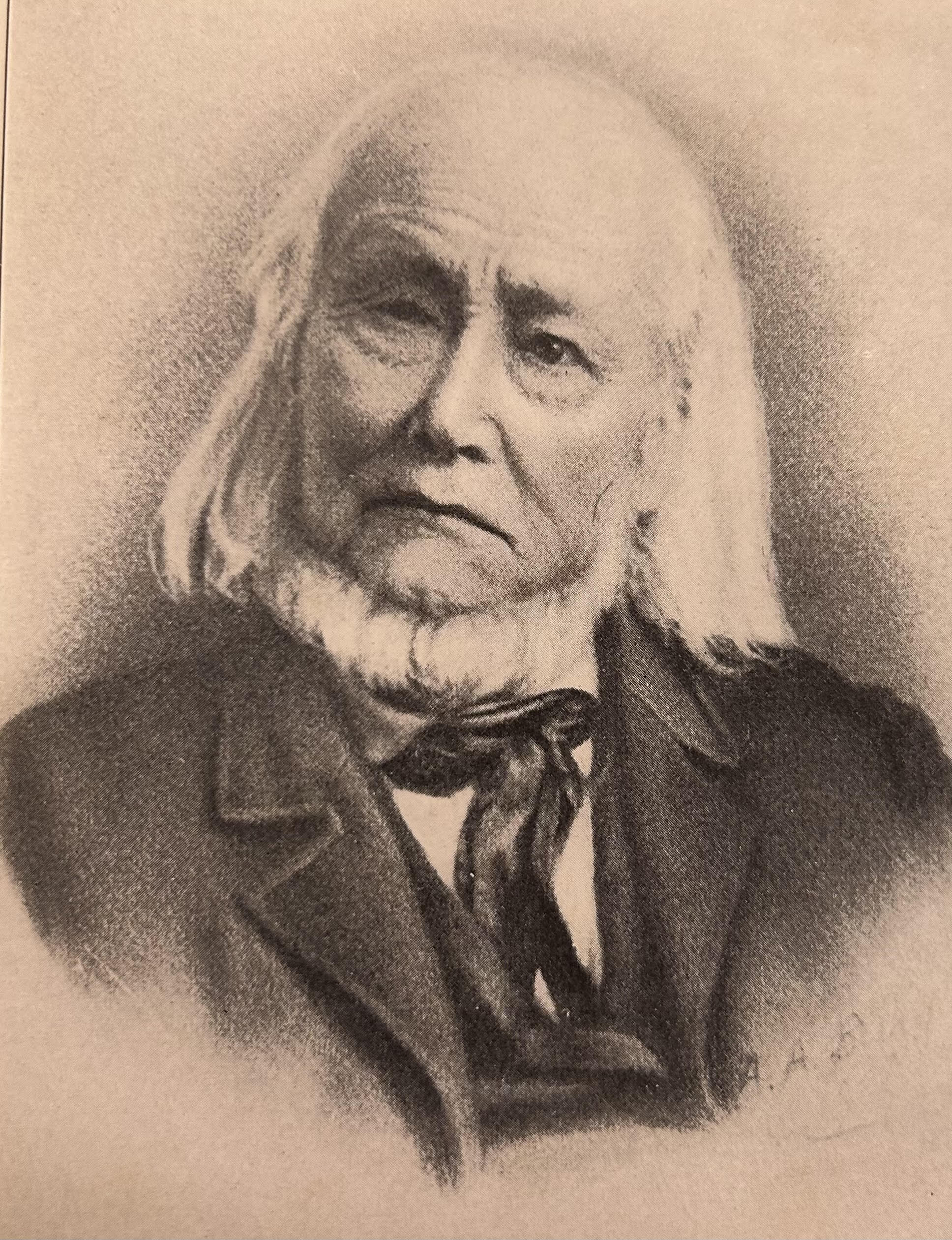
This jolly-looking fellow is Martin Bates. He was a prominent businessman and land owner who lived in Dedham from 1788-1869. At one time he owned the Norfolk House on Court Street, one of Dedham’s most popular taverns which still stands today.
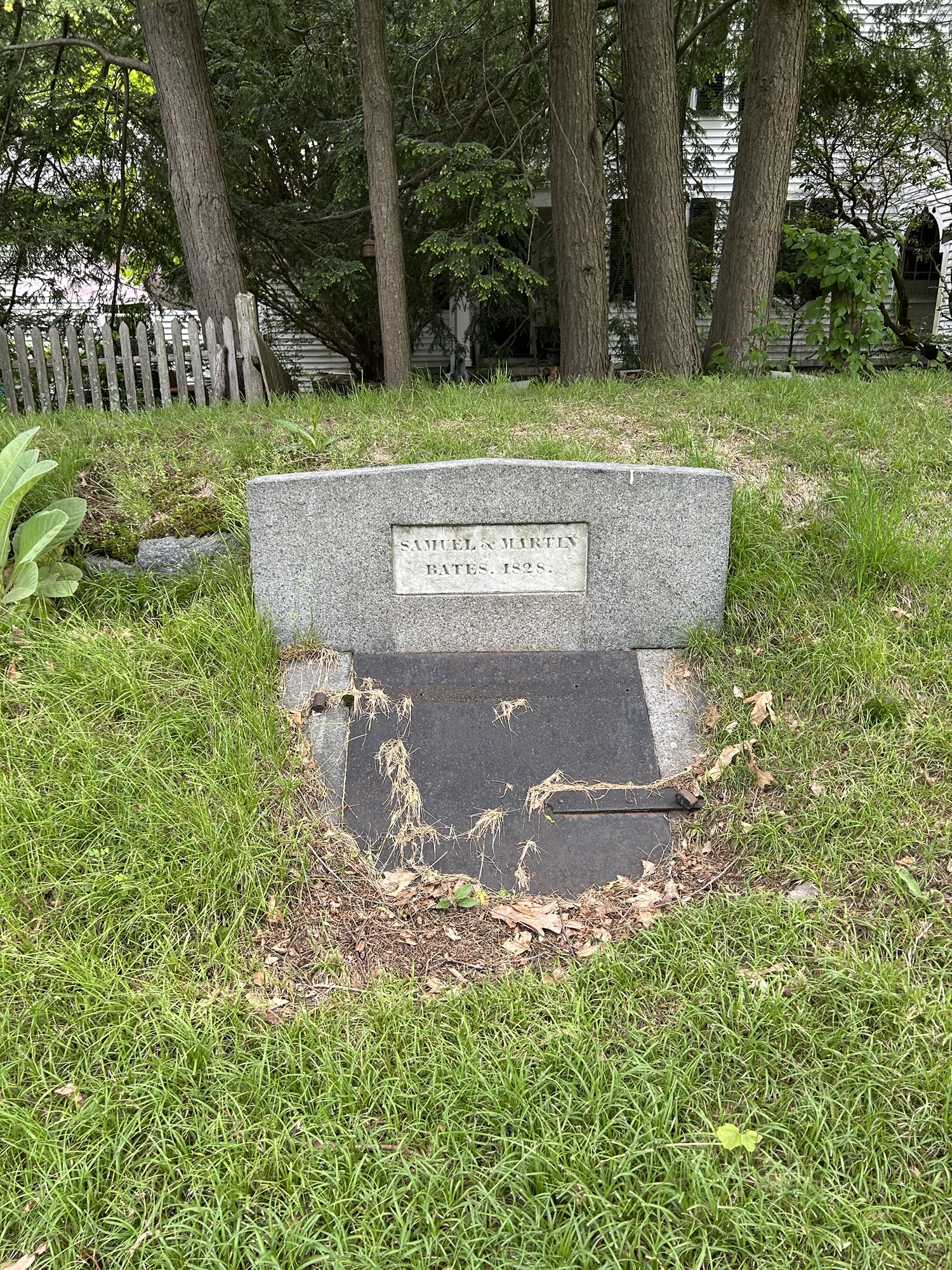
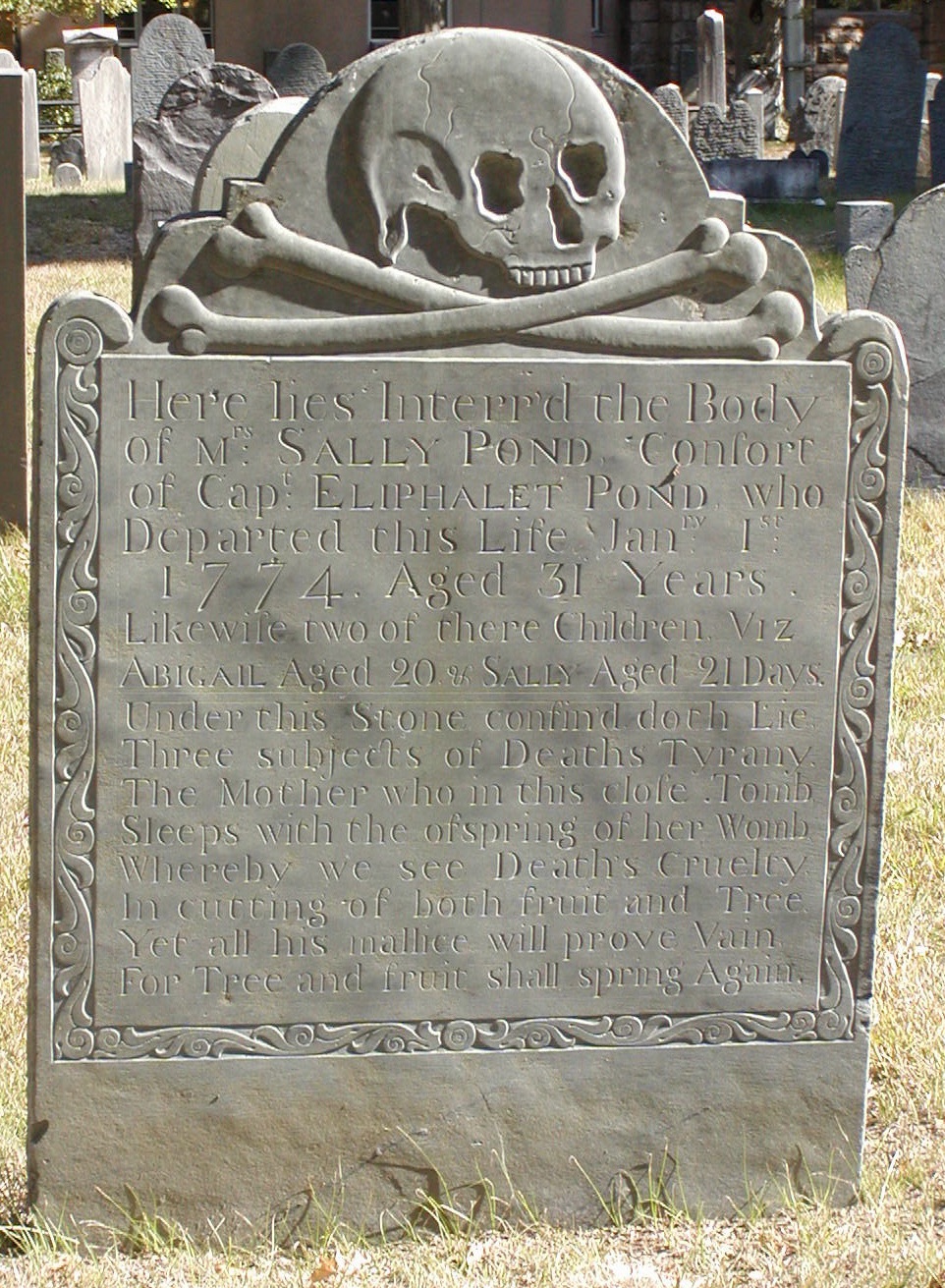
This is the Bates family tomb in the Village Avenue Graveyard. On Saturday October 18 and October 25, Martin Bates will exit his tomb to great visitors as the Dedham Museum and Archive presents the first ever “Voices from the Graveyard” Walking Tour. Marty and six other “Dead-hamites” will be on hand to share stories of their lives (and deaths) in old Shiretown. This is a special seasonal event you don’t want to miss- but hurry, some time slots are already sold out and tickets are going fast. Visit the Museum website for more information and for tickets. I’ll be looking for you among the gravestones! https://www.dedhammuseum.org/programs-events/seasonal-walking-tours/
The gravestone of Sally Pond and her infant children, carved by noted Boston area carver John Homer.
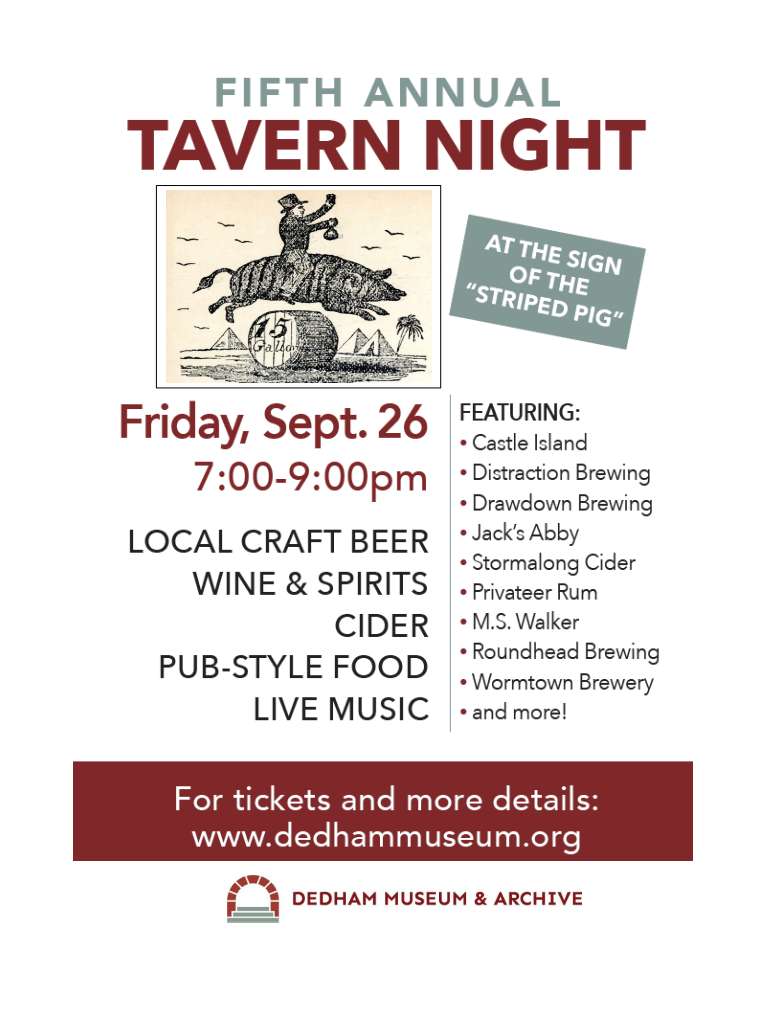
Don’t miss this fun event coming on Friday! This year’s theme is The Striped Pig, a unique event in Dedham history that I wrote about in my Dedham: Historic and Heroic Tales from Shiretown book. Read a short summary below. Hope to see you there!
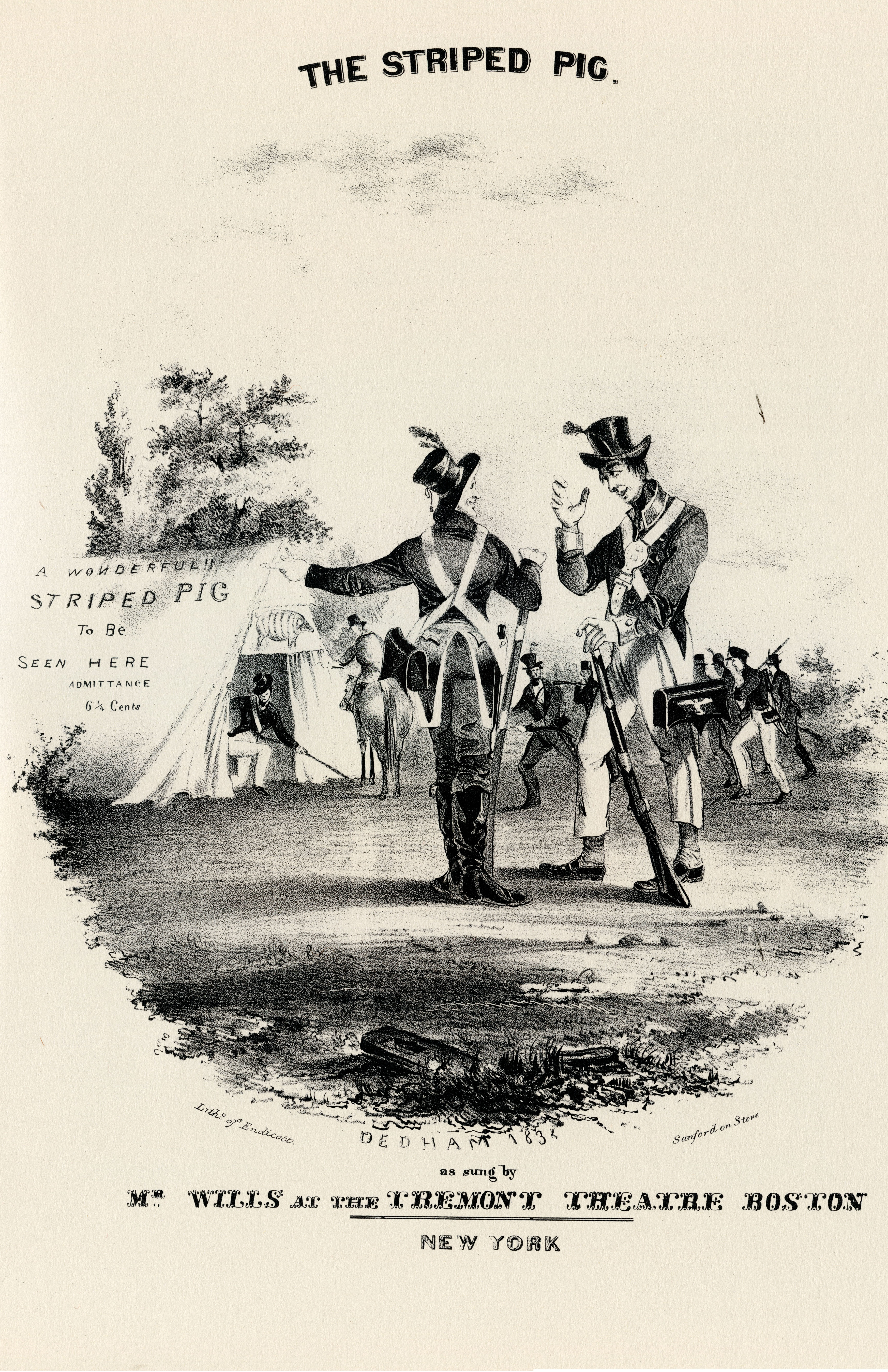
Sheet music from the 1838 ballad
The Annual Military Muster in September 1838 on Dedham’s Lower Plain (present day Hyde Park) was looking like it would be a gloomy affair. Earlier in the year, temperance advocates had succeeded in getting the Massachusetts legislature to pass the “15-gallon law,” which prohibited the sale of alcoholic beverages in quantities less than 15 gallons. And what’s a military muster without access to abundant quantities of rum and whiskey?
Enter an inventive local who saved the day and unwittingly created a nationwide phenomenon that is still talked about to this day. The crafty vendor erected a tent on the field, with a sign inviting one and all to see the “Great Curiosity” of a Striped Pig. After paying their 6 and ¼ cents, patrons were indeed treated to the spectacle of a large and apparently contented pig, adorned with dark stripes looking suspiciously like fresh black paint. As a bonus, each paying customer was given a FREE glass of rum, thus quenching their thirst without breaking the law!
Within days the story of Dedham’s Wonder had spread across the country, and the Striped Pig was being celebrated in music halls and taverns far and wide. The phrase entered the nation’s vocabulary meaning both a ruse to skirt an unfair law (“We’ll have to try a Striped Pig device”) and a way to describe a drunken person (“Looks like he’s been riding the Striped Pig”). Striped Pig political parties were formed, some of which helped to bring an end to the 15-gallon law (and the re-election hopes of Governor Edward Everett who had signed it into law).
The Dedham Museum celebrates the creativity of that enterprising entrepreneur and his determined efforts to raise the “spirits” of Dedham’s citizens on that late summer night almost 200 years ago.
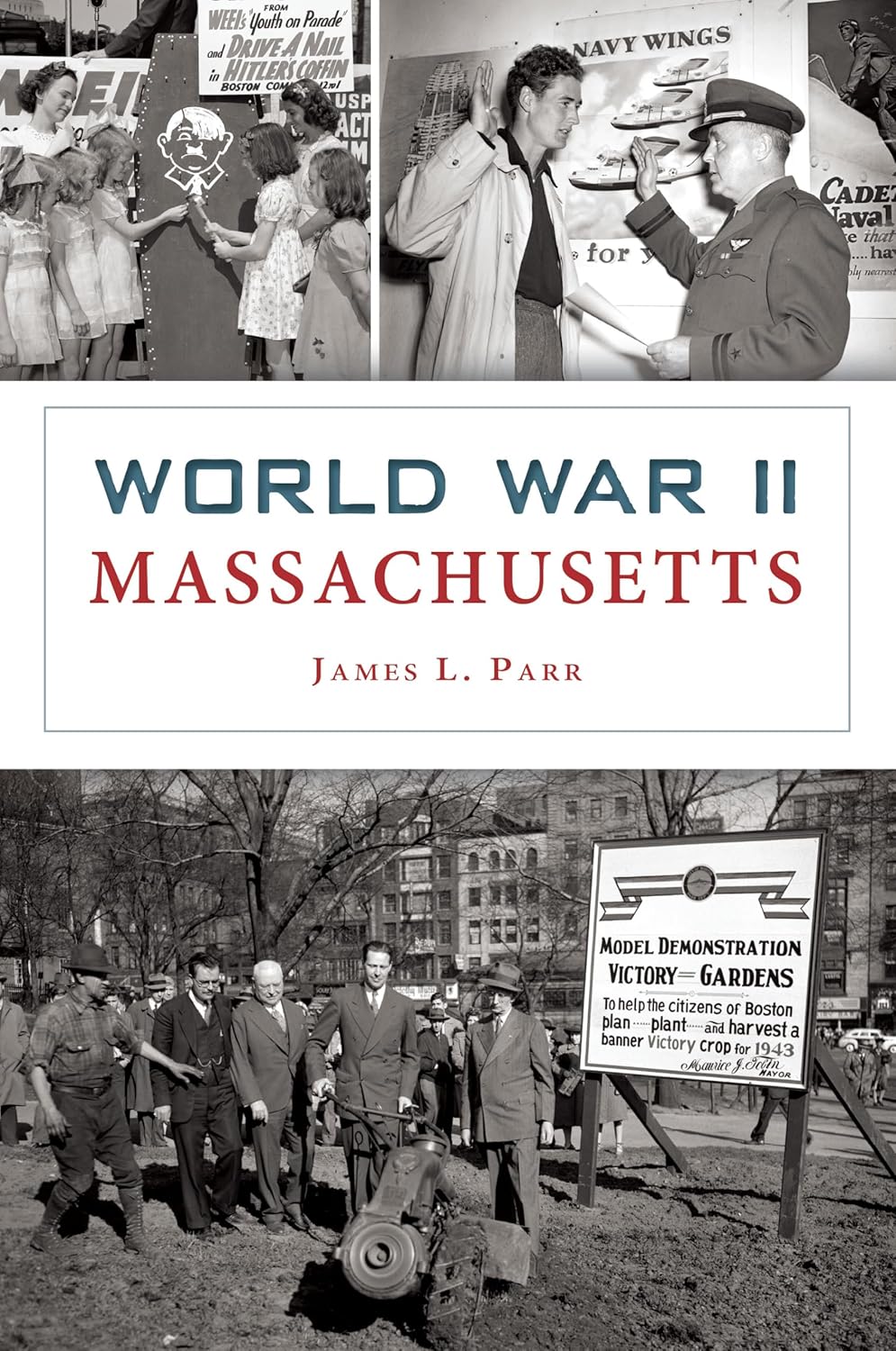
I will be sharing stories from my most recent book World War II Massachusetts at the Morse Institute Library in Natick this Thursday, September 11 at 6:30. This will be the 22nd talk I have given since the book’s publication in March 2024. What I most enjoy when giving these presentations is chatting with audience members who remember the events I have written about and share their stories with me. It is always exciting to hear about the blackouts, scrap drives, shortages, and rationing from the people, now in their mid-eighties, who experienced these events as children.
Here is a link to the Morse Institute website which has more information about the talk. Come on by if you’re in the area and want to hear some unbelievable tales of the Bay State home front during the war.
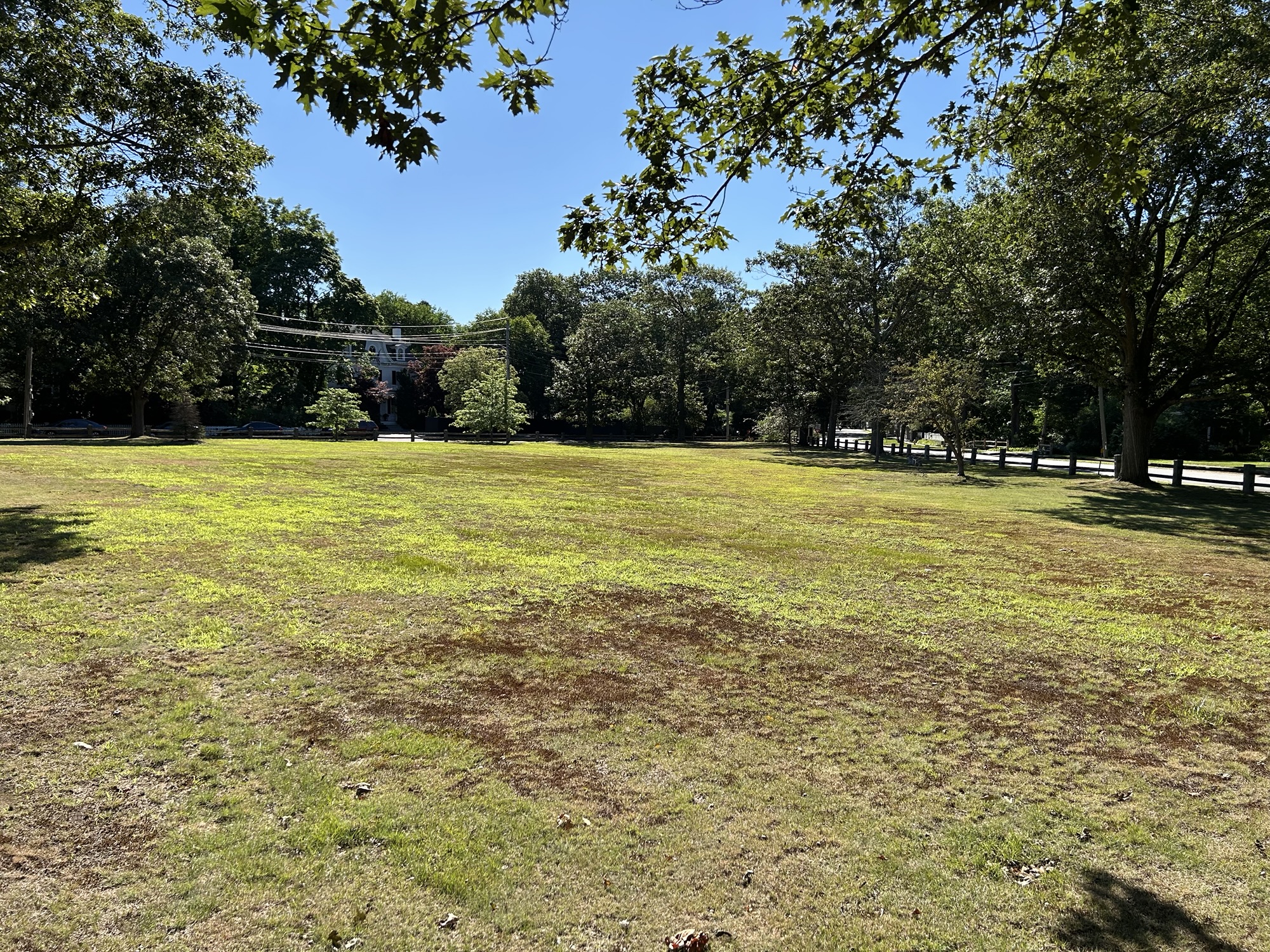
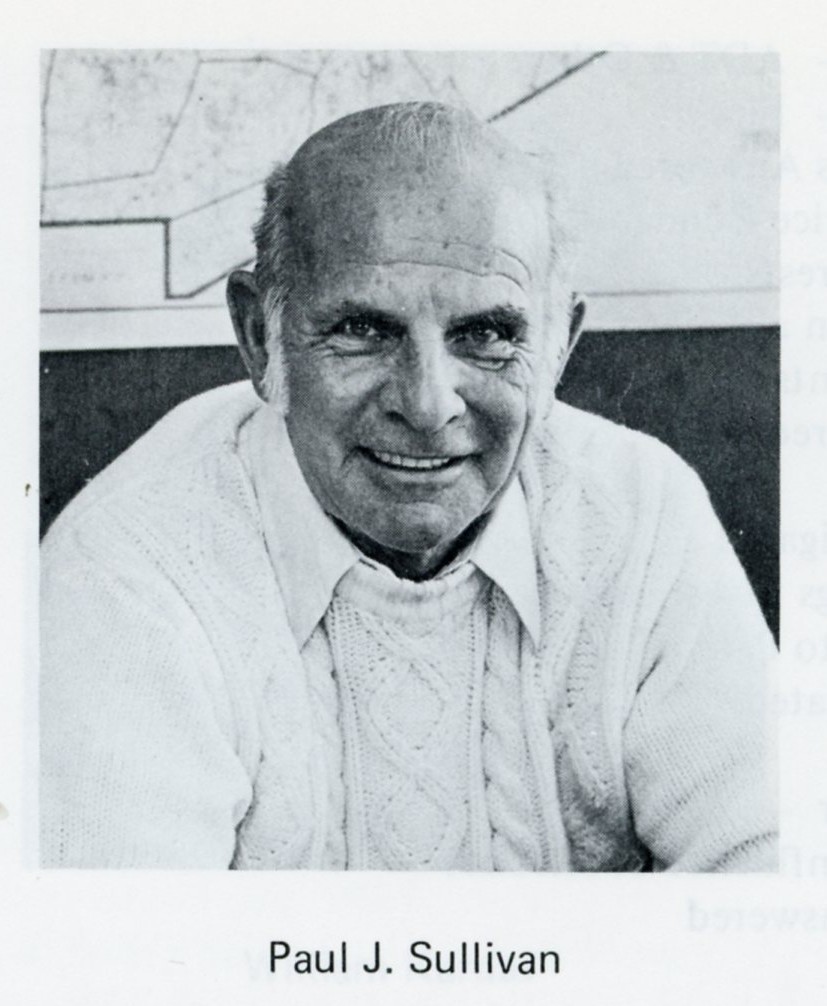
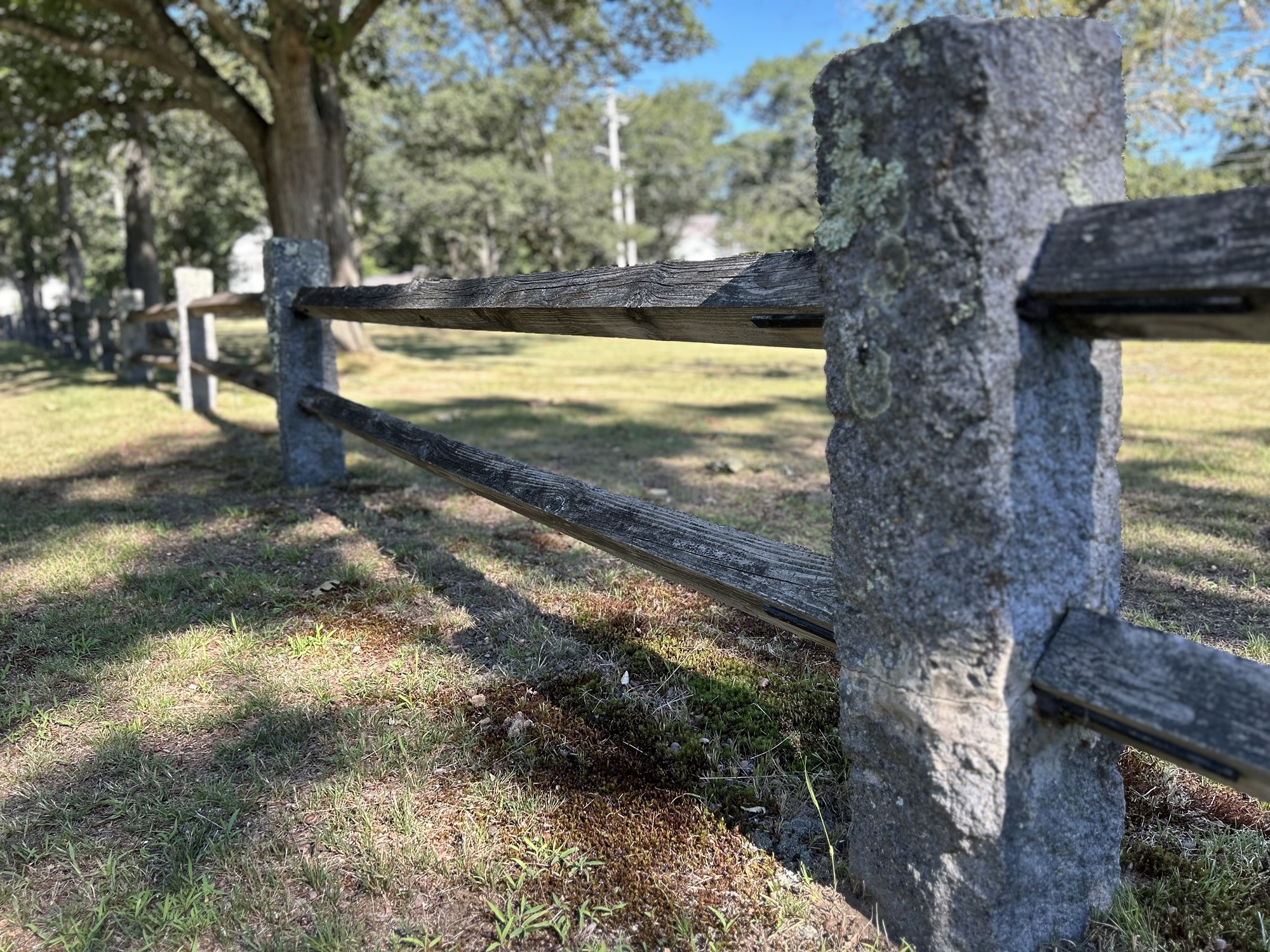
In early July 1975, DPW Commissioner Paul Sullivan authorized the white fence rails around the Dedham Common to be painted red, white and blue in honor of the country’s upcoming Bicentennial. The response by neighborhood residents was swift and overwhelmingly negative. At a special meeting of the select board attended by over 90 concerned citizens, the board voted 3-2 to keep the color scheme as is, despite the presentation of a petition signed by over 100 residents. After learning of several not-so subtle threats to repaint the fence, town officials posted a 24-hour guard at the Common for a few days.
Over the next few months, while there were several unsuccessful attempts to return the fence to its traditional white color, the newly formed Historic Districts Commission was able to meet and settle the matter once and for all. In September the Commission voted to make a request of the select board to repaint the fence by October 15. Commissioner Sullivan stated he would abide by the Commission’s request, and after a week’s rain delay the fence was repainted by volunteers on October 23.
Epilogue
On June 29, 1976, this headline appeared in the Patriot Ledger: Selectmen Order Common Grass Mowed. The article went on to describe the “harvest” of tall grass that had not been mowed since the fence painting brouhaha almost a year before. DPW Commissioner Sullivan explained that he thought the Common was under historic commission control, and would cut the grass only if ordered to by selectman. “It was nice hay,” he remarked, with the article noting that the commissioner was never one to forget a favor or a slight.
Aside from some Karen Read supporters setting up by the Common at the intersection of Routes 135 and 109, the past 50 years there have been free of excitement and controversy. Today, the rails of the fence are unpainted, and will most likely remain that way throughout the country’s semiquincentennial (250th) celebration next year.
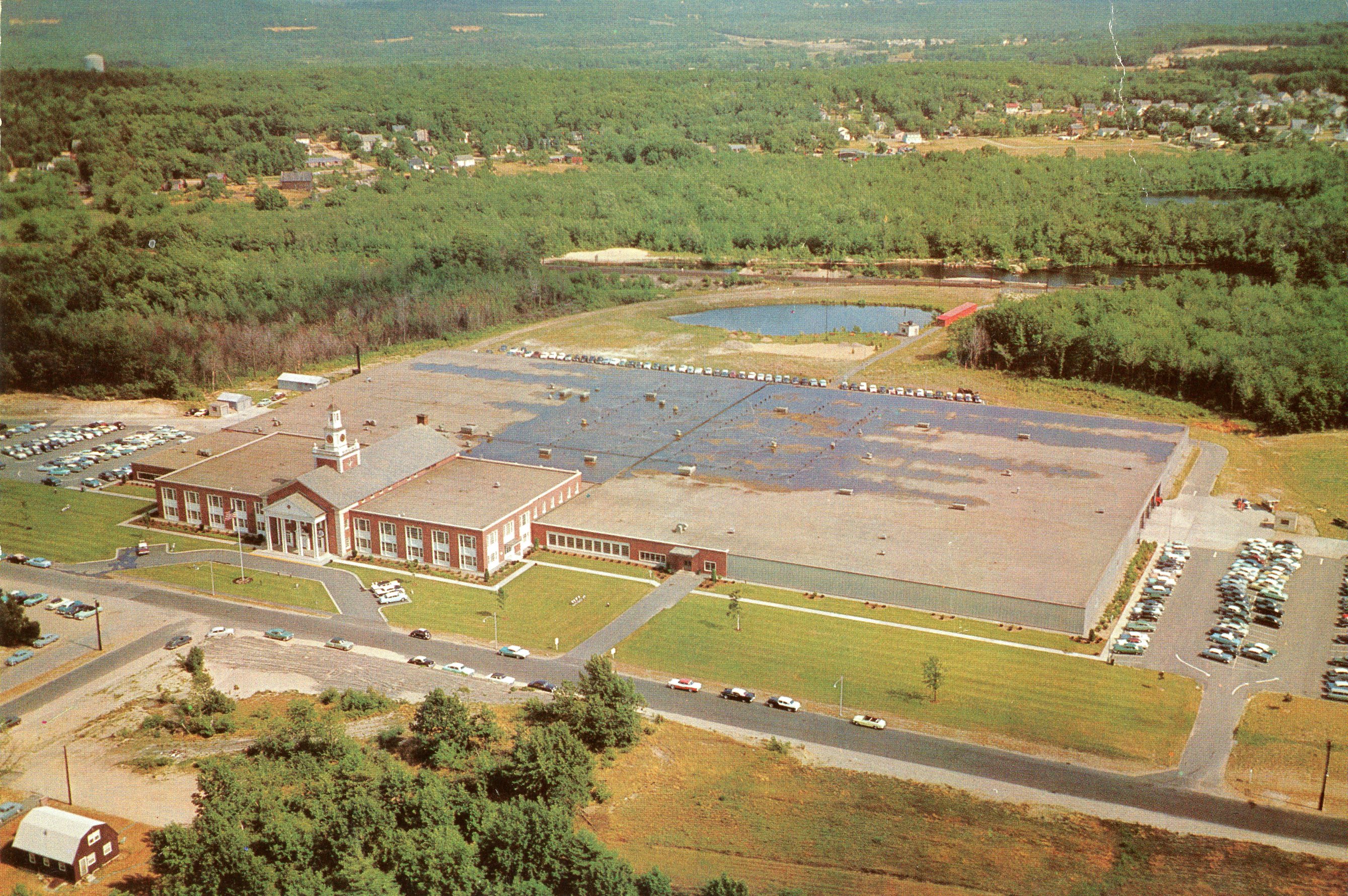
The Rust Craft Greeting Card Company as seen in a 1950s postcard view (courtesy of Dedham Museum and Archive)
I can’t really improve upon the caption that accompanied this picture in newspapers across the country on July 24, 1955, the day after the greeting card company opened its new headquarters in Dedham:
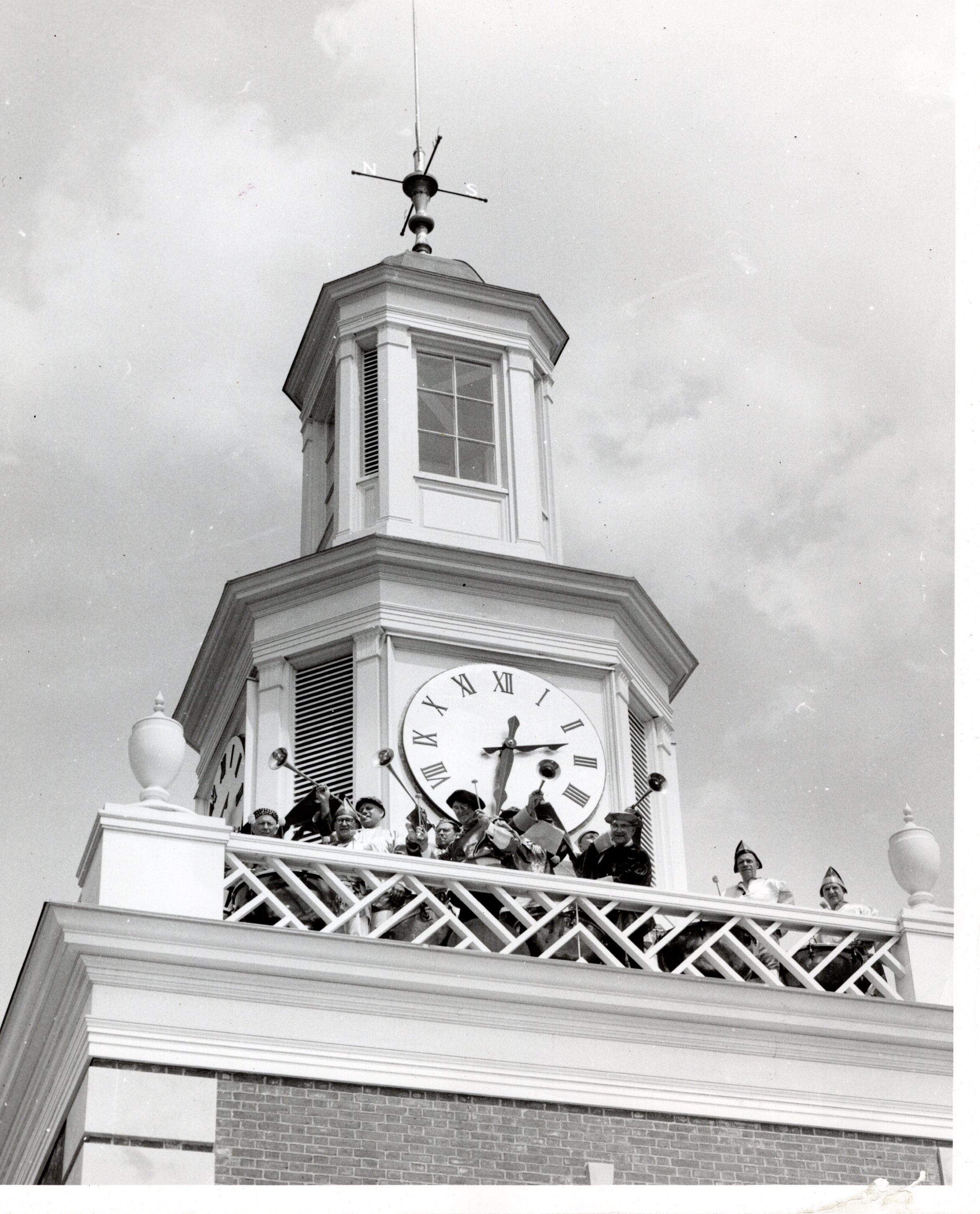
700-YEAR-OLD “BLESS HOUSE” CEREMONY, symbolic of inviting good luck to the opening of a new building, was reenacted yesterday as the Rust Craft Greeting Card Co. officially opened its nine-acre plant in Dedham, Mass. Perched atop the clock tower of the new building were these authentically garbed musicians, drumming out evil influences and summoning the good with long heraldic trumpets. 10,000 visitors toured the $3,500,000 plant and watched the making of greeting cards.
During the ceremony described above, six drummers beat kettle drums from the cupola of the building, driving evil spirits away, while trumpeters facing the four points of the compass sounded their 4 foot-long horns, calling good and gentle spirits into the building. Just to cover their bases, company officials invited Father William Kenneally from St. Mary’s Catholic Church and Reverend Rudolph Roell from St. Paul’s Episcopal Church to give blessings as well.
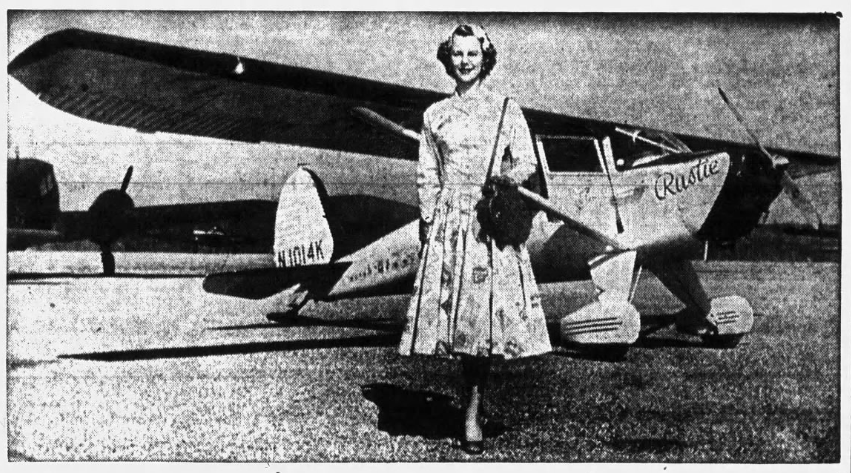
Later in the afternoon, town officials presented Rust Craft co-founder Donald Rust with a silk flag bearing the company logo, along with a large, framed replica of the original Indian land deeds to the Rust Craft property. Also on hand was goodwill ambassador “Rustie,” described by the Transcript as “a living greeting card herself, warm and friendly, lovely to look at, and with a cheery greeting for everyone.”
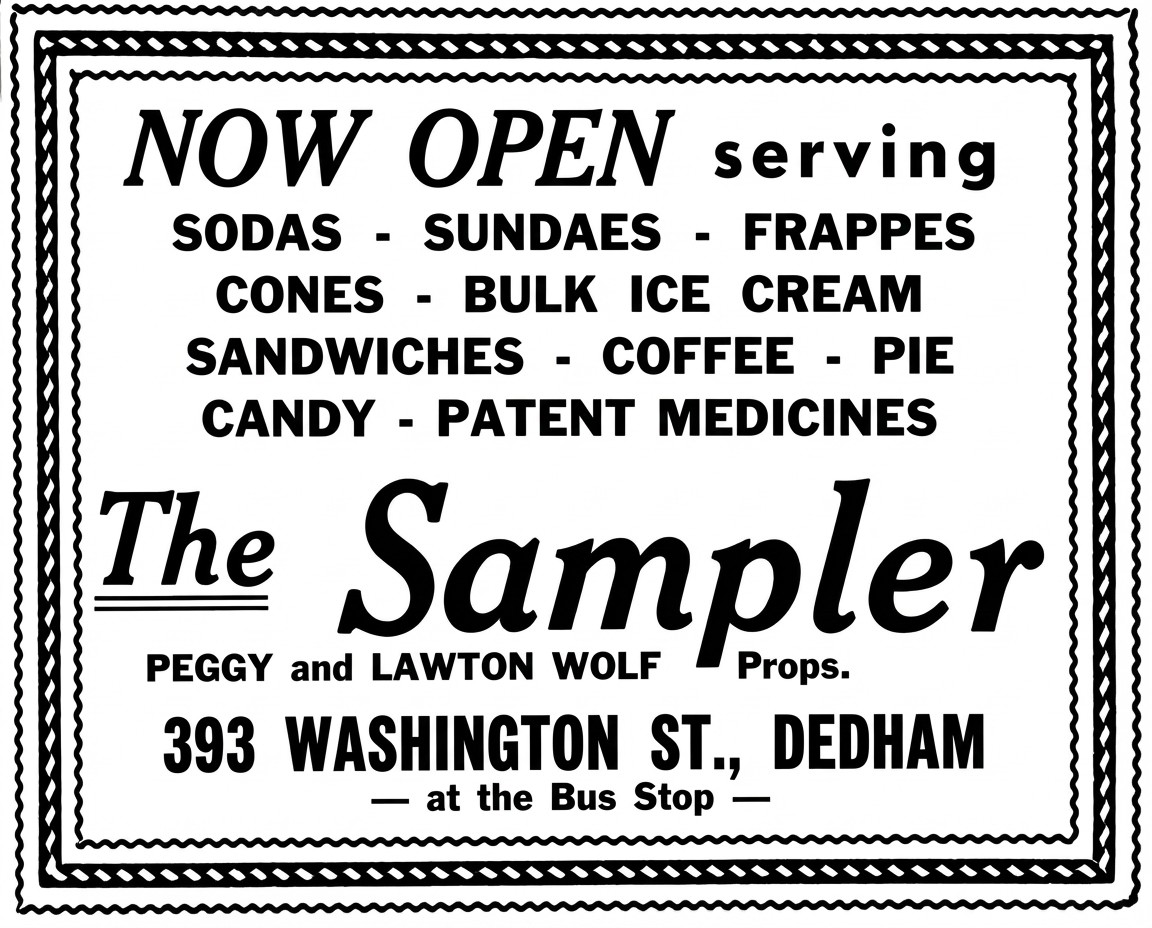
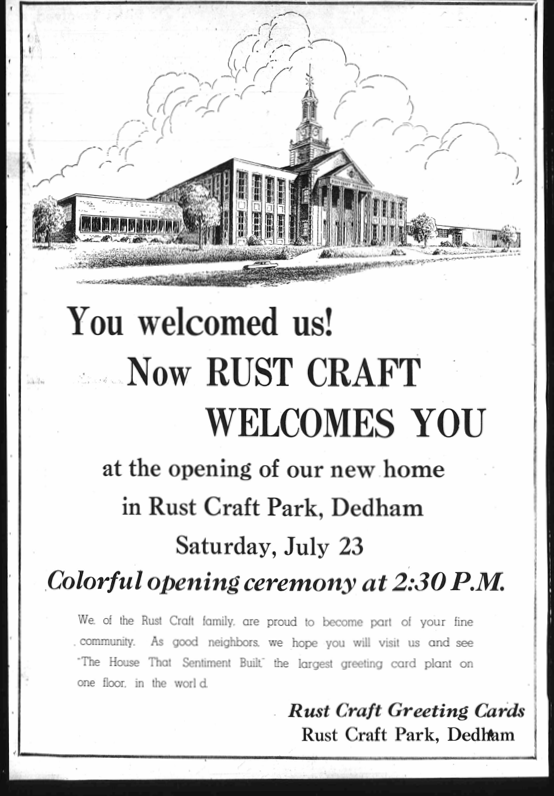
“Rustie” the ‘living trademark’ of the Rust Craft Company stands by the plane she piloted on nationwide promotional tours. Note her dress, which is printed with a variety of greeting card images.This full page ad from the Transcript shows the excitement surrounding Rust Craft’s relocation from Boston to Dedham.
This is the logo used by Rust Craft for several years after their move to Dedham, perhaps inspired by the unique medieval opening day ceremony of that hot July day 70 years ago.
Rust Craft operated in Dedham until 1980 when it moved its operations to Pennsylvania, before going out of business in 1982. The Dedham Museum and Archive is putting together an exhibit highlighting the people, products, and pictures of the company’s 25 years in town. If you have any stories to share, or photos/artifacts to loan us for this exhibit, we would love to hear from you! Please email us at memories@dedhammuseum.org
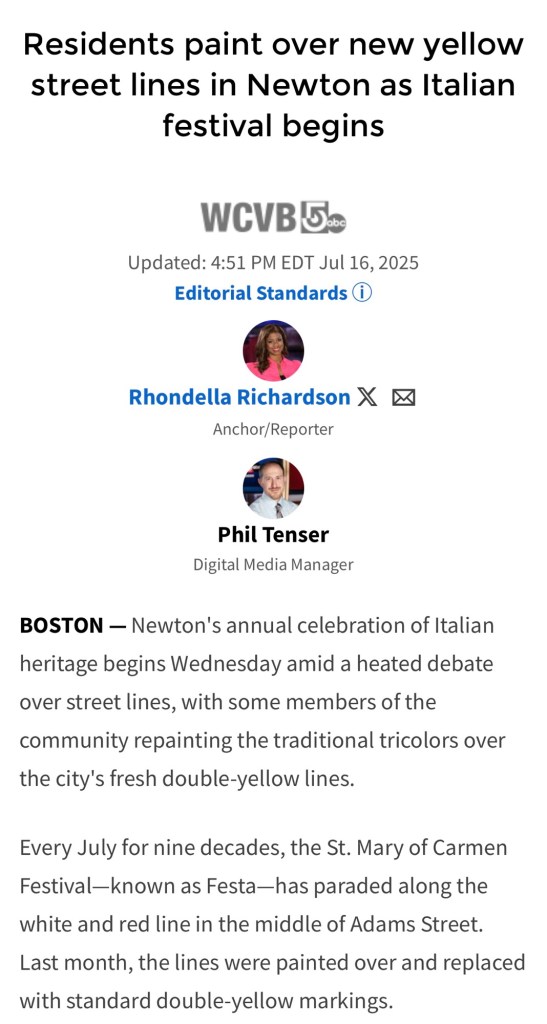
You may have heard about the furor in Newton over the city’s decision to paint over the street lines that for years had traditionally been green, white and red, the colors of the Italian flag. This story is remarkably similar to the “Battle of Dedham Common” 50 years ago. Certainly, the emotions of those involved are just as strong as they were for Dedham residents of half a century ago. Read the linked story, and see if you don’t agree.
Dedham Common, 1890s- Courtesy of Dedham Museum and Archive
50 years ago, communities and businesses began observing the 200th anniversary of the founding of our country, beginning in April 1975 with celebrations and commemorations of the famous battles that marked the start of the Revolution. In the summer of ’75 the town of Dedham saw residents engaged in their own battle, one that could fittingly be described as “uncommon.”
Sometime around the 4th of July, residents in Precinct One were shocked to find the wooden railings surrounding the Town Common had been transformed from traditional white to a Bicentennial color scheme of red, white and blue. The reaction of the townspeople, especially those living on streets adjacent to the Common, was swift and strong. The new paint job was described as “garish,” “an aesthetic outrage,” “the worst of taste” and “inappropriate, incongruous and demeaning.” “It looks like the town trollop,” one woman remarked to a Boston Globe reporter.
Boston Globe July 13 1975
As equally enraging to locals was the process by which the fence received its tacky paint job. Despite the existence of a Bicentennial Commission and a recently formed Historical District Commission, neither group was consulted before Public Works Commissioner Paul Sullivan supervised the work. Sullivan explained that several benches in East Dedham had already been painted the patriotic colors with no public complaint, and when it came time to repaint the Common fence, it seemed like an appropriate way to honor the country’s Bicentennial. “I think it looks wonderful,” he said at a mid-July select board meeting. “Our forefathers would turn over in their graves if they could see it,” was one response to Sullivan’s remarks.
At the July 15 meeting, the select board voted 3-2 to keep the patriotic paint scheme, despite the vocal disapproval of most of the 80-plus in attendance and the presentation of a petition signed by over 100 townspeople demanding the fence be repainted white. At times the meeting became heated, with residents and members of the select board shouting at each other, questioning the taste of those in favor of the red, white and blue color scheme and the patriotism of those opposed. The meeting ended with more than a few attendees asserting that the fence would be repainted white again, one way or another. Hours after the crowd dispersed, a midnight caller to the Transcript calling himself “The Dedham Militia Man” stated “We do not like the fence red, white and blue. The fence now has black crepe paper on it and soon it will be white.” Such threats of civil disobedience were taken seriously by town officials, and a 24- hour police guard was posted at the Common for the next few days.
North Adams Transcript/August 11 1975
News stories throughout New England took a rather bemused tone when describing the kerfuffle, but Dedham residents, especially those living near the Common, took the matter very seriously. Throughout the summer, members of the various historical committees continued to meet to resolve this issue. But for the time being, the fence would keep its “Andy Warhol type pop-art” color scheme.
PART 2 Coming next week: A little history of the Town Common and the resolution to the ongoing disagreement
Kevin Hampe, clerk-treasurer of the Society in Dedham for Apprehending Horse Thieves, talks to Chronicle’s Ted Reinstein outside the old Norfolk Hotel on Court Street, where the society was founded in 1810.
Monday June 9, 7:30 on Channel 5 (WCVB)- I will be on Chronicle talking to Ted Reinstein about Dedham’s Town Forest as part of his “Who Knew?” series. Also on the segment will be the Fairbanks House, Society in Dedham for Apprehending Horse Thieves and the Dedham Museum and Archive. Here’s a link to the promo; be sure to watch!
While researching various subjects in the Dedham Transcript archives for this blog, I frequently come across the Dedham Playground write-ups published every week in the summer. These summaries were written by the high school and college students who worked at the various playgrounds around town and would include the names of all the neighborhood kids who had attended that week and a description of the activities they were involved in. I found many mentions of my own name and that of my sister and all the kids in my Tower Street neighborhood who used to frequent Paul Park in the late 60s-early 70s. Along with volleyball, baseball, pot holder making and plaster of Paris, one regularly mentioned activity was Kalah. I have fond memories of playing this game for hours on end, and when I became an elementary school teacher I introduced it to my students as Mancala, which it is commonly known and sold as today. At first I thought that Kalah was a nickname the Paul Park kids made up, but then I found this Transcript headline from 1958 and I knew I needed to do some more research.
As it turns out, Kalah was a brand name for the mancala-type game invented here in Boston in 1940 by Yale Graduate William Julius Champion, Jr. It is believed that Champion adapted an ancient bean counting game from either Asia or Africa to create a 20th century version. Champion founded the Kalah Game Corporation in 1958 and the wooden boards were manufactured in various places, including Holbrook, Massachusetts, until the 1970s. Beginning in the late 1950s, recreation departments in towns across the country were sponsoring tournaments at playgrounds and community centers, and Kalah had taken its place among such timeless pastimes as checkers, chess and horseshoes.
Kids in Chicago playing Kalah in 1960 at the height of its popularity
I’m sure many of you have fond memories of scooping those dried beans from pod to pod while sitting on a splintery bench in a Dedham playground. Here’s to that highly addictive game and here’s to all the college and high school teens who worked at those playgrounds. They kept us safe, entertained, and out of our mother’s hair on those hot summer days.
I am James L. Parr. I grew up on Tower St. and went to St. Mary's and Dedham High (Class of 1977). I teach school in Framingham and co-wrote a book of Framingham history, which led me to write a book of weird Dedham history called Dedham: Historic and Heroic Tales from Shiretown. That book led to this blog. To order your own copy of the book, e-mail me at jameslparr@yahoo.com